







Question: Case Study: Transportation and Logistics The challenges and complexities faced by Fraser River Furniture as they evolve from a domestic, to national, to international, to

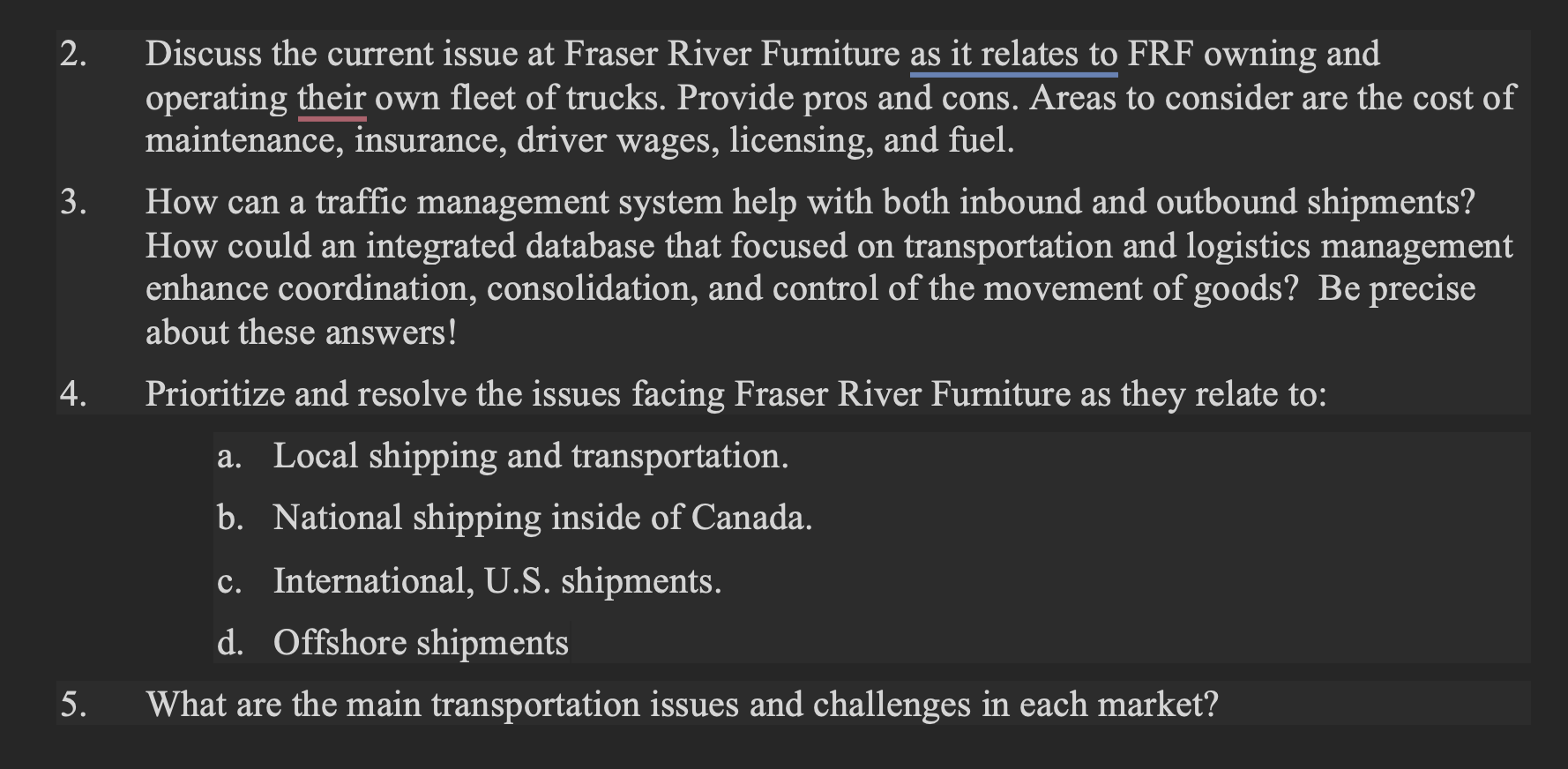
Case Study: Transportation and Logistics The challenges and complexities faced by Fraser River Furniture as they evolve from a domestic, to national, to international, to global supplier are explored. As you read through the case, think about issues relating to the use of proprietary versus for-hire carriers, as well as utilizing third-party logistics providers. Fraser River Furniture Kelly Watt was not having a good day. Kelly is the transportation manager at Fraser River Furniture. Located in the Vancouver area, Fraser River Furniture manufactures and distributes ooth mass produced and custom furniture. They ship locally to retail stores as well as across Canada, into the United States and also abroad. The business was well known for its quality and exceptional customer service and as such he had a competitive advantage over their competition. Use of Canadian wood combined with their flair for design made Fraser River products attractive o discerning customers for both their regular production and custom designs. There were several other producers of furniture in Western Canada, but Fraser River was universally considered the pest. Transportation and Logistics The company owned and operated their own fleet of trucks. When the company was in its infancy this was the best way for them to manage transportation. Managing their own fleet enabled them to coordinate both inbound and outbound deliveries to save time, money and be as efficient and effective as possible. Kelly took pride in the fact that transportation and logistics was manually managed and coordinate in house. A transportation management system was not Business was good and over a few short years their markets expanded from local to national and most recently, international and offshore. Their customers used to be primarily local. Now their customer base was local, national, international and offshore. Coordination of transportation and logistics at Fraser River Furniture, under the current system and structure, had become impossible. Kelly Watt now likened the job to herding cats. The reasons for Kelly's bad day were many. Today's scheduled deliveries to customers were late. Some fleet trucks were experiencing mechanical issues. Others were flat out missing. Incoming deliveries of materials were late. The loading/off-loading schedule for their shipping docks were all incorrect. As a result there was a line of trucks on the shoulder of the road leading to the plant either trying to get loaded or trying to get off loaded. Kelly leaned back in the chair, looked out the office window across the shipping/receiving area. The complexity and manageability of Fraser River Furniture's transportation and logistics system had outgrown their systems functionality. Kelly knew there had to be a better way. Issues and Concerns Kelly had met with senior management and discussed how the transportation and logistics function at Fraser River had become exceedingly complex. Increased sales volume and expanded markets combined with late deliveries and an over budget transportation system has placed their reputation and operation at risk. Late deliveries to local customers were becoming more frequent. National and international shipments were increasingly difficult to coordinate. The result was a drastic upsurge in transportation cost combined with an increase in the number of late deliveries. Kelly Watt came to the realization that the transportation and logistics area of the business immediately needed updating to adapt to the changing nature of the operation. Areas of concern were around volume and speed of delivery. High volume items required fast delivery. The lower volume items could be shipped by slower less costly delivery methods. Custom orders were low volume, however, customer service required faster more expensive transportation options for these customers. The major problem facing Kelly was that the shipping/transport/logistics infrastructure in place from the past was woefully inadequate to meet the present demands of Fraser River Furniture's customers. High volume items that should be shipped as cheaply as possible were becoming more costly to deliver as Kelly was forced to use local contract or for hire carriers to deliver to meet deadlines. Lower volume items that used to be delivered via consolidated "milk runs" by Fraser's fleet trucks were now being transported by costly less than truck load carriers. This was done in an effort to meet delivery deadlines. International shipments were being held at the Canada/U.S. border due to incorrect, incomplete or missing documentation. Offshore shipments had the same issues of not being cleared at shipping ports in Vancouver. Once the paperwork was corrected, orders frequently needed to be flown out to meet delivery schedules. Where to go From Here Kelly knew the timeline was short to fix the transportation and logistics issues at Fraser River Furniture. It would not be long until the increased transportation, shipping and distribution costs would drastically impact profitability. Deceasing levels of customer service and increasing levels of late deliveries would soon drive customers to use other furniture manufacturers. Kelly Watt knew there was technology available, in the form of transportation management systems, that would facilitate their shipping and logistics issues. There were also third-party or integrated logistics service providers to help with logistics, shipping regulations and international compliance issues and regulations. Kelly Watt knew that for Fraser River Furniture to continue to deliver quality furniture, on time, a strategic mix of private and for hire transportation was needed. The complexity and diversity of the business had outgrown their existing transportation and logistics system and structure. Questions 1. What is the problem/issue addressed in the case? 2. Discuss the current issue at Fraser River Furniture as it relates to FRF owning and operating their own fleet of trucks. Provide pros and cons. Areas to consider are the cost of maintenance, insurance, driver wages, licensing, and fuel. 3. How can a traffic management system help with both inbound and outbound shipments? How could an integrated database that focused on transportation and logistics management enhance coordination, consolidation, and control of the movement of goods? Be precise about these answers! 4. Prioritize and resolve the issues facing Fraser River Furniture as they relate to: a. Local shipping and transportation. b. National shipping inside of Canada. c. International, U.S. shipments. d. Offshore shipments 5. What are the main transportation issues and challenges in each market
Step by Step Solution
There are 3 Steps involved in it

Get step-by-step solutions from verified subject matter experts
 Study Help