







Question: CASE STUDY When the trial is completed, the court sends the verdict to the ticketing system. The verdict and trial date are recorded for the
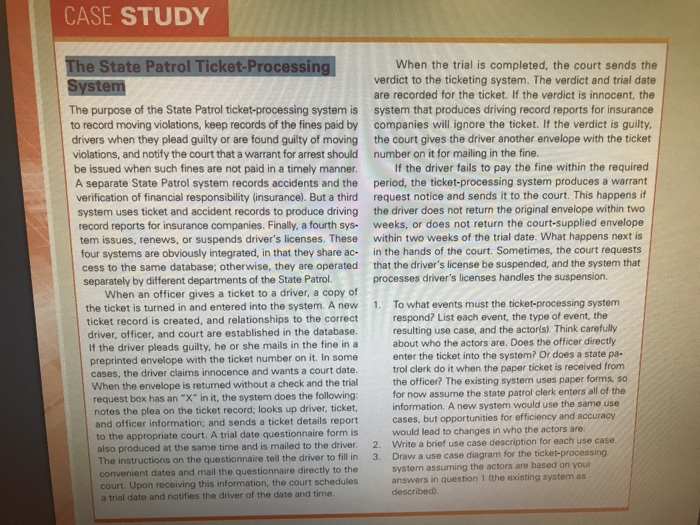
CASE STUDY When the trial is completed, the court sends the verdict to the ticketing system. The verdict and trial date are recorded for the ticket. If the verdict is innocent, the The purpose of the State Patrol ticket-processing system is system that produces driving record reports for insurance to record moving violations, keep records of the fines paid by companies will ignore the ticket. If the verdict is guilty drivers when they plead guilty or are found guilty of moving the court gives the driver another envelope with the ticket violations, and notify the court that a warrant for arrest should number on it for mailing in the fine. be issued when such fines are not paid in a timely manner. If the driver fails to pay the fine within the required A separate State Patrol system records accidents and the period, the ticket-processing system produces a warrant verification of financial responsibility (insurance). But a third request notice and sends it to the court. This happens if system uses ticket and accident records to produce driving the driver does not return the original envelope within two record reports for insurance companies. Finally, a fourth sys- weeks, or does not return the court-supplied envelope tem issues, renews, or suspends driver's licenses. These within two weeks of the trial date. What happens next is four systems are obviously integrated, in that they share ac- in the hands of the court. Sometimes, the court requests cess to the same database; otherwise, they are operated that the driver's license be suspended, and the system that separately by different departments of the State Patrol. processes driver's licenses handles the suspension When an officer gives a ticket to a driver, a copy of the ticket is turned in and entered into the system. A new ticket record is created, and relationships to the correct driver, officer, and court are established in the database. If the driver pleads guilty, he or she mails in the fine in a preprinted envelope with the ticket number on it. In some cases, the driver claims innocence and wants a court date. hen the envelope is returned without a check and the trial request box has an "X in it, the system does the following: notes the plea on the ticket record; looks up driver, ticket, d officer information; and sends a ticket details report To what events must the ticket-processing system respond? List each event, the type of event, the resulting use case, and the actoris). Think carefully about who the actors are. Does the officer directly enter the ticket into the system? Or does a state pa trol clerk do it when the paper ticket is received from the officer? The existing system uses paper forms, so for now assume the state patrol clerk enters all of the information. A new system would use the same use cases, but opportunities for efficiency and accuracy would lead to changes in who the actors Write a brief use case description for each use case. Draw 1. rm is also produced at the same time and is mailed to the driver. The instructions on the questionnaire tell the driver to fill in convenient dates and mail the questionnaire directly to the court. Upon receiving this information, the court schedules to the appropriate court. A trial date questionnaire fo 2. 3. a use case diagram for the ticket-processing system assuming the actors are based on your answers in question 1 tthe existing system as a trial date and notifies the driver of the date and time CASE STUDY When the trial is completed, the court sends the verdict to the ticketing system. The verdict and trial date are recorded for the ticket. If the verdict is innocent, the The purpose of the State Patrol ticket-processing system is system that produces driving record reports for insurance to record moving violations, keep records of the fines paid by companies will ignore the ticket. If the verdict is guilty drivers when they plead guilty or are found guilty of moving the court gives the driver another envelope with the ticket violations, and notify the court that a warrant for arrest should number on it for mailing in the fine. be issued when such fines are not paid in a timely manner. If the driver fails to pay the fine within the required A separate State Patrol system records accidents and the period, the ticket-processing system produces a warrant verification of financial responsibility (insurance). But a third request notice and sends it to the court. This happens if system uses ticket and accident records to produce driving the driver does not return the original envelope within two record reports for insurance companies. Finally, a fourth sys- weeks, or does not return the court-supplied envelope tem issues, renews, or suspends driver's licenses. These within two weeks of the trial date. What happens next is four systems are obviously integrated, in that they share ac- in the hands of the court. Sometimes, the court requests cess to the same database; otherwise, they are operated that the driver's license be suspended, and the system that separately by different departments of the State Patrol. processes driver's licenses handles the suspension When an officer gives a ticket to a driver, a copy of the ticket is turned in and entered into the system. A new ticket record is created, and relationships to the correct driver, officer, and court are established in the database. If the driver pleads guilty, he or she mails in the fine in a preprinted envelope with the ticket number on it. In some cases, the driver claims innocence and wants a court date. hen the envelope is returned without a check and the trial request box has an "X in it, the system does the following: notes the plea on the ticket record; looks up driver, ticket, d officer information; and sends a ticket details report To what events must the ticket-processing system respond? List each event, the type of event, the resulting use case, and the actoris). Think carefully about who the actors are. Does the officer directly enter the ticket into the system? Or does a state pa trol clerk do it when the paper ticket is received from the officer? The existing system uses paper forms, so for now assume the state patrol clerk enters all of the information. A new system would use the same use cases, but opportunities for efficiency and accuracy would lead to changes in who the actors Write a brief use case description for each use case. Draw 1. rm is also produced at the same time and is mailed to the driver. The instructions on the questionnaire tell the driver to fill in convenient dates and mail the questionnaire directly to the court. Upon receiving this information, the court schedules to the appropriate court. A trial date questionnaire fo 2. 3. a use case diagram for the ticket-processing system assuming the actors are based on your answers in question 1 tthe existing system as a trial date and notifies the driver of the date and time
Step by Step Solution
There are 3 Steps involved in it

Get step-by-step solutions from verified subject matter experts
 Study Help