







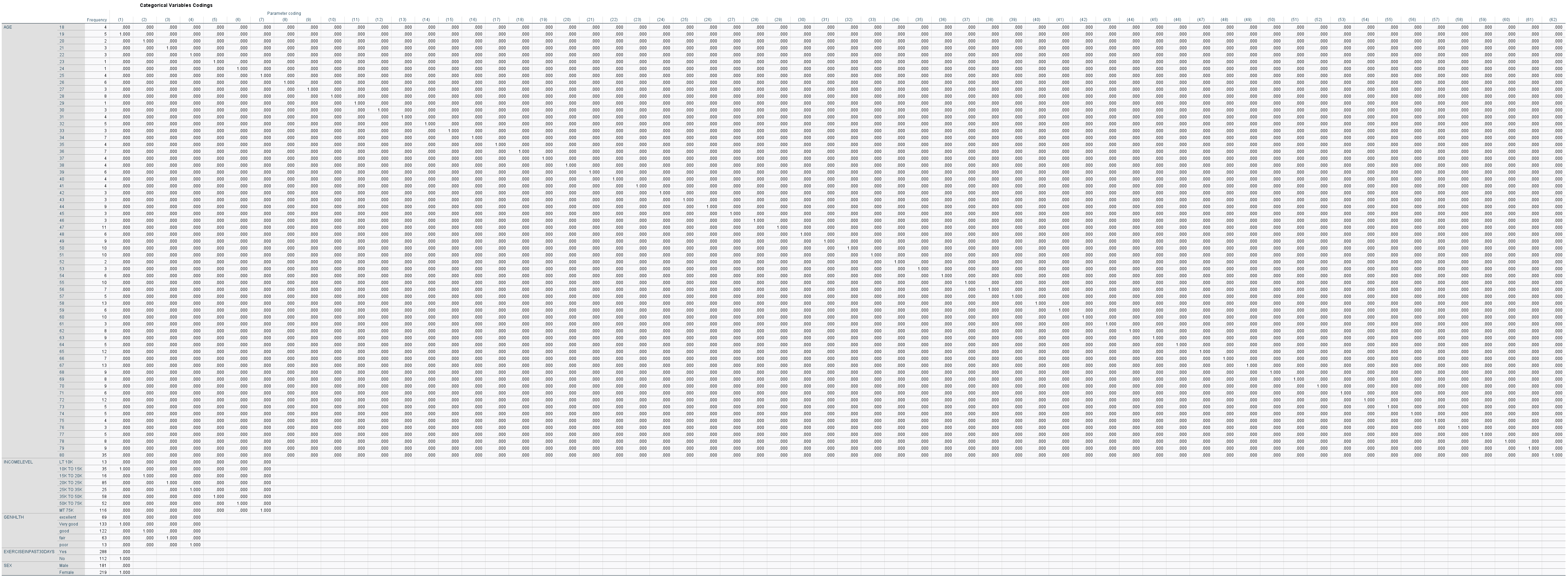
Question: Categorical Variables Ccreate lengthy paragraph:Dependent Variable: BMICATE_BIN (1 = HIGH_BMI, 0 = LOW_BMI)Predictors: AGE, GENHLTH_NUM, SEX, EXERCISEINPAST30DAYS, INCOMELEVELInterpretation:None of the predictors were statistically significant (p
Categorical Variables Ccreate lengthy paragraph:Dependent Variable: BMICATE_BIN (1 = HIGH_BMI, 0 = LOW_BMI)Predictors: AGE, GENHLTH_NUM, SEX, EXERCISEINPAST30DAYS, INCOMELEVELInterpretation:None of the predictors were statistically significant (p > 0.05) in predicting whether someone falls into the HIGH_BMI category.Although general health had a positive coefficient (suggesting poorer health may be linked to HIGH_BMI), the effect was weak and non-significant.Age and exercise showed expected directional trends (older individuals or those not exercising having higher BMI), but again, not statistically significant in this model.Conclusion:The logistic regression did not identify any significant predictors of HIGH_BMI in this synthetic sample. While the direction of some relationships (e.g., exercise and general health) aligns with public health expectations, larger samples or different variable encodings may be necessary for more definitive results. NARRATIVE INTERPRETATION BASED ON LOGISTIC REGRESSION RESULTSResearch Question (RQ):Does age and general health status significantly predict the likelihood of being in the HIGH_BMI category among adults, after controlling for sex, exercise behavior, and income level?A binary logistic regression was conducted to examine whether age and general health status predict the likelihood of an individual being classified in the HIGH_BMI category. The dependent variable was BMI category (HIGH_BMI vs. LOW_BMI), while the p
Step by Step Solution
There are 3 Steps involved in it

Get step-by-step solutions from verified subject matter experts
 Study Help