







Question: Categorize the cost: sunk, opportunity, variable, fixed, Direct materials, direct labor, overhead, potential cash flow. Note: when paying for wood you pay by the board
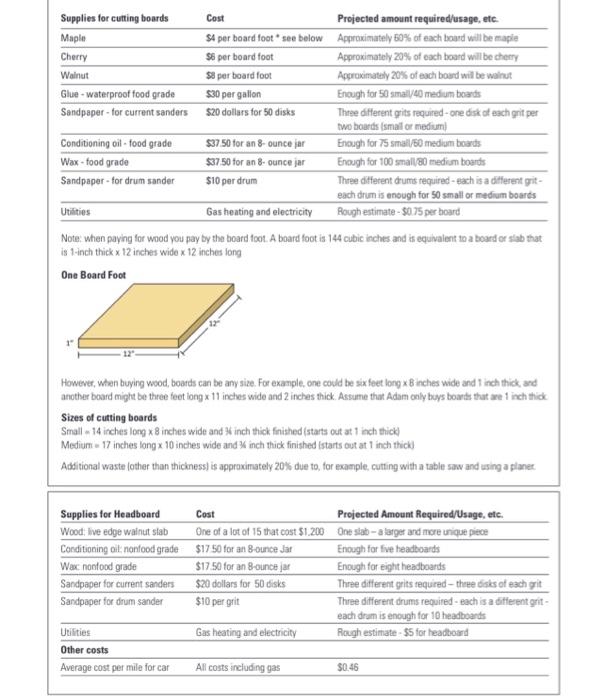
Note: when paying for wood you pay by the board foot. A board foot is 144 cubic inches and is equivalent to a board or slab that is 1-inch thick 12 inchas wide 12 inches long However, when buying wood, boards can be any size. For example, one covld be six feet long x8 inches wide and 1 inch thick, and another board might be three feet long x11 inches wide and 2 inches thick. Assume that Adam only buys boants that are 1 inch thick. Sizes of cutting boards Small =14 inches long 8 inches wide and 36 inch thick finished (starts out at 1 inch thick) Medium =17 inches lang x. 10 inches wide and y inch thick finished istarts out at 1 inch thick] Additional waste (other than thickness) is appraximately 20% due to, for example, culting with a table saw and esing a planer
Step by Step Solution
There are 3 Steps involved in it

Get step-by-step solutions from verified subject matter experts
 Study Help