







Question: Cause and effect conclusions cannot be made in observational studies because of confounding variables. Experiments allow such conclusions by holding confounding variables constant among several
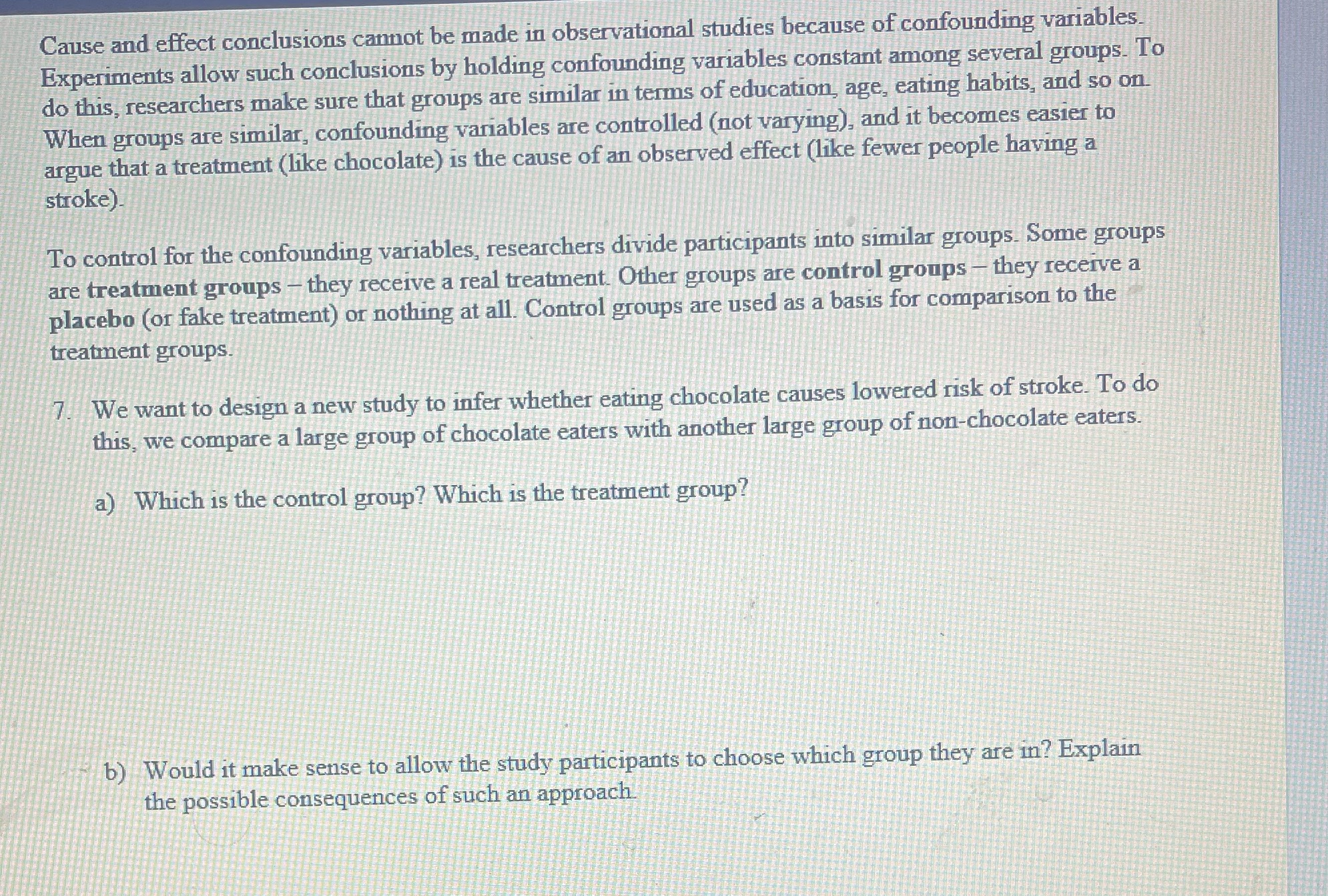
Cause and effect conclusions cannot be made in observational studies because of confounding variables. Experiments allow such conclusions by holding confounding variables constant among several groups. To do this, researchers make sure that groups are similar in terms of education, age, eating habits, and so on. When groups are similar, confounding variables are controlled (not varying), and it becomes easier to argue that a treatment (like chocolate) is the cause of an observed effect (like fewer people having a stroke). To control for the confounding variables, researchers divide participants into similar groups. Some groups are treatment groups - they receive a real treatment. Other groups are control groups - they receive a placebo (or fake treatment) or nothing at all. Control groups are used as a basis for comparison to the treatment groups. 7. We want to design a new study to infer whether eating chocolate causes lowered risk of stroke. To do this, we compare a large group of chocolate eaters with another large group of non-chocolate eaters. a) Which is the control group? Which is the treatment group? b) Would it make sense to allow the study participants to choose which group they are in? Explain the possible consequences of such an approach
Step by Step Solution
There are 3 Steps involved in it

Get step-by-step solutions from verified subject matter experts
 Study Help