



Question: c,d, and e the answer options are stock 1 or stock 2 Consider the following information on Stocks I and II: The market risk premium
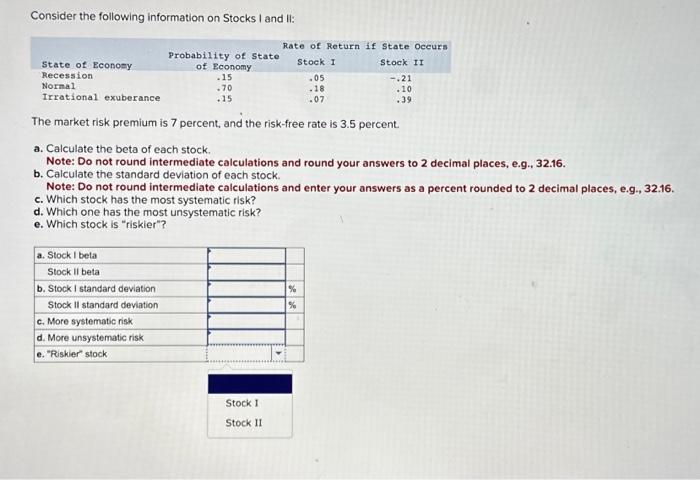
Consider the following information on Stocks I and II: The market risk premium is 7 percent, and the risk-free rate is 3.5 percent. a. Calculate the beta of each stock. Note: Do not round intermediate calculations and round your answers to 2 decimal places, e.g., 32.16. b. Calculate the standard deviation of each stock. Note: Do not round intermediate calculations and enter your answers as a percent rounded to 2 decimal places, e.g., 32.16. c. Which stock has the most systematic risk? d. Which one has the most unsystematic risk? e. Which stock is "riskier"? Consider the following information on Stocks I and II: The market risk premium is 7 percent, and the risk-free rate is 3.5 percent. a. Calculate the beta of each stock. Note: Do not round intermediate calculations and round your answers to 2 decimal places, e.g., 32.16. b. Calculate the standard deviation of each stock. Note: Do not round intermediate calculations and enter your answers as a percent rounded to 2 decimal places, e.g., 32.16. c. Which stock has the most systematic risk? d. Which one has the most unsystematic risk? e. Which stock is "riskier
Step by Step Solution
There are 3 Steps involved in it

Get step-by-step solutions from verified subject matter experts