







Question: Cellular Automata: A cellular automaton is an array or grid of cells, each containing an integer, float, or other data. After a time step, each
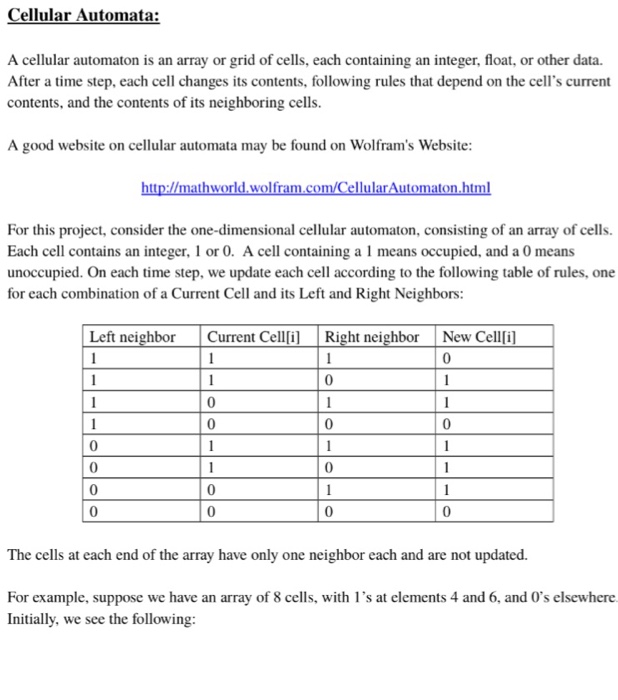
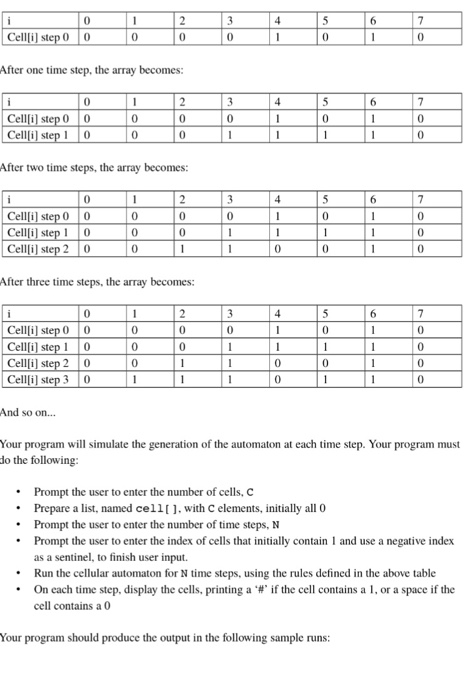
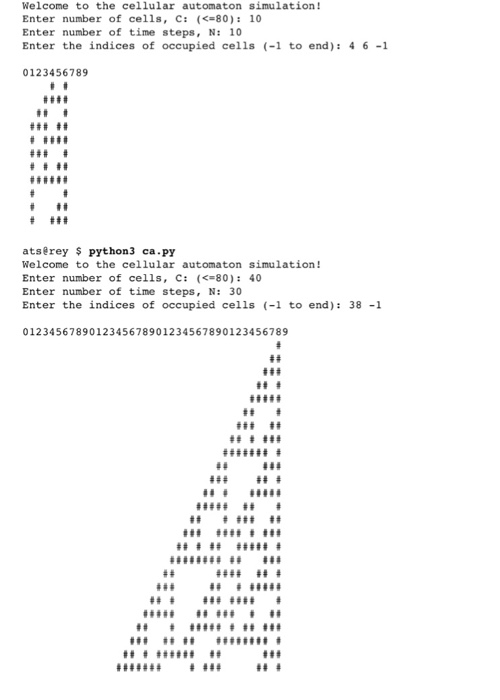
Cellular Automata: A cellular automaton is an array or grid of cells, each containing an integer, float, or other data. After a time step, each cell changes its contents, following rules that depend on the cell's current contents, and the contents of its neighboring cells A good website on cellular automata may be found on Wolfram's Website: For this project, consider the one-dimensional cellular automaton, consisting of an array of cells. Each cell contains an integer, 1 or 0. A cell containing a 1 means occupied, and a 0 means unoccupied. On each time step, we update each cell according to the following table of rules, one for each combination of a Current Cell and its Left and Right Neighbors: Left neighbor Current Celli Right neighbor New Celli] 0 0 0 0 0 0 0 0 0 0 0 0 The cells at each end of the array have only one neighbor each and are not updated. For example, suppose we have an array of 8 cells, with I's at elements 4 and 6, and O's elsewhere Initially, we see the following: Cellular Automata: A cellular automaton is an array or grid of cells, each containing an integer, float, or other data. After a time step, each cell changes its contents, following rules that depend on the cell's current contents, and the contents of its neighboring cells A good website on cellular automata may be found on Wolfram's Website: For this project, consider the one-dimensional cellular automaton, consisting of an array of cells. Each cell contains an integer, 1 or 0. A cell containing a 1 means occupied, and a 0 means unoccupied. On each time step, we update each cell according to the following table of rules, one for each combination of a Current Cell and its Left and Right Neighbors: Left neighbor Current Celli Right neighbor New Celli] 0 0 0 0 0 0 0 0 0 0 0 0 The cells at each end of the array have only one neighbor each and are not updated. For example, suppose we have an array of 8 cells, with I's at elements 4 and 6, and O's elsewhere Initially, we see the following
Step by Step Solution
There are 3 Steps involved in it

Get step-by-step solutions from verified subject matter experts
 Study Help