







Question: cem 5 7 the case below, the original source material is given along with a sample of student work. Determine the type of plagiarism by
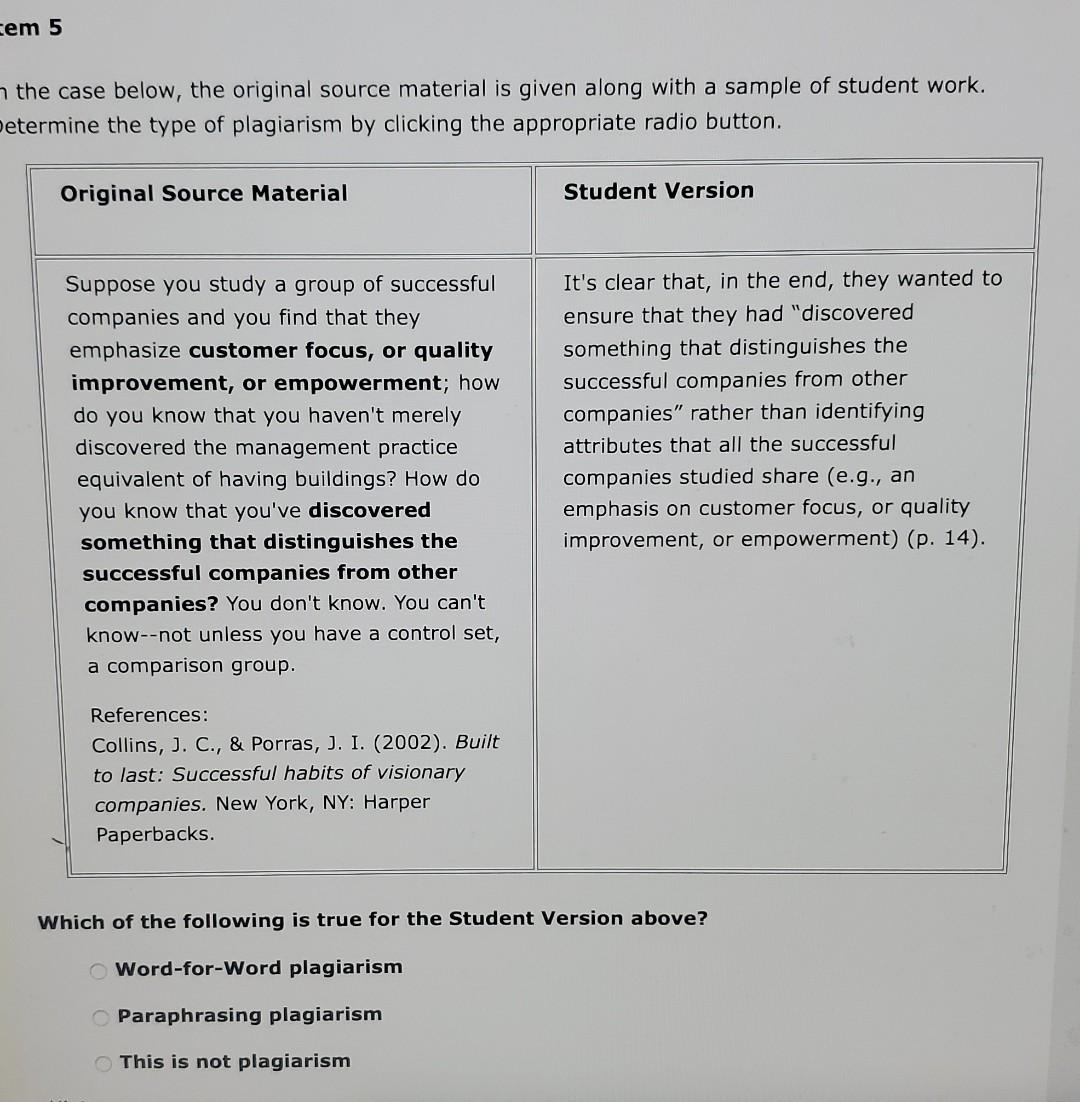
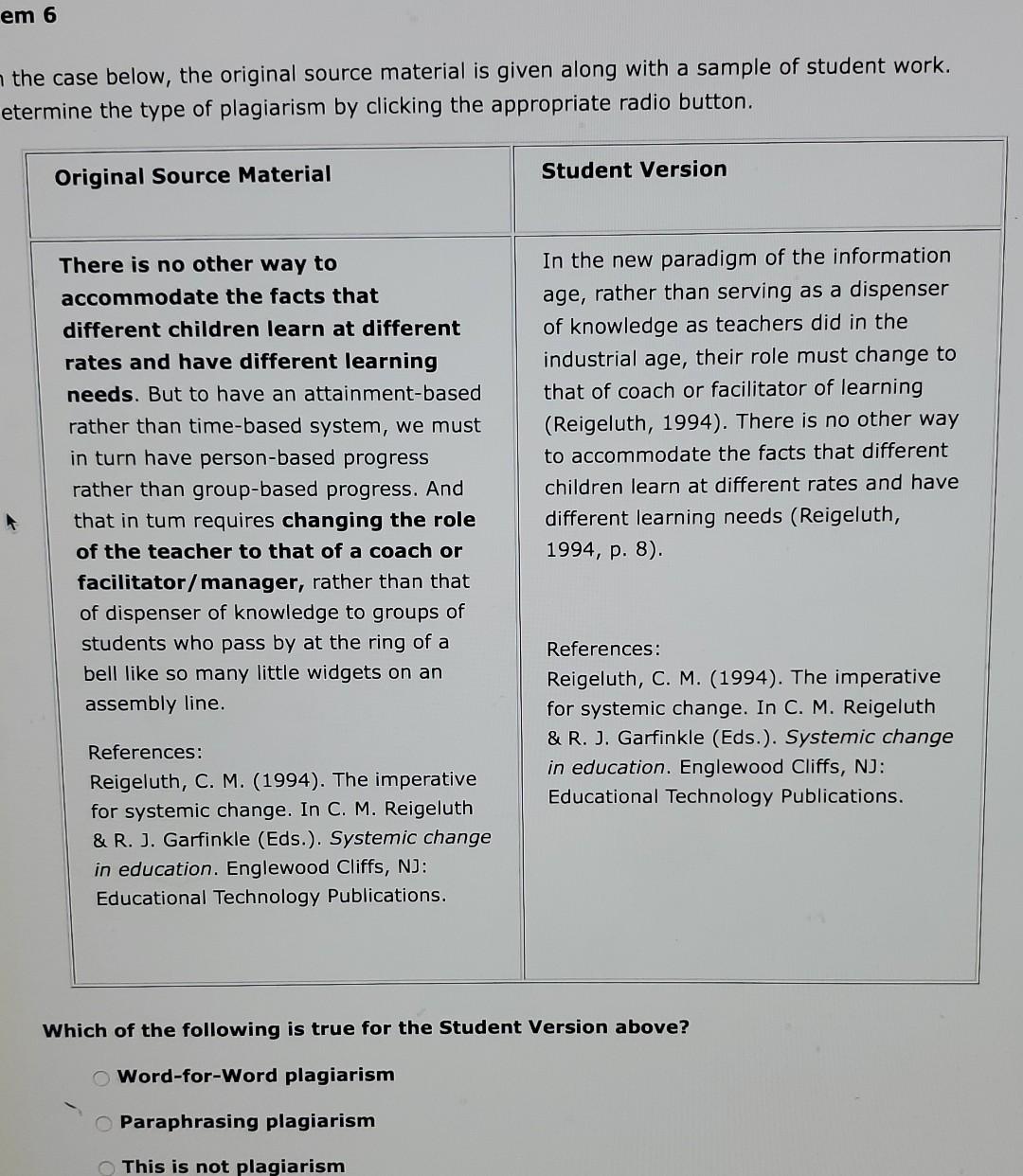
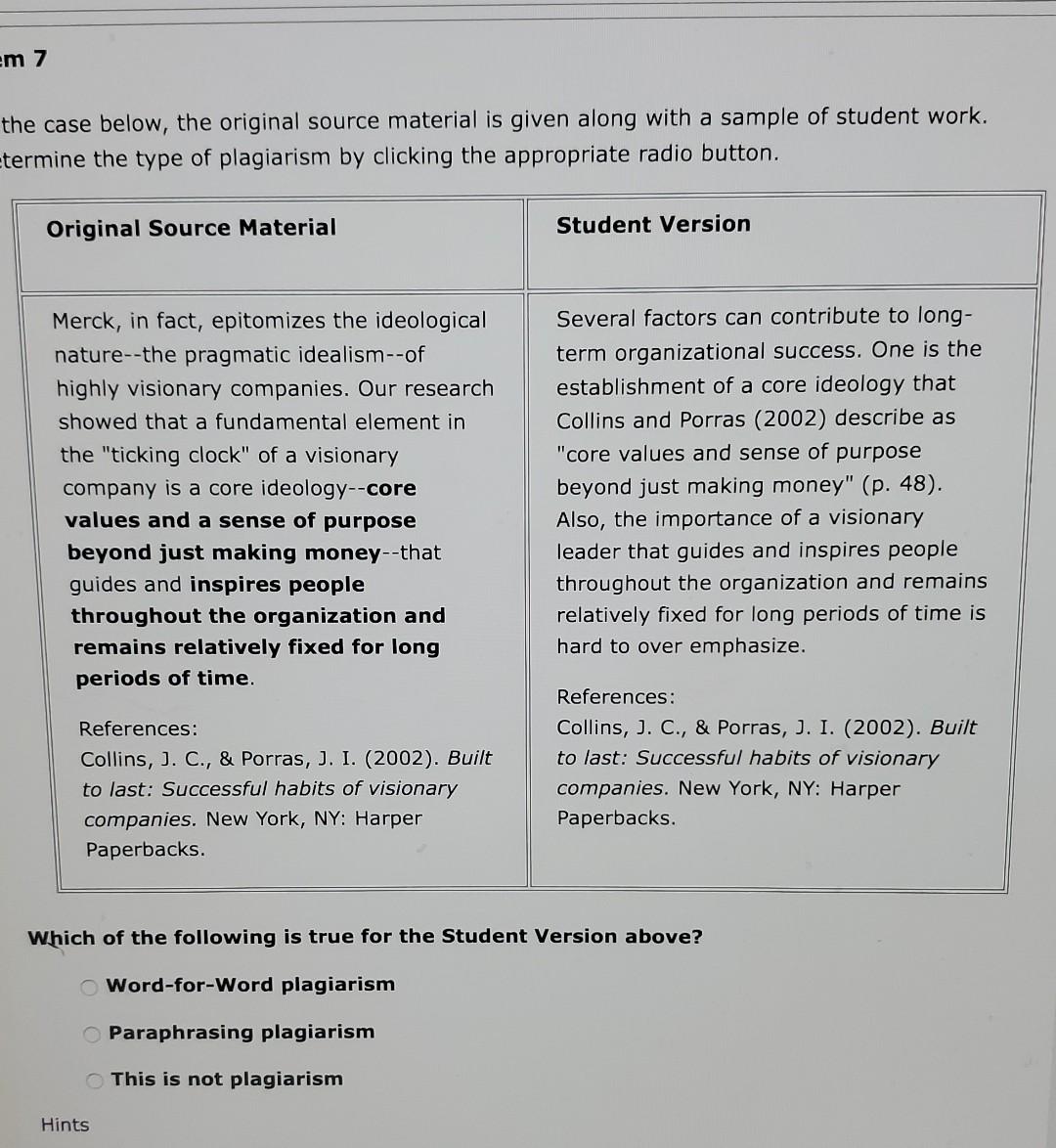
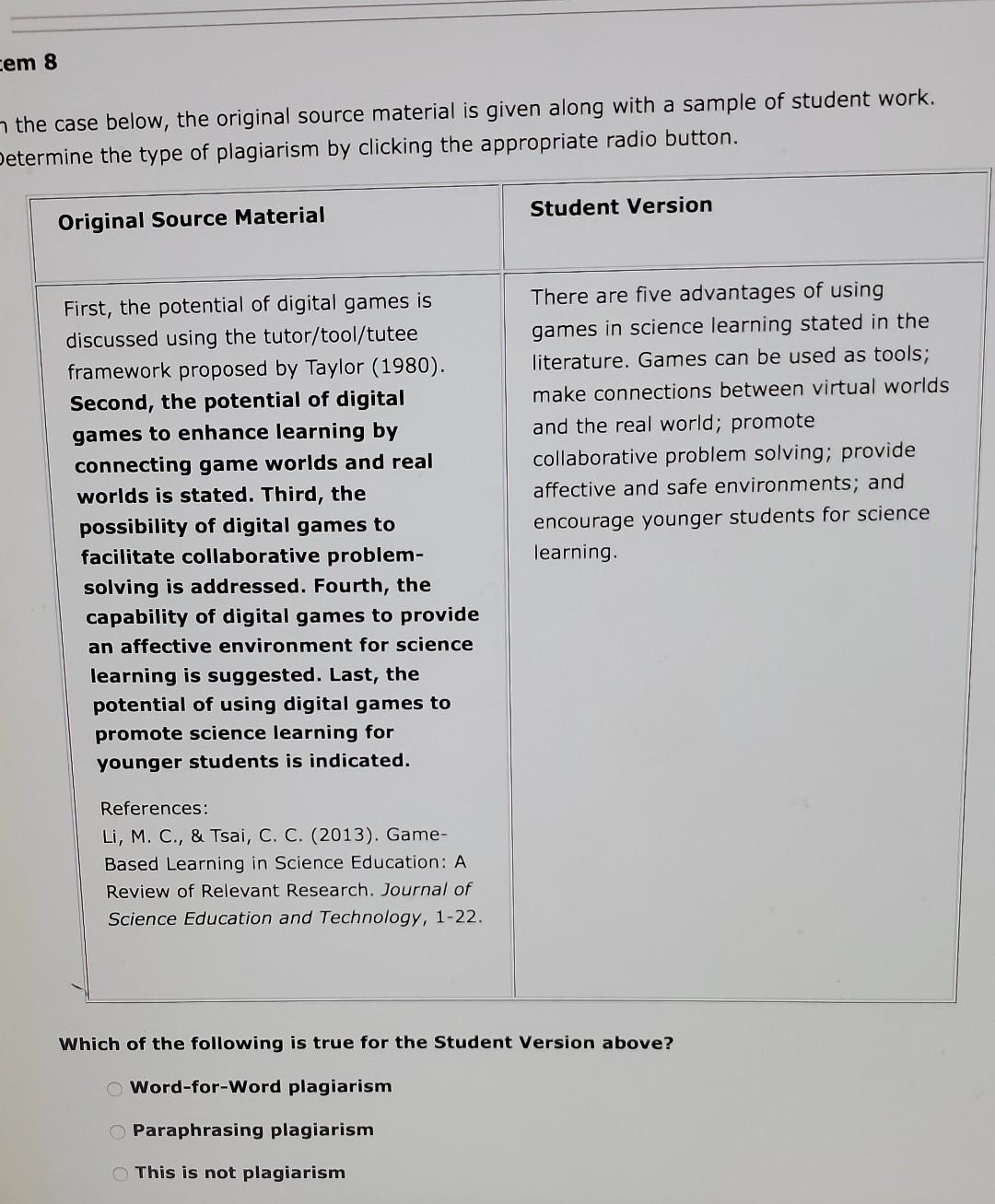
cem 5 7 the case below, the original source material is given along with a sample of student work. Determine the type of plagiarism by clicking the appropriate radio button. Original Source Material Student Version Suppose you study a group of successful companies and you find that they emphasize customer focus, or quality improvement, or empowerment; how do you know that you haven't merely discovered the management practice equivalent of having buildings? How do you know that you've discovered something that distinguishes the successful companies from other companies? You don't know. You can't know--not unless you have a control set, a comparison group. It's clear that, in the end, they wanted to ensure that they had discovered something that distinguishes the successful companies from other companies" rather than identifying attributes that all the successful companies studied share (e.g., an emphasis on customer focus, or quality improvement, or empowerment) (p. 14). References: Collins, J. C., & Porras, J. I. (2002). Built to last: Successful habits of visionary companies. New York, NY: Harper Paperbacks. Which of the following is true for the Student Version above? Word-for-Word plagiarism Paraphrasing plagiarism This is not plagiarism em 6 the case below, the original source material is given along with a sample of student work. etermine the type of plagiarism by clicking the appropriate radio button. Original Source Material Student Version There is no other way to accommodate the facts that different children learn at different rates and have different learning needs. But to have an attainment-based rather than time-based system, we must in turn have person-based progress rather than group-based progress. And that in tum requires changing the role of the teacher to that of a coach or facilitator/manager, rather than that of dispenser of knowledge to groups of students who pass by at the ring of a bell like so many little widgets on an assembly line. In the new paradigm of the information age, rather than serving as a dispenser of knowledge as teachers did in the industrial age, their role must change to that of coach or facilitator of learning (Reigeluth, 1994). There is no other way to accommodate the facts that different children learn at different rates and have different learning needs (Reigeluth, 1994, p. 8). References: Reigeluth, C. M. (1994). The imperative for systemic change. In C. M. Reigeluth & R. J. Garfinkle (Eds.). Systemic change in education. Englewood Cliffs, NJ: Educational Technology Publications. References: Reigeluth, C. M. (1994). The imperative for systemic change. In C. M. Reigeluth & R. J. Garfinkle (Eds.). Systemic change in education. Englewood Cliffs, NJ: Educational Technology Publications. Which of the following is true for the Student Version above? Word-for-Word plagiarism Paraphrasing plagiarism This is not plagiarism em 7 the case below, the original source material is given along with a sample of student work. etermine the type of plagiarism by clicking the appropriate radio button. Original Source Material Student Version Merck, in fact, epitomizes the ideological nature--the pragmatic idealism--of highly visionary companies. Our research showed that a fundamental element in the "ticking clock" of a visionary company is a core ideology--core values and a sense of purpose beyond just making money--that guides and inspires people throughout the organization and remains relatively fixed for long periods of time. Several factors can contribute to long- term organizational success. One is the establishment of a core ideology that Collins and Porras (2002) describe as "core values and sense of purpose beyond just making money" (p. 48). Also, the importance of a visionary leader that guides and inspires people throughout the organization and remains relatively fixed for long periods of time is hard to over emphasize. References: Collins, J. C., & Porras, J. I. (2002). Built to last: Successful habits of visionary companies. New York, NY: Harper Paperbacks. References: Collins, J. C., & Porras, J. I. (2002). Built to last: Successful habits of visionary companies. New York, NY: Harper Paperbacks. Which of the following is true for the Student Version above? o Word-for-Word plagiarism Paraphrasing plagiarism This is not plagiarism Hints cem 8 the case below, the original source material is given along with a sample of student work. Determine the type of plagiarism by clicking the appropriate radio button. Student Version Original Source Material First, the potential of digital games is discussed using the tutor/tool/tutee framework proposed by Taylor (1980). Second, the potential of digital games to enhance learning by connecting game worlds and real worlds is stated. Third, the possibility of digital games to facilitate collaborative problem- solving is addressed. Fourth, the capability of digital games to provide an affective environment for science learning is suggested. Last, the potential of using digital games to promote science learning for younger students is indicated. There are five advantages of using games in science learning stated in the literature. Games can be used as tools; make connections between virtual worlds and the real world; promote collaborative problem solving; provide affective and safe environments; and encourage younger students for science learning References: Li, M. C., & Tsai, C. C. (2013). Game- Based Learning in Science Education: A Review of Relevant Research. Journal of Science Education and Technology, 1-22. Which of the following is true for the Student Version above? Word-for-Word plagiarism Paraphrasing plagiarism This is not plagiarism
Step by Step Solution
There are 3 Steps involved in it
1 Expert Approved Answer
Step: 1 Unlock

Question Has Been Solved by an Expert!
Get step-by-step solutions from verified subject matter experts
Step: 2 Unlock
Step: 3 Unlock
 Study Help