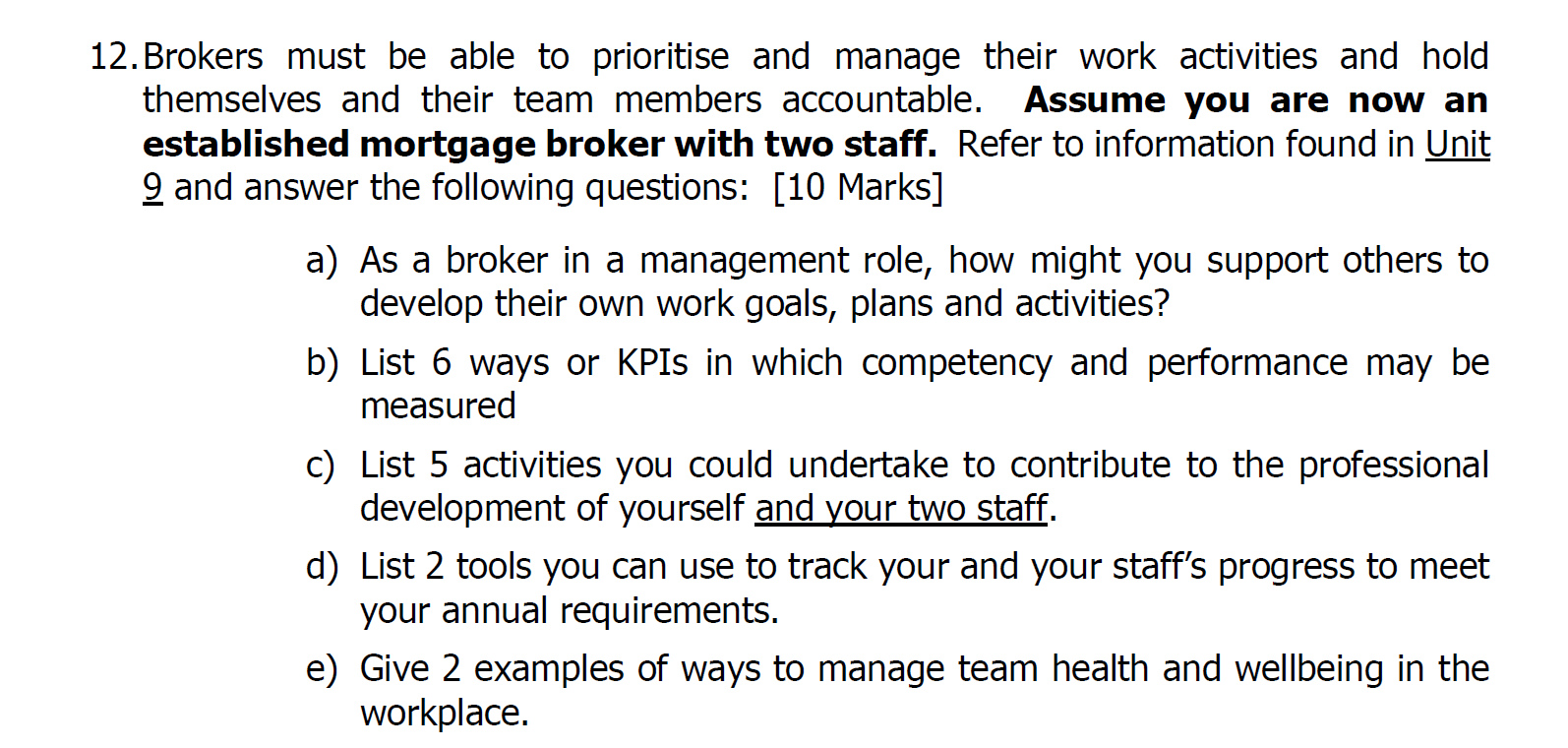
Question: CERTIFICATE IV IN FINANCE AND MORTGAGE BROKING - FN540820 Page 1 UNIT 9 MANAGE PERSONAL AND PROFESSIONAL DEVELOPMENT Unit Code: BSBPEF501 This unit describes the
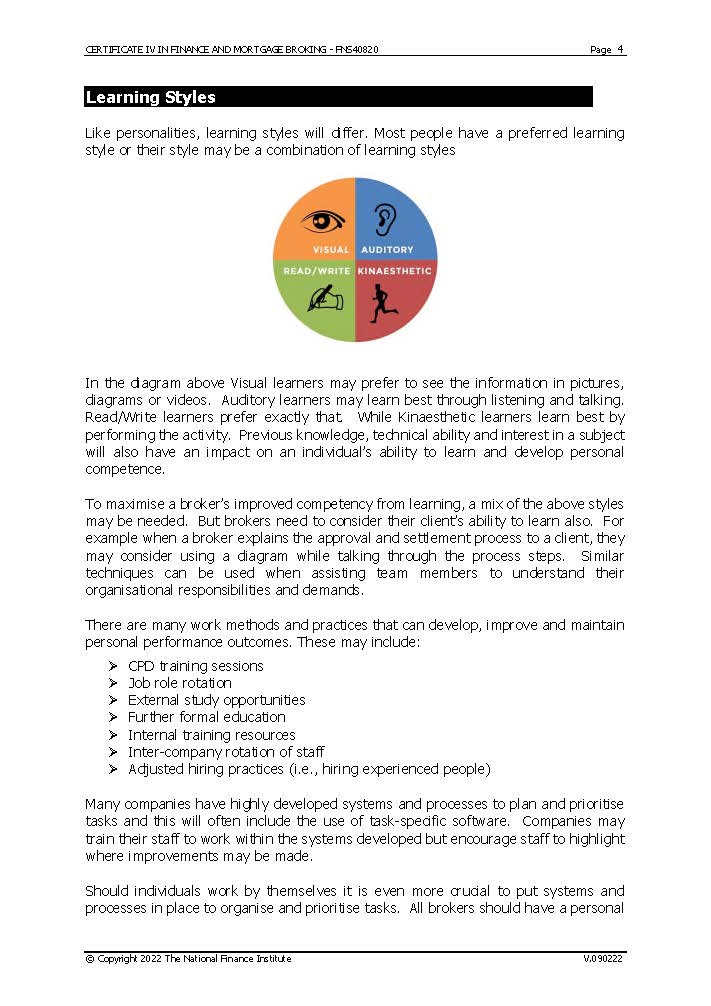
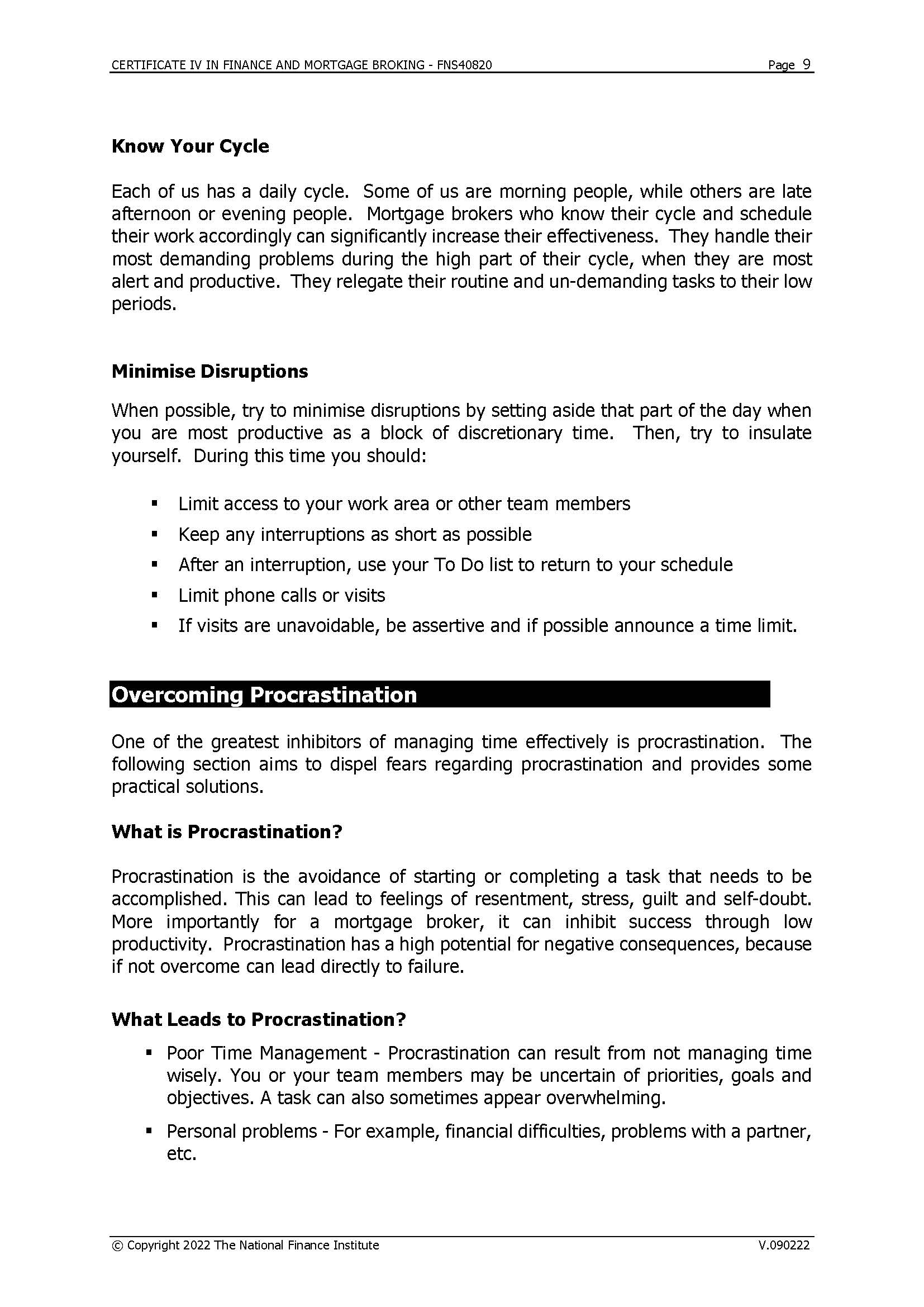
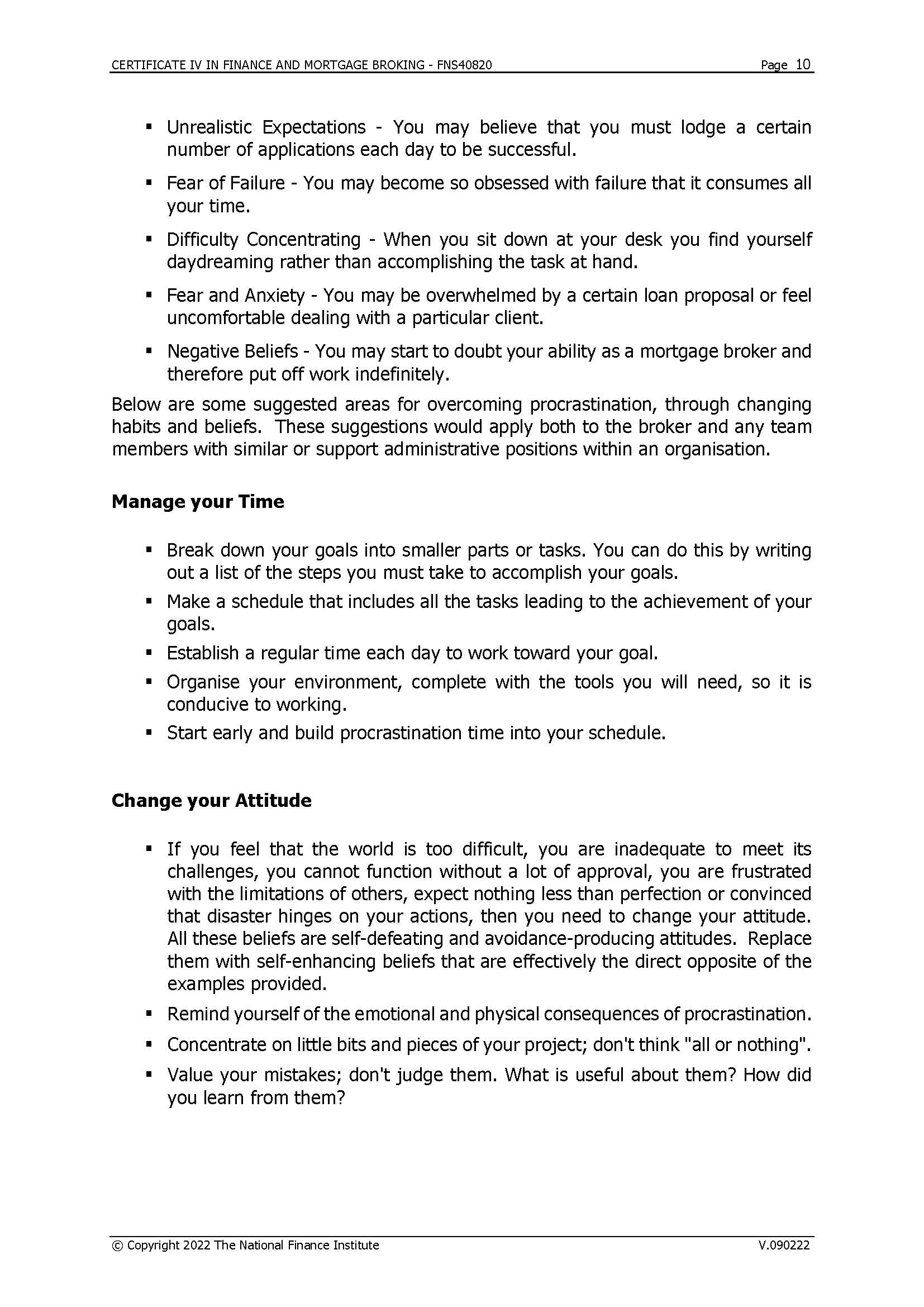
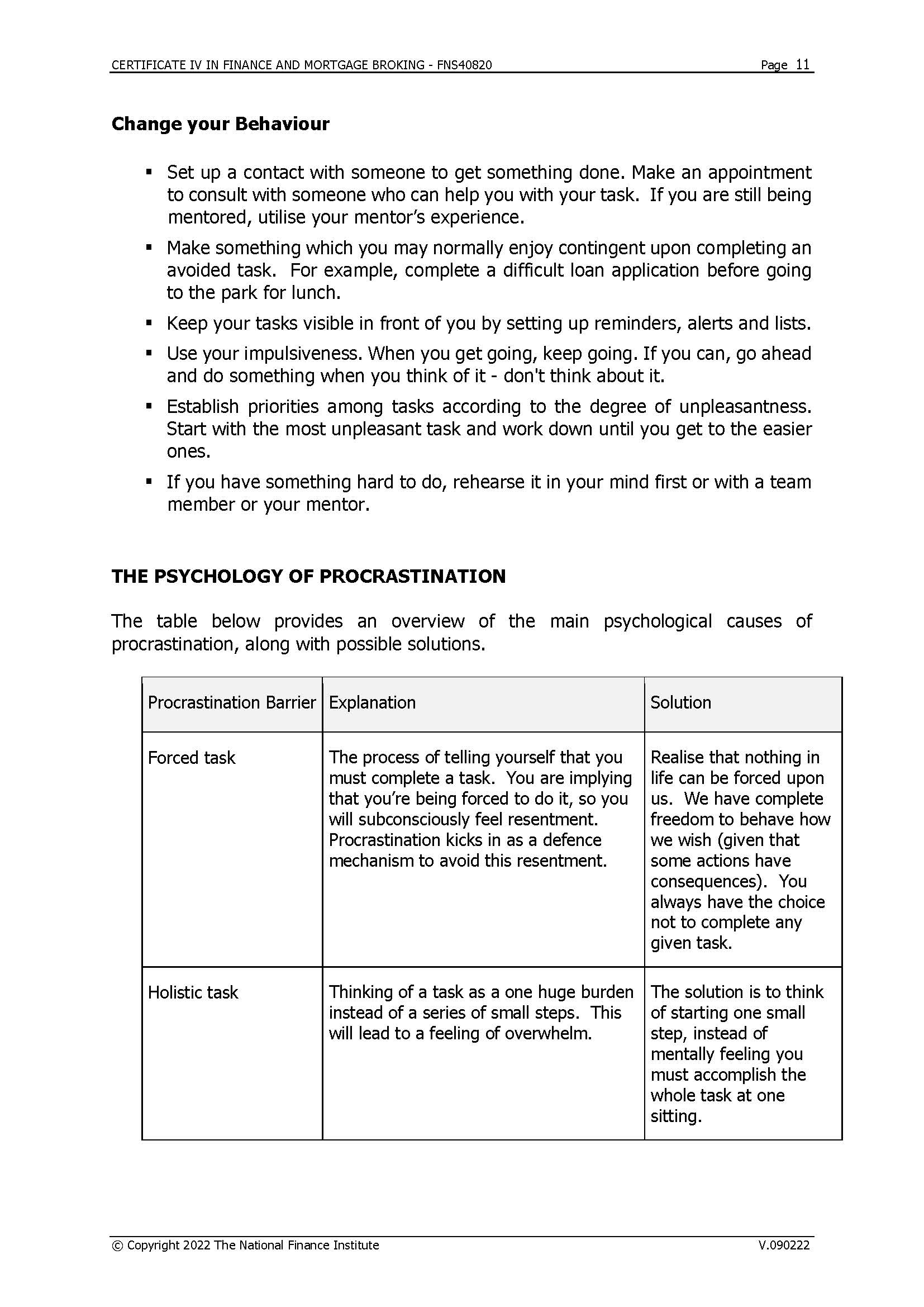
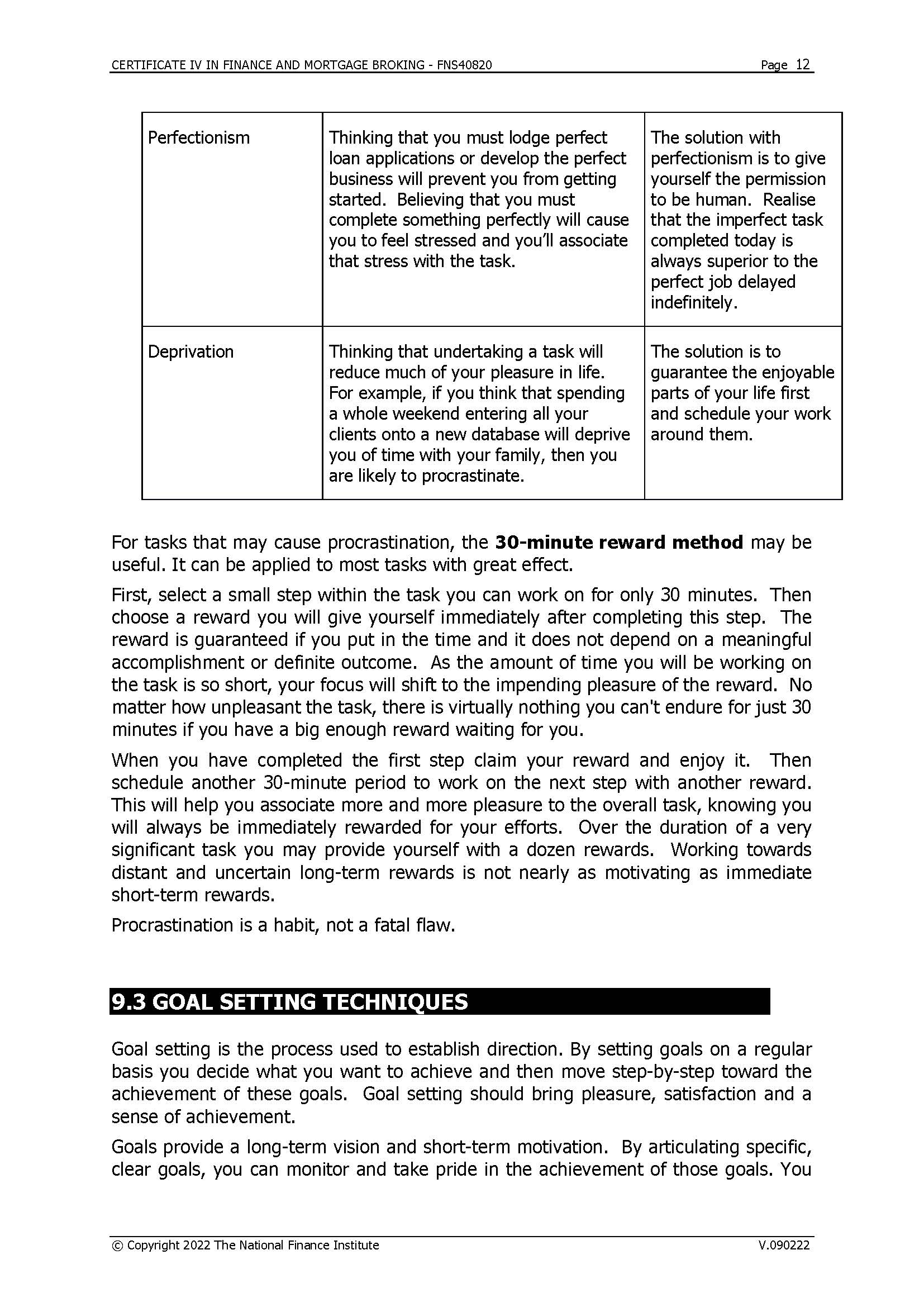
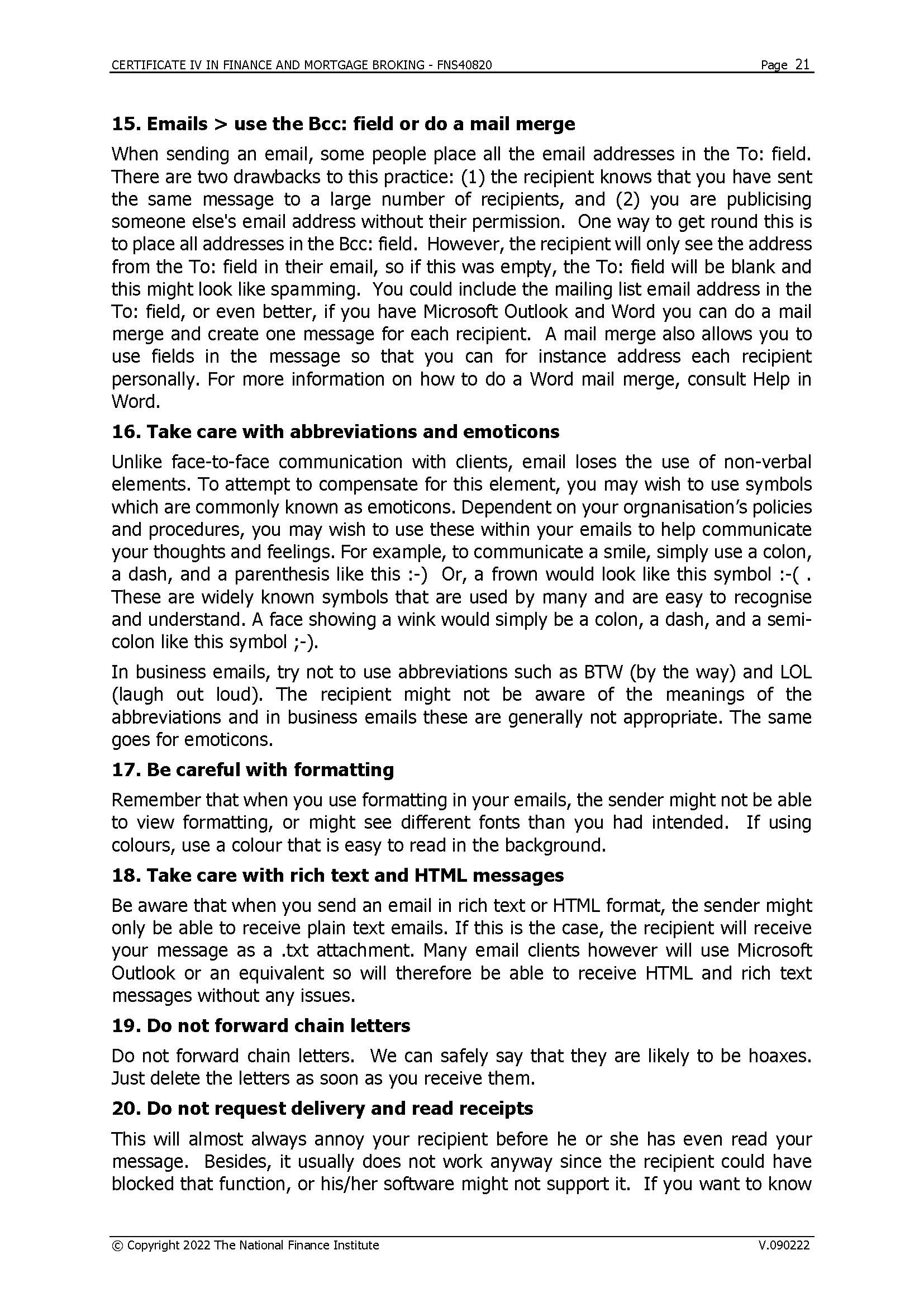
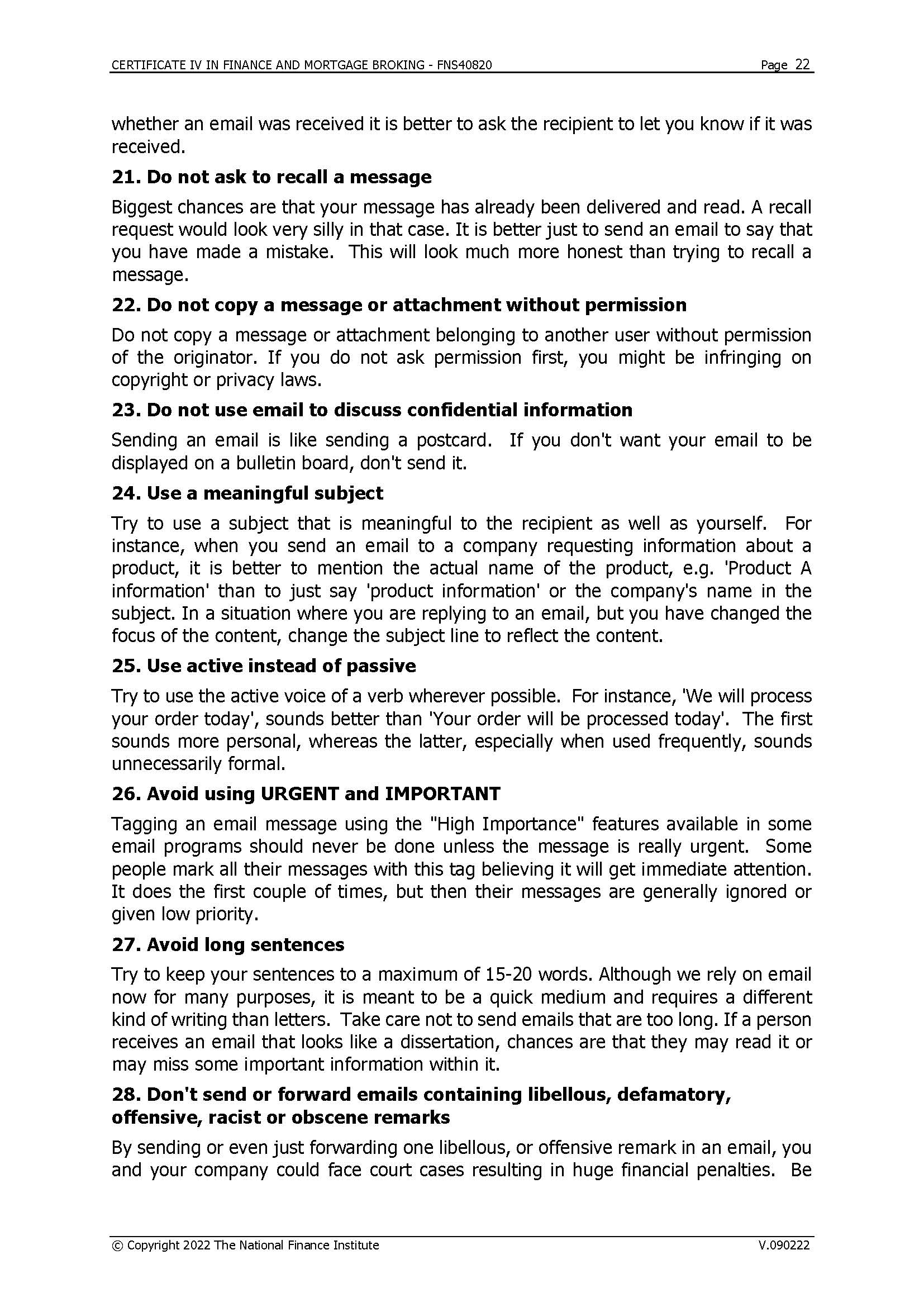
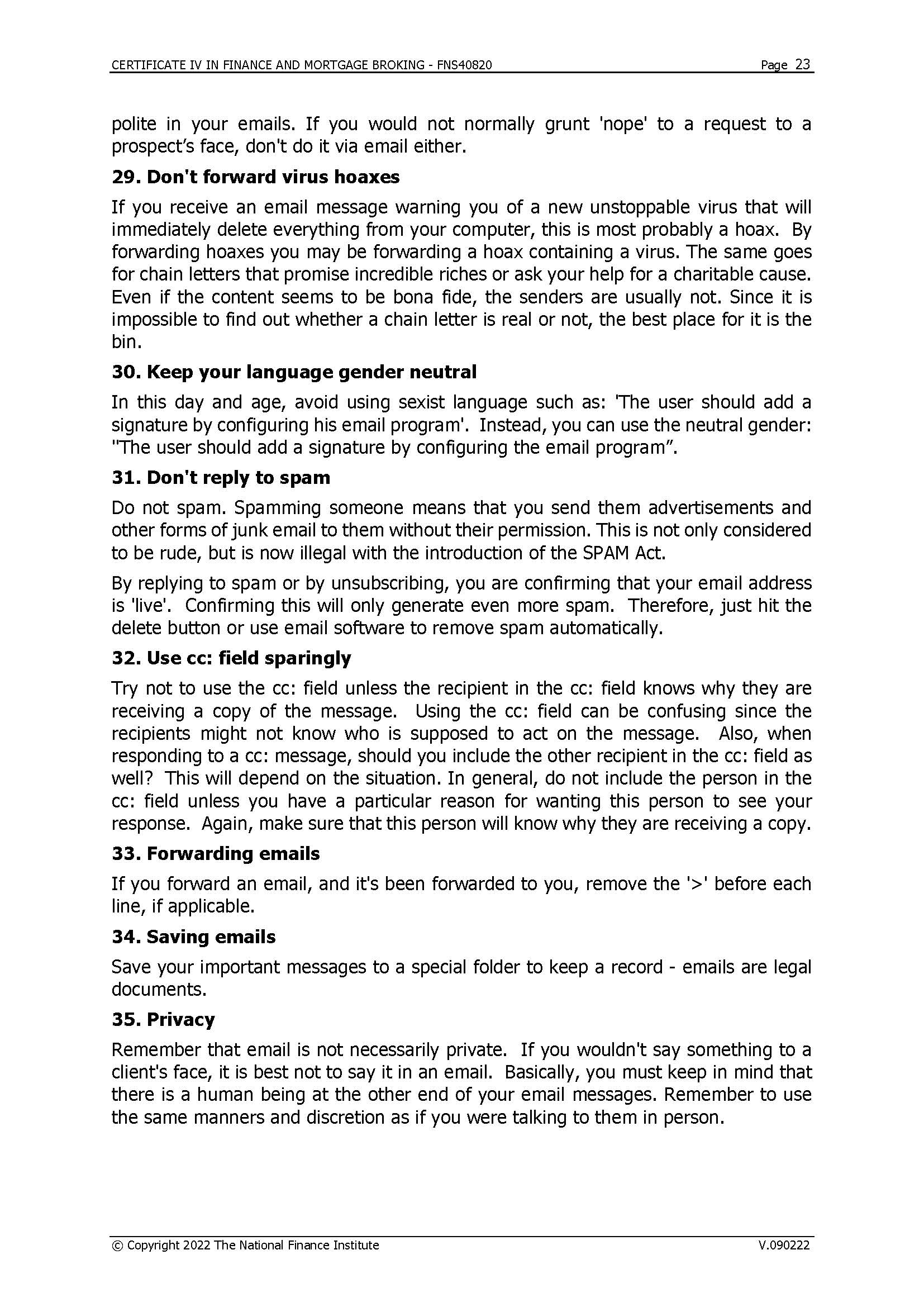
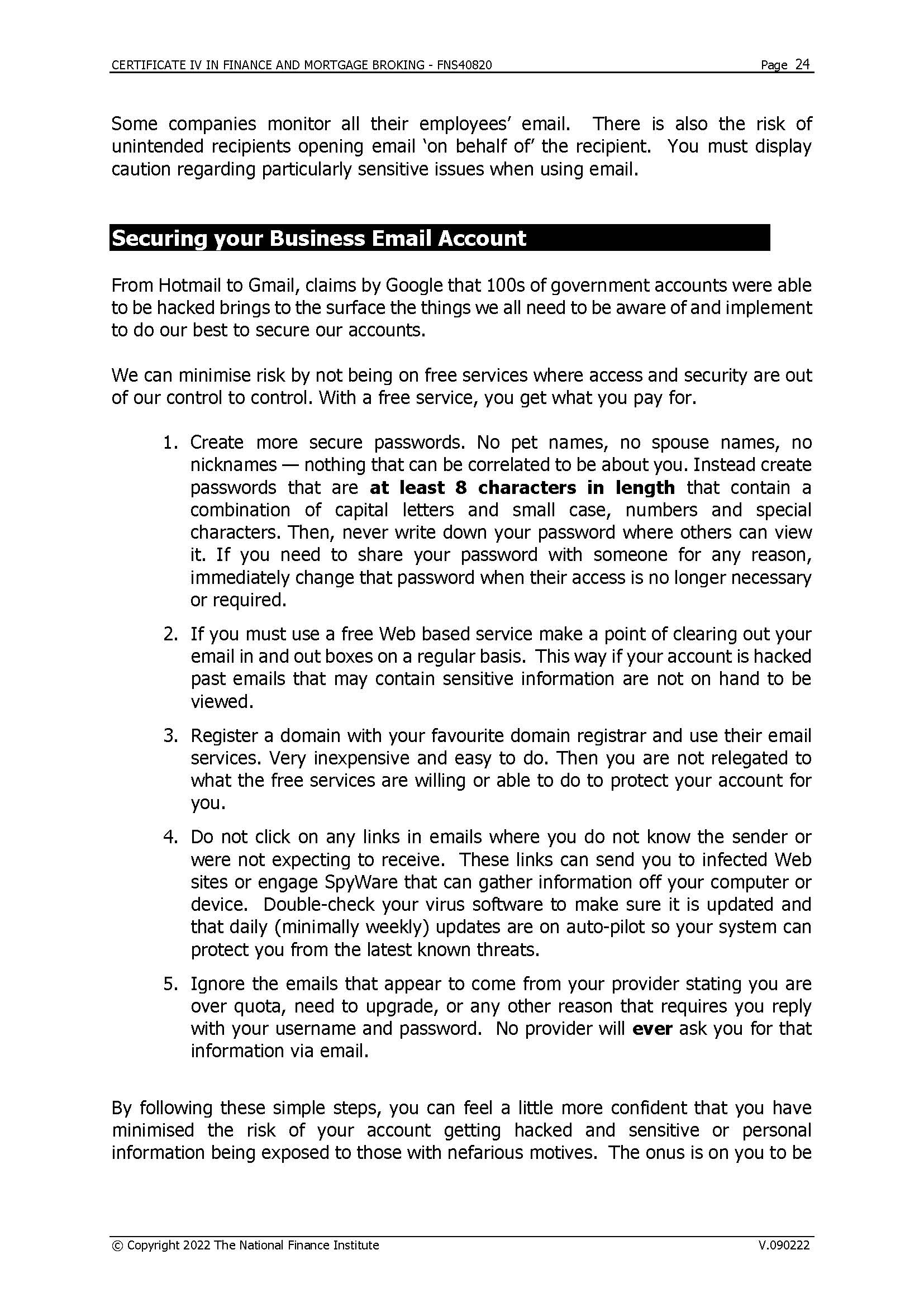
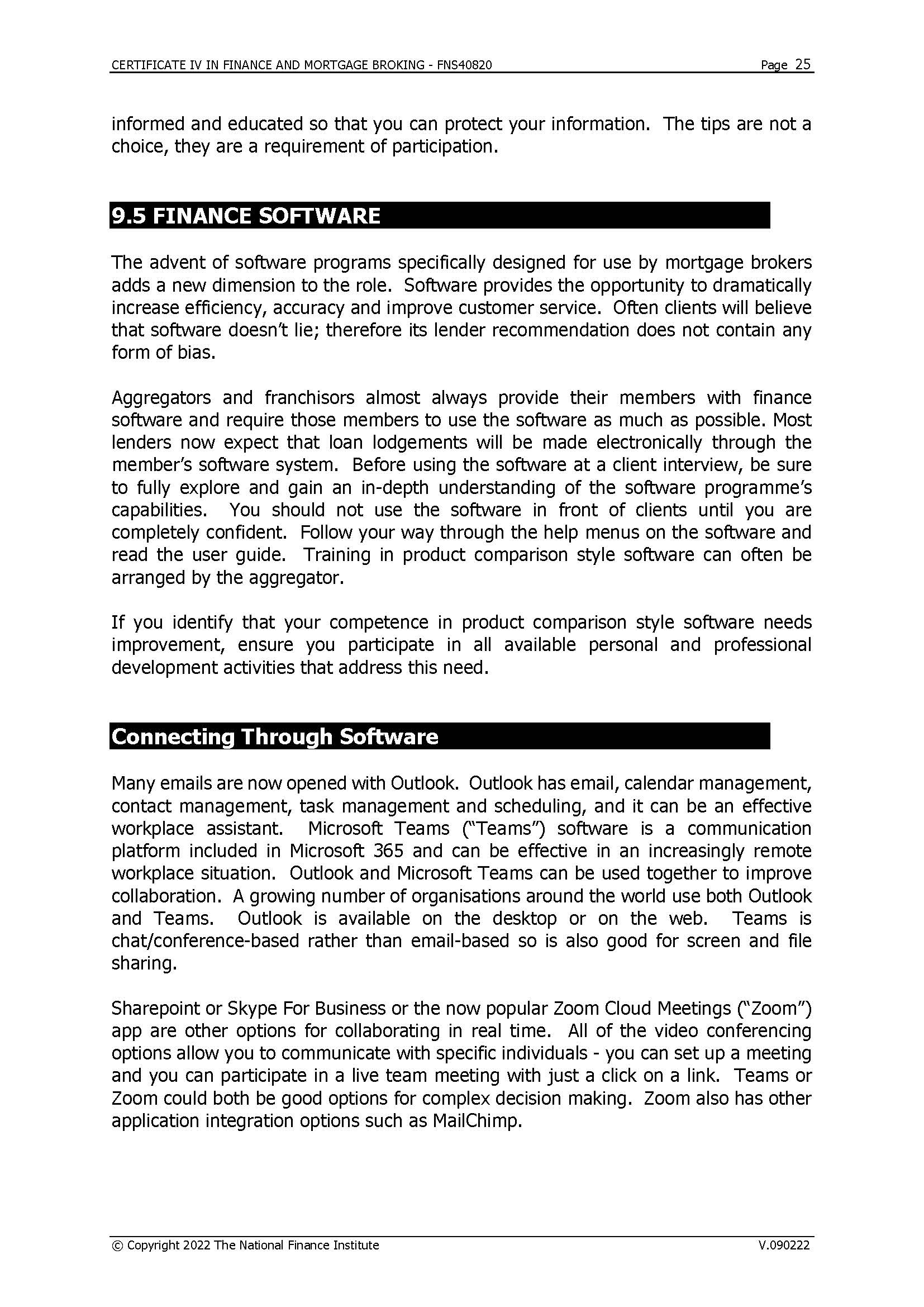
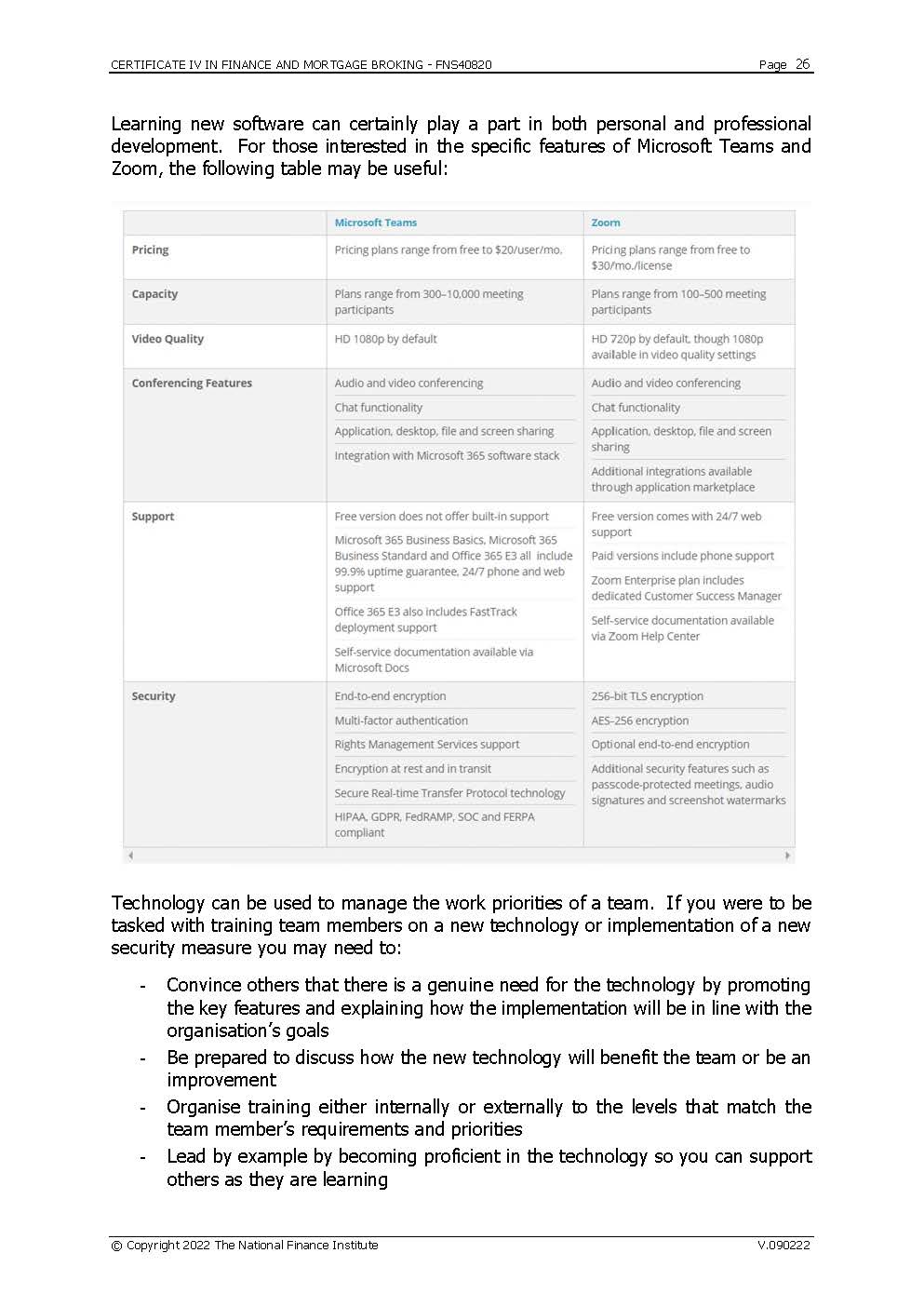
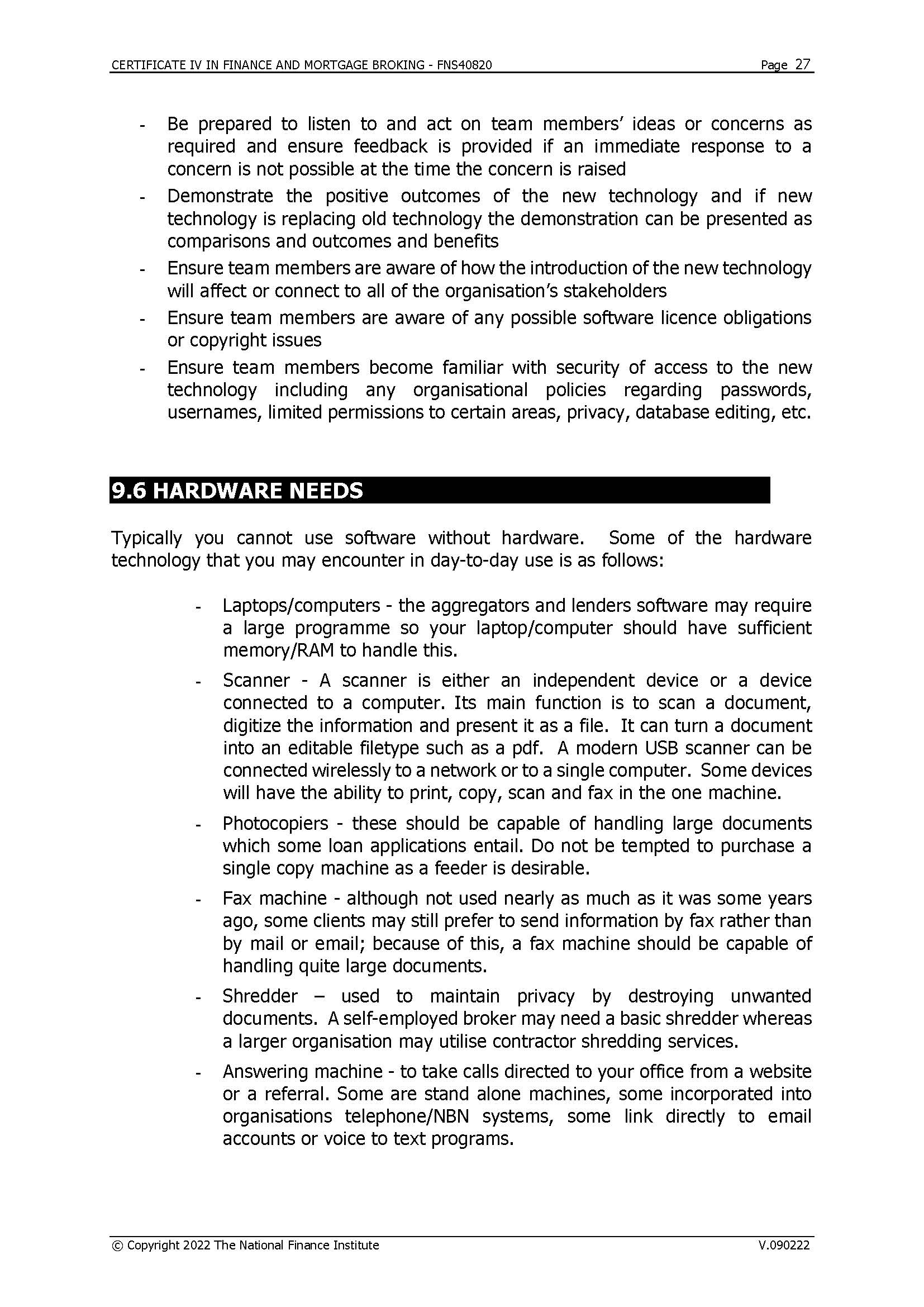
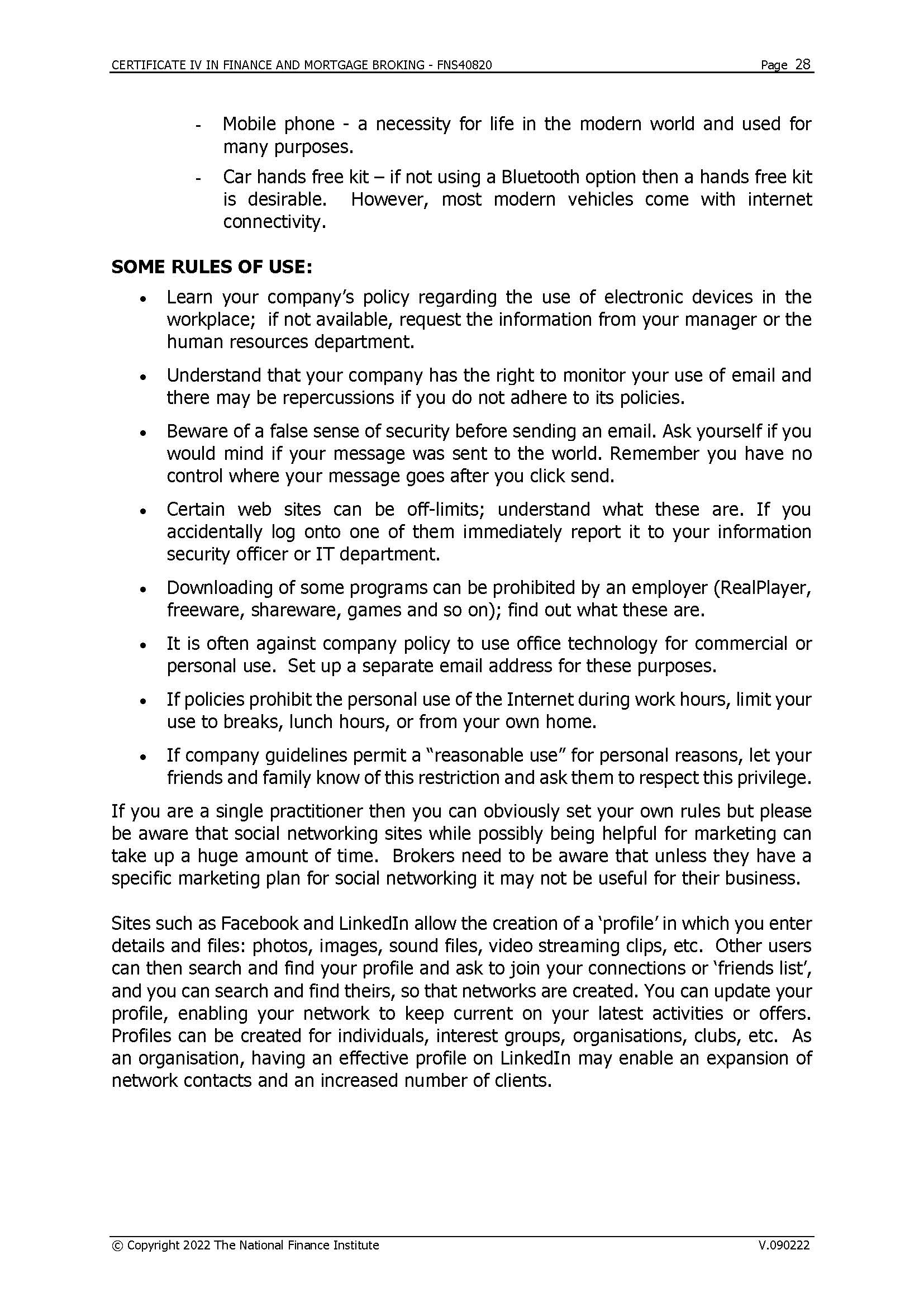
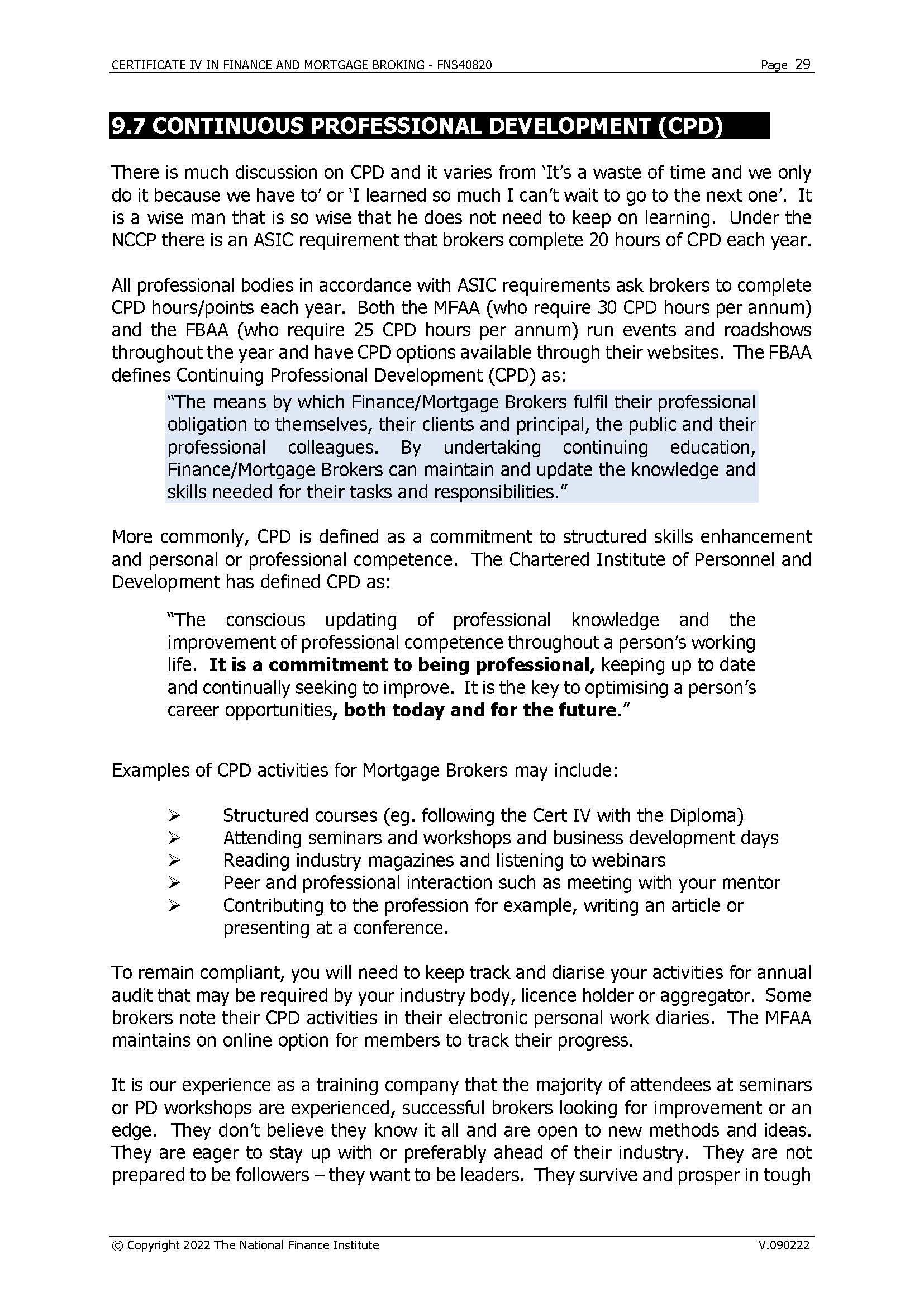
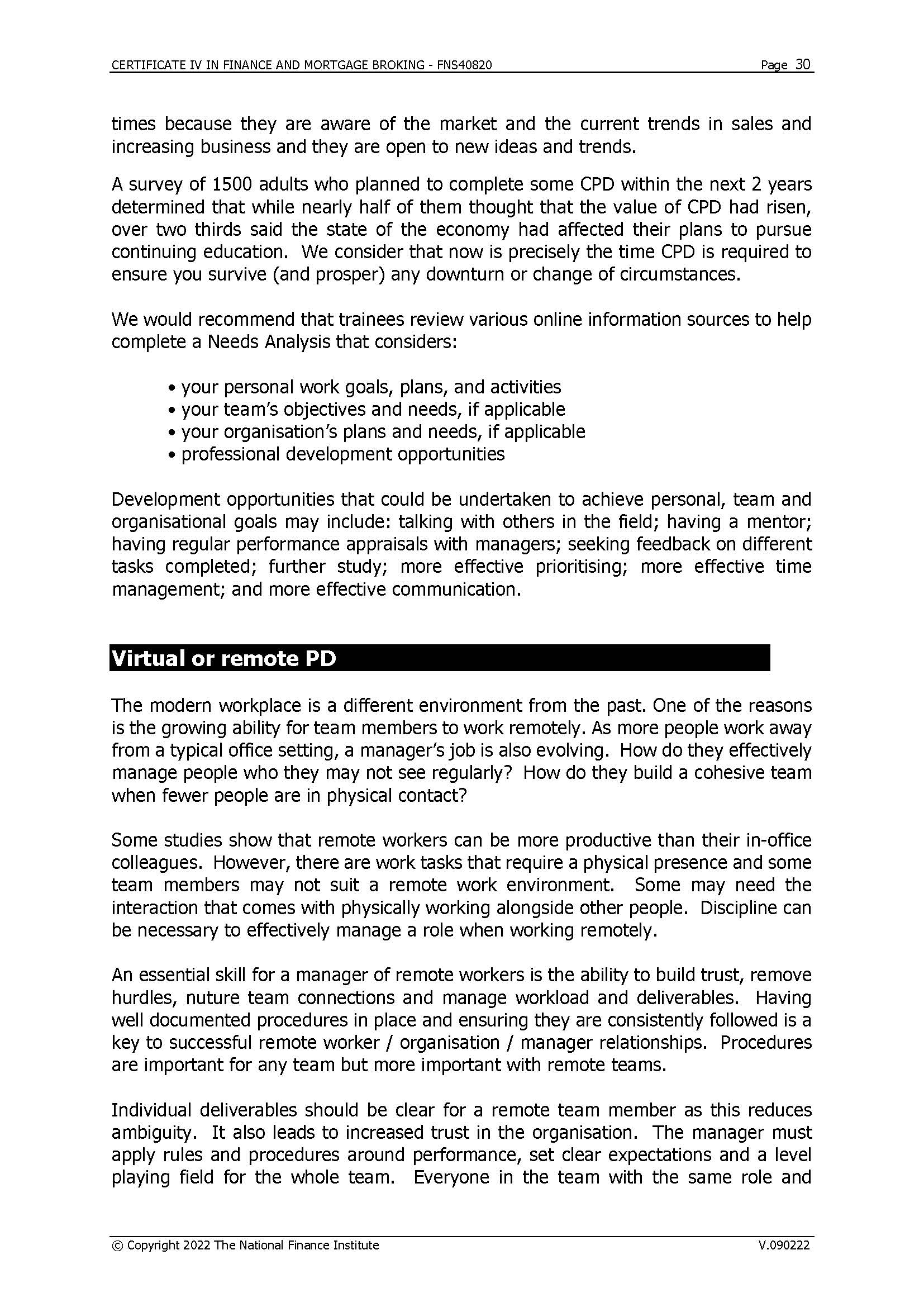
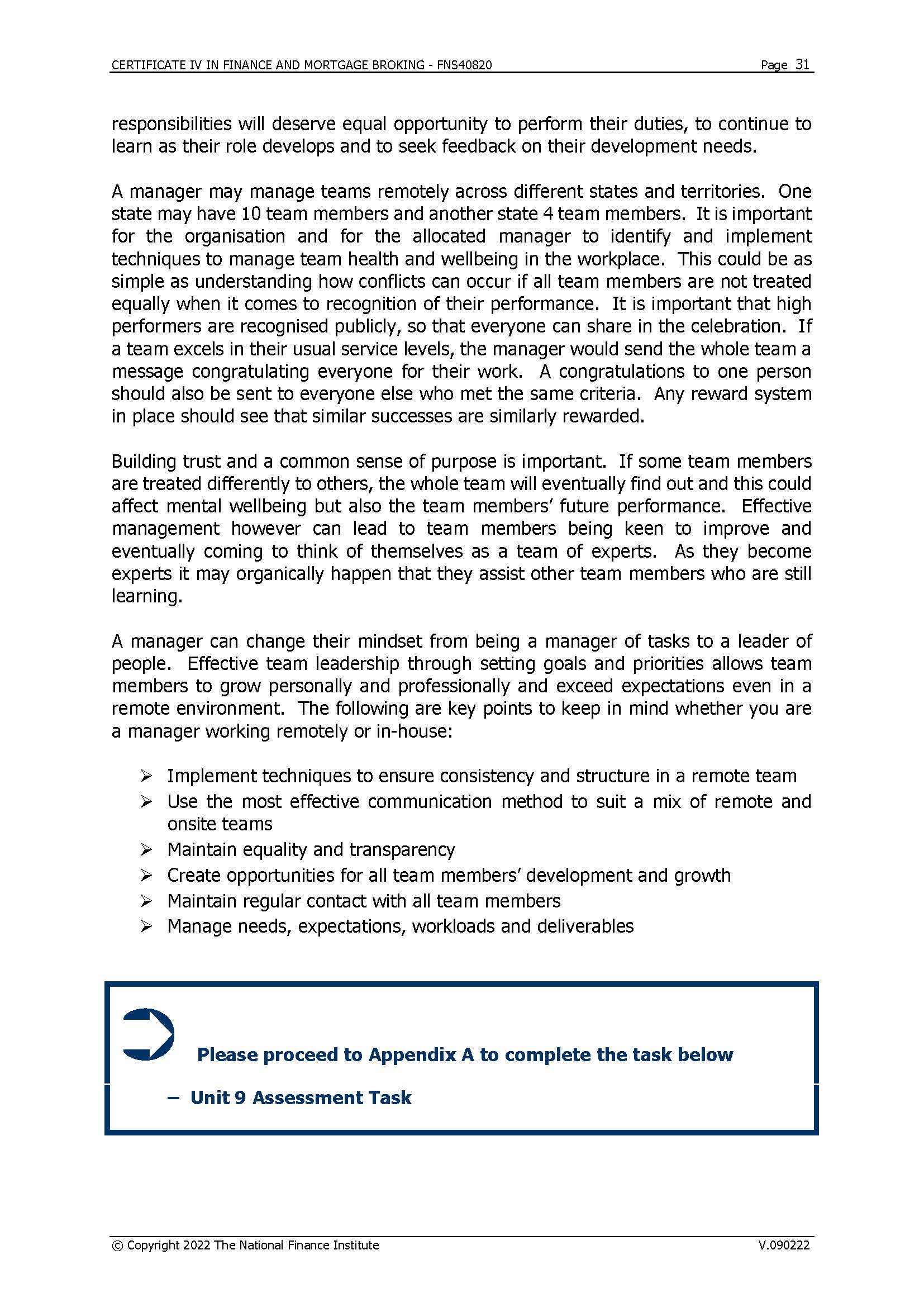
CERTIFICATE IV IN FINANCE AND MORTGAGE BROKING - FN540820 Page 1 UNIT 9 MANAGE PERSONAL AND PROFESSIONAL DEVELOPMENT Unit Code: BSBPEF501 This unit describes the skills and knowledge required to implement systems and process that support the personal and professional development of self and others. It applies to individuals working in a range of managerial positions who are accountable for the development and performance of others. To be successful, brokers need to take responsibility for their own professional development. Brokers should be able to prioritise and manage their work activities and hold themselves accountable. There is a saying in business that people who fail to plan, plan to fail. A broker also needs to understand how to support others to develop work goals, plans and activities that align with their responsibilities, whether they be in a similar role or a related or support role. A self-employed broker is not alone. There are other stakeholders in a broker's success. For example, a credit representative must adhere to the Australian Credit Licence Holder's policies. Aggregators may have minimum standards regarding loan writing volumes that a broker must achieve. By submitting high quality loan applications, a broker's efforts could have an impact on a lender's credit assessment teams' prioritisation of those submissions. 9.1 PRODUCTIVITY AND PERFORMANCE The major reason most people use a broker is convenience, and there is an expectation that the broker has superior knowledge of the range of loan products available and current conditions and regulations. It is extremely important for brokers to be totally up to date on product knowledge, compliance issues and the current economic climate. The industry bodies such as MFAA and FBAA have updates on their websites and through their quarterly magazines. They also arrange seminar series and annual conferences where members can stay abreast of current trends and changes. This not only can support the broker's development but can support others with whom they associate. Lending institutions are constantly running product update sessions in conjunction with aggregators and franchisors and brokers must attend these on a regular basis to ensure their knowledge is current and pertinent. @ Copyright 2022 The National Finance Institute V.090222CERTIFICATE IV IN FINANCE AND MORTGAGE BROKING - FNS40820 Pa e 2 Staying up to date is obviously very important but there are also some additional key elements to becoming a productive mortgage broker, including: - Time management and prioritisation strategies - Goal development and assessment techniques - Effective communication - Ongoing development of competence A broker who continues to set goals and develop their skills and facilitates their team members' development and achievement of goals will enjoy higher levels of office efficiency, which will result in increased success and increased health and wellbeing. The most effective brokers are those who have an effective business plan and marketing plan. Many brokers tend to work individually which means it is even more important to have a plan. Should a broker be in a team environment, a focus on the organisation's established business/marketing plan should reveal what will affect their own role with responsibilities and accountabilities within that plan. When a broker joins an organisation it is likely that a Position Description would have been a part of the introduction to the organisation's processes and procedures. A Position Description is likely to be an effective documented way for you to understand your own and your team members' responsibilities. The Business Plan is likely to be an effective documented way to identify your organisational framework to facilitate your own and your team members' work goals. Performance reviews may also form a part of an organisation's processes. This will allow the organisation to assess team members' activities to ensure alignment with organisational goals. It will also be an effective way to provide feedback to all team members. Competency and performance may be measured on a number of areas, some specific to a particular broker and some collectively to a team of brokers. These KPIs (Key Performance Indicators) may include: - Number of marketing calls per month - Number of loans submitted per month - Number of loans approved during the month - Number of interviews conducted per month - Amount of time spent on CPD activities - Amount of time spent understanding software programs - Expenses incurred in activities. Should the broker work individually it is recommended to survey all clients following loan applications to obtain feedback on overall performance during the loan process. To ensure this feedback is received, the number of questions should be limited to three or four, and a business reply envelope or on|ine reply option should be available Copyright 2022 The National Finance Institute V.090222 CERTIFICATE IV IN FINANCE AND MORTGAGE BROKING - FNS40820 Pa e 3 to encourage the clients to return their feedback to you without too much effort on their part. It is best to leave it for them to complete in their own time. Online surveys are relatively easy to create and there are number of companies that offer this service if it is not already an established method within the organisation. Feedback received back from clients is likely to be shared within the organisation and could serve as a good opportunity for a broker to seek feedback from relevant personnel on their own development needs. Ifthe organisation is undertaking regular competency reviews of their team members, this may provide an opportunity for the broker to document and raise their own development needs, priorities and plans. Aggregators/franchisors run frequent upgrading workshops for mortgage brokers and lenders run a continuous cycle of product updates and policy changes. Brokers should attend as many as possible (as long as they are relevant) to ensure they maintain their product knowledge and stay up to date on the latest techniques. Should a broker be in a management role, they will need to understand the requirements of the people that work with them. There are many ways to support others to develop their work goals, plans and activities. A manager or team leader needs to be able to effectively communicate what is expected of each team member, their area of responsibility and how their role ts within the organisational framework. Helping people to set realistic goals, measuring how they have performed against their targets, providing constructive feedback and facilitating access to relevant training and professional development activities may all have a positive impact on individuals and the team as a whole. Behaviour is also important. When working within a team, a broker should be aware of their own behaviour and be respectful of others, including respecting varying personality types. Different job roles often attract people of different personality types. A detail-oriented loan processor may be very different from an extravert business development manager. The ability to adapt, engage and communicate with many types of people will not only lead to good relationships within a broker's business but will also contribute to building rapport with clients. Copyright 2022 The National Finance Institute V.090222 CERTIFICATE IV IN FINANCE AND MORTGAGE BROKING - FN540820 Page 4 Learning Styles Like personalities, learning styles will differ. Most people have a preferred learning style or their style may be a combination of learning styles VISUAL AUDITORY READ/WRITE KINAESTHETIC In the dagram above Visual learners may prefer to see the information in pictures, diagrams or videos. Auditory learners may learn best through listening and talking. Read/Write learners prefer exactly that While Kinaesthetic learners learn best by performing the activity. Previous knowledge, technical ability and interest in a subject will also have an impact on an individual's ability to learn and develop personal competence. To maximise a broker's improved competency from learning, a mix of the above styles may be needed. But brokers need to consider their client's ability to learn also. For example when a broker explains the approval and settlement process to a client, they may consider using a diagram while talking through the process steps. Similar techniques can be used when assisting team members to understand their organisational responsibilities and demands. There are many work methods and practices that can develop, improve and maintain personal performance outcomes. These may include: >CFD training sessions Job role rotation * External study opportunities * Further formal education *Internal training resources *Inter-company rotation of staff >Adjusted hiring practices (i.e., hiring experienced people) Many companies have highly developed systems and processes to plan and prioritise tasks and this will often include the use of task-specific software. Companies may train their staff to work within the systems developed but encourage staff to highlight where improvements may be made. Should individuals work by themselves it is even more crucial to put systems and processes in place to organise and prioritise tasks. All brokers should have a personal @ Copyright 2022 The National Finance Institute 7.0 90222CERTIFICATE IV IN FINANCE AND MORTGAGE BROKING - FNS40820 Pa e 5 development plan outlining their career objectives and an action plan on how that may be achieved. A personal development plan may be as simple as how many loans they wish to submit per month, but may also include their goals on developing future skills. For example, a broker who has been successfully managing residential loans for clients may have a goal to fully understand how to successfully manage a commercial loan application. The following sections contain information on time management strategies and most would agree on the importance of effectively managing time and prioritising commitments. An electronic diary or even a hard copy diary may be one method that could greatly assist this process and ensure adequate work-life balance is achieved. Work life balance becomes ever more important as clients' needs increase. 9.2 TIME MANAGEMENT STRATEGIES AND GOALS There is a strong link between time management and goal setting. Goals will drive you to succeed; time management will allow you to \"drive\" more productively. Time management is more logistical, whereas goal setting is more motivational. First, let us turn our attention to time management. Time management is the efficient management of your time to achieve productivity outcomes. Within your working life you have a limited amount of time to produce the results you desire, so time management is critical to your success. Managing your time effectively can enable you to maintain a work/life balance, achieve deadlines, reduce stress and work smarter instead of harder. In fact, good time management, combined with the ability to set realistic KPI's for yourself and your team are essential techniques to manage health and wellbeing in the workplace. The following strategies are designed to assist you in managing your time more productively. Mortgage brokers who use their time effectively know what activities they want to accomplish, the best order to tackle the activities and tasks are prioritised according to when the need to complete those activities is established. Time is a limited resource in that, if it is wasted, it can never be replaced. While people talk about \"saving time\CERTIFICATE IV IN FINANCE AND MORTGAGE BROKING - FNS40820 Page 6 The majority of time is spent responding to requests, demands and problems initiated by others. We call this response time and treat it as uncontrollable. The portion that is under a mortgage broker's control is called discretionary time. Most of the suggestions offered to improve time management apply to its discretionary component, because this is the only part that is manageable. The challenge is to know what time is discretionary and then to organise activities so as to accumulate discretionary time in blocks large enough to be useful. Those who are good at identifying and organising their discretionary time get significantly more accomplished, and the outcomes they accomplish are more likely to be high-priority activities. Using your time effectively requires that you know the objectives you want to accomplish, the activities that will lead to the accomplishment of those objectives and the importance and urgency of each activity. TIME MANAGEMENT REMINEElif \\--\\ ORGANISENG RESOURCES Copyright 2022 The National Finance Institute v.090222 CERTIFICATE IV IN FINANCE AND MORTGAGE BROKING - FNS40820 Page 7 Daily Plans are an essential tool for any successful mortgage broker. Consideration should be given to the following: 1. Appointments: Schedule your appointments with time before and after to allow for the unexpected (trafc jams, no parking, etc.) 2. Your call plan: 2 to 4 potential referral points should be contacted each week. In addition, you should call on your current referral points at least once a fortnight. This has to be done in a manner not to be intrusive, but rather in a helpful and informative manner. 3. Family: Start writing down all important family events. Some mortgage brokers take care of their clients but forget that their families need attention also. 4. Health: Why make a lot of money if you are not going to be healthy enough to enjoy it? The healthier you are the better you will be able to cope with the stress and work. It is important that both you and any team members spend some time each week on a physical activity to maintain health and wellbeing. 5. Prospecting: You need to be continually expanding your network base to be successful and this means meeting people. 6. Meetings: Group meetings and company activities will be important if you are part of a team. Team meetings may allow each individual to contribute to effective time management through raising topics such as of prioritisation of personal, team and organisational demands. 7. Correspondence: Rather than putting things off each day, allocate 30-60 minutes each day to writing to referral points, customers and dealing with paperwork. We suggest you do this rst thing in the morning when you are fresh. 8. Telephone: The telephone is crucial and can save time and money when making appointments. 9. Email: Email has taken over as the number one method of communication. Allocate blocks of time in each day to deal with incoming emails. 10.SelfLearning: The market is changing faster than ever before. You need to set aside time each week to learn what's new in the market, keep your product knowledge up to date and keep learning. Self Monitoring Managing your time more effectively starts with discovering where all your time goes. The above list provides some categories, but you may be able to identify others. Keep a daily activity log for 3 to 7 days. From the time you get up to the time you go to sleep, record your activities, the time you started and nished and the amount of time each activity consumed. At the end of day reect on your time use with these questions: - In what areas could I save time? - Did I accomplish what was most important? Copyright 2022 The National Finance Institute V.090222 CERTIFICATE IV IN FINANCE AND MORTGAGE BROKING - FNS40820 Pa e 8 - At what time of the day was I most productive / least productive? - Is there anything I need to change? - What activities were high, medium or low priority? Once you know where your time is going you can use scheduling strategies to manage your time. Master Schedule Make a master schedule of your time, which is a template for a typical week in your life. List all your weekly non-negotiable xed activities. They may include any of the following: - Sleep - Meals - Grocery shopping - TV/Online Activities - Travel time - Exercise - Socialising - Sport/Hobbies - Volunteer work Using this master schedule template ll in the blank spots with your week's tasks at the commencement of each week. Daily Schedule Next, make a daily schedule which is a prioritised list of activities for the next day. - Remember that work expands to fill the time available, so estimate how long the work should take and give yourself a deadline. - Tackle less interesting and more difficult tasks during your high energy and peak concentration times. Leave the easier work for low times. - Always have small tasks on hand so you can ll in any little windows of time during your day. - Combine activities listen to audios of mortgage journals while exercising. - Allow extra time for the unexpected - Return calls at a fixed time - Handle mail once Copyright 2022 The National Finance Institute V.090222 CERTIFICATE IV IN FINANCE AND MORTGAGE BROKING - FNS40820 Pa e 9 Know Your Cycle Each of us has a daily cycle. Some of us are morning people, while others are late afternoon or evening people. Mortgage brokers who know their cycle and schedule their work accordingly can significantly increase their effectiveness. They handle their most demanding problems during the high part of their cycle, when they are most alert and productive. They relegate their routine and un-demanding tasks to their low periods. Minimise Disruptions When possible, try to minimise disruptions by setting aside that part of the day when you are most productive as a block of discretionary time. Then, try to insulate yourself. During this time you should: - Limit access to your work area or other team members - Keep any interruptions as short as possible - After an interruption, use your To Do list to return to your schedule - Limit phone calls or visits - If visits are unavoidable, be assertive and if possible announce a time limit. Overcoming Procrastination One of the greatest inhibitors of managing time effectively is procrastination. The following section aims to dispel fears regarding procrastination and provides some practical solutions. What is Procrastination? Procrastination is the avoidance of starting or completing a task that needs to be accomplished. This can lead to feelings of resentment, stress, guilt and self-doubt. More importantly for a mortgage broker, it can inhibit success through low productivity. Procrastination has a high potential for negative consequences, because if not overcome can lead directly to failure. What Leads to Procrastination? - Poor Time Management - Procrastination can result from not managing time wisely. You or your team members may be uncertain of priorities, goals and objectives. A task can also sometimes appear overwhelming. - Personal problems - For example, financial difculties, problems with a partner, etc. Copyright 2022 The National Finance Institute V.090222 CERTIFICATE IV IN FINANCE AND MORTGAGE BROKING FNS40820 Page 10 - Unrealistic Expectations - You may believe that you must lodge a certain number of applications each day to be successful. - Fear of Failure - You may become so obsessed with failure that it consumes all your time. - Difficulty Concentrating - When you sit down at your desk you find yourself daydreaming rather than accomplishing the task at hand. - Fear and Anxiety - You may be overwhelmed by a certain loan proposal or feel uncomfortable dealing with a particular client. - Negative Beliefs - You may start to doubt your ability as a mortgage broker and therefore put off work indefinitely. Below are some suggested areas for overcoming procrastination, through changing habits and beliefs. These suggestions would apply both to the broker and any team members with similar or support administrative positions within an organisation. Manage your Time - Break down your goals into smaller parts or tasks. You can do this by writing out a list of the steps you must take to accomplish your goals. - Make a schedule that includes all the tasks leading to the achievement of your goals. - Establish a regular time each day to work toward your goal. - Organise your environment, complete with the tools you will need, so it is conducive to working. - Start early and build procrastination time into your schedule. Change your Attitude - If you feel that the world is too difcult, you are inadequate to meet its challenges, you cannot function without a lot of approval, you are frustrated with the limitations of others, expect nothing less than perfection or convinced that disaster hinges on your actions, then you need to change your attitude. All these beliefs are self-defeating and avoidance-producing attitudes. Replace them with self-enhancing beliefs that are effectively the direct opposite of the examples provided. - Remind yourselfof the emotional and physical consequences of procrastination. - Concentrate on little bits and pieces of your project; don't think "all or nothing". - Value your mistakes; don't judge them. What is useful about them? How did you learn from them? Copyright 2022 The National Finance Institute V.090222 CERTIFICATE IV IN FINANCE AND MORTGAGE BROKING FNS40820 Page 11 Change your Behaviour - Set up a contact with someone to get something done. Make an appointment to consult with someone who can help you with your task. If you are still being mentored, utilise your mentor's experience. - Make something which you may normally enjoy contingent upon completing an avoided task. For example, complete a difcult loan application before going to the park for lunch. - Keep your tasks visible in front of you by setting up reminders, alerts and lists. - Use your impulsiveness. When you get going, keep going. If you can, go ahead and do something when you think of it - don't think about it. - Establish priorities among tasks according to the degree of unpleasantness. Start with the most unpleasant task and work down until you get to the easier ones. - If you have something hard to do, rehearse it in your mind first or with a team member or your mentor. THE PSYCHOLOGY OF PROCRASTINATION The table below provides an overview of the main psychological causes of procrastination, along with possible solutions. Procrastination Barrier Explanation Solution Forced task The process of telling yourself that you Realise that nothing in must complete a task. You are implying life can be forced upon that you're being forced to do it, so you us. We have complete will subconsciously feel resentment. freedom to behave how Procrastination kicks in as a defence we wish (given that mechanism to avoid this resentment. some actions have consequences). You always have the choice not to complete any given task. Holistic task Thinking of a task as a one huge burden The solution is to think instead of a series of small steps. This of starting one small will lead to a feeling of overwhelm. step, instead of mentally feeling you must accomplish the whole task at one sitting. Copyright 2022 The National Finance Institute V.090222 CERTIFICATE IV IN FINANCE AND MORTGAGE BROKING FNS40820 Page 12 Perfectionism Thinking that you must lodge perfect The solution with loan applications or develop the perfect perfectionism is to give business will prevent you from getting yourself the permission started. Believing that you must to be human. Realise complete something perfectly will cause that the imperfect task you to feel stressed and you'll associate completed today is that stress with the task. always superior to the perfect job delayed indefinitely. Deprivation Thinking that undertaking a task will The solution is to reduce much of your pleasure in life. guarantee the enjoyable For example, if you think that spending parts of your life rst a whole weekend entering all your and schedule your work clients onto a new database will deprive around them. you of time with your family, then you are likely to procrastinate. For tasks that may cause procrastination, the 30-minute reward method may be useful. It can be applied to most tasks with great effect. First, select a small step within the task you can work on for only 30 minutes. Then choose a reward you will give yourself immediately after completing this step. The reward is guaranteed if you put in the time and it does not depend on a meaningful accomplishment or denite outcome. As the amount of time you will be working on the task is so short, your focus will shift to the impending pleasure of the reward. No matter how unpleasant the task, there is virtually nothing you can't endure forjust 30 minutes if you have a big enough reward waiting for you. When you have completed the first step claim your reward and enjoy it. Then schedule another 30-minute period to work on the next step with another reward. This will help you associate more and more pleasure to the overall task, knowing you will always be immediately rewarded for your efforts. Over the duration of a very significant task you may provide yourself with a dozen rewards. Working towards distant and uncertain long-term rewards is not nearly as motivating as immediate short-term rewards. Procrastination is a habit, not a fatal flaw. 9.3 GOAL SETTING TECHNIQUES Goal setting is the process used to establish direction. By setting goals on a regular basis you decide what you want to achieve and then move step-bystep toward the achievement of these goals. Goal setting should bring pleasure, satisfaction and a sense of achievement. Goals provide a long-term vision and short-term motivation. By articulating specific, clear goals, you can monitor and take pride in the achievement of those goals. You Copyright 2022 The National Finance Institute V.090222 CERTIFICATE IV IN FINANCE AND MORTGAGE BROKING FNS40820 Page 13 don't have to have too many just enough to give you a sense of achievement when you get them. The process of setting and achieving goals provides motivation and confidence in your ability to achieve results as a mortgage broker. Goal Setting Process The greatest failing of most mortgage brokers is when they establish business goals as their focus, at the exclusion of personal/life goals. Business goals have no associated passion to drive us to succeed unless they are directly linked to personal goals. For example, if you have a personal goal to go on an overseas holiday next year, then this could be linked to a business goal of increasing your settlements by 15%. Personal goals will motivate you to achieve results. Goals are set on a number of different levels: (1) first, you decide what you want to do with your life and what large-scale goals you want to achieve (2) second, you break these down into milestones that you must hit so that you reach your lifetime goals and (3) third, you must link all your goals between personal and business aspects. Lifetime Goals Considering what you want to achieve in your lifetime isn't always easy, because setting lifetime goals gives you the overall perspective that shapes all other aspects of your decision making. This is the blueprint for your life in the future. To give a balanced coverage of all the important areas of your life, you might establish goals categorised into attitude, finance, career, education, family, tness, community service, sport and relationships. Once you have decided your goals in these categories, assign a priority to them from first to last. Next review the goals and re-prioritise until you are completely satised they reflect the type of life you want to lead. Ensure the goals you have set are what M want to achieve, not what your spouse, family or employer wants them to be. Once you have set your lifetime goals, set a series of milestones that you should reach if you are to achieve your lifetime plan. Action Plans To ensure your lifetime goals are not just far-flung dreams, you need to set some action plans that outline ways to work toward your goals. These action plans should outline activities, deadlines, responsibilities and costs of achieving each action. Copyright 2022 The National Finance Institute V.090222 C ERTIFICATE IV IN FINANCE AND MORTGAGE BROKING FNS40820 Pa e 14 Daily \"To Do" List Finally set a daily to-do list of things that you should do today to work towards your lifetime goals. This will help you to improve the realism of your lifetime goals. Once you have decided your first set of plans, keep the process going by reviewing and updating your to-do list on a daily basis. Periodically review the longer term plans and modify them to reect your changing priorities. Setting Goals Effectively The following broad guidelines will help you to set effective goals: State each goal as a positive statement: Express your goals positively, for example 'Execute this technique well' is a much better goal than 'Don't make this stupid mistake'. Be precise: Set a precise goal, putting in dates, times and amounts so that you can measure achievement. If you do this, you will know exactly when you have achieved the goal and gain complete satisfaction from having achieved it. Set priorities: When you have several goals, give each a priority. This helps you to avoid feeling ovenNhelmed by too many goals and helps to direct your attention to the most important ones. Write goals down: this crystallises them and gives them more force. Put them in a prominent place, perhaps on your wall above your computer screen. Keep operational goals small: Keep the low-level goals you are working towards small and achievable. If a goal is too large, then it can seem that you are not making progress towards it. Keeping goals small and incremental gives more opportunities for reward. Derive today's goals from larger ones. Do not set goals too low: Just as it is important not to set goals unrealistically high, do not set them too low. People tend to do this where they are afraid of failure or where they are lazy. You should set goals so that they are slightly out of your immediate grasp, but not so far that there is no hope of achieving them. No one will put serious effort into achieving a goal that they believe is unrealistic. Overall, your goals should be S.M.A.R.T: 0 Specific o Measurable o Attainable 0 Relevant 0 Time limited Copyright 2022 The National Finance Institute V.090222 CERTIFICATE IV IN FINANCE AND MORTGAGE BROKING FNS40820 Pa e 15 Achieved Goals When you have achieved a goal, take the time to enjoy the satisfaction of having done so. Absorb the implications of the goal achievement and observe the progress you have made towards other goals. If the goal was a significant one, reward yourself appropriately. 9.4 EFFECTIVE COMMUNICATION Work environments vary greatly according to industry, company culture, and the nature of the job itself. Organisations dene their own expectations of professionalism as pertaining to the use of technical or electronic devices in the workplace and then formalise policies that govern such hot issues as information security and personal use of electronic devices on the job. Often, a new team member would be notified of procedures and any expectations during initial training within the organisation, either with an assigned mentor who shares information and models acceptable behaviour, or through a formal training program. Some programs use online and/or corporate trainers who instruct new employees on company policy and expose them to an environment where they learn other unwritten rules governing ofce behaviour. Telephone Techniques Proper telephone technique involves basic common sense that everyone should display. Following are some of the fundamental techniques for handling incoming and outgoing phone calls. Remember the golden rule do not leave your phone on during an interview. The clients will interpret this as you feeling expected calls are more important than them. Incoming Calls All incoming calls should be answered in a timely manner (preferably in less than 3 rings). Business telephones should consistently be answered with a phrase similar to, "Thank you for calling XYZ Home Loans, this is Bill." This immediately informs the caller that they have phoned the right business and lets them know to whom they are speaking. Keep to a minimum putting callers on hold. It is inevitable that on some occasions you will have to put people on hold, so ask if it is okay. Be sure to check back with them every minute to ensure they are still willing to hold. Speak clearly and slowly when you answer the telephone. Do not slur or mu mble your words. Speak with confidence so the person on the other end has the feeling that you know what you are doing. Copyright 2022 The National Finance Institute V.090222 CERTIFICATE IV IN FINANCE AND MORTGAGE BROKING FNS40820 Pa e 16 Never be rude to a caller, no matter how disrespectful they are toward you. Always remember to handle yourself in a professional manner. Outgoing Calls When calling another business, it is proper etiquette to give your name and your business name to whomever answers the telephone. On the occasion when you get the wrong number, apologise to the person who answers the phone --do notjust hang up. When leaving a phone message always state your name, business name, phone number and reason for calling. Do not use up an unreasonable amount of time as some answering machines will cut off after a certain time. As a mortgage broker you will spend a signicant amount of time on the telephone, so it is an important communication medium to master. Mobile Phone Etiquette As a mortgage broker you will spend a lot of time on your mobile phone. Clients expect to have access to you at most times, so a mobile phone provides this access when you are away from the office. There are certain rules of etiquette regarding the use of mobile phones that you should keep in mind: 1) Location: There are places where it is dangerous and/or inappropriate to use a mobile phone (or even have it turned on in readiness to receive calls). Yourjudgment is your best guide in these cases, but four places that are definitely in appropriate areas for use include any performance venue (opera, music hall, movie theatre), the inside of a vehicle which you are driving (unless a car kit or hands-free device is fitted), inside hospitals and at service stations. 2) Time: There are going to be times when your activity at that moment is more important than anybody that may call on your mobile. An example would be when you are having an important discussion with a business partner or client. Interrupting the conversation by answering your mobile phone is not appropriate. 3) Volume: Most people seem to raise their voices when speaking on mobile phones. There is no reason to project your end of the conversation to every ear within ten metres. The party on the other end of the line can hear you quite well and you should speak in a tone of voice appropriate to your surroundings until your caller asks you to do othenrvise. As a responsible mobile phone user, you should be aware of the environment surrounding you before making or receiving a call. It is important to recognise the Copyright 2022 The National Finance Institute V.090222 CERTIFICATE IV IN FINANCE AND MORTGAGE BROKING FNS40820 Pa e 17 privacy issues regarding discussing client proposals on mobile phones when other people are within hearing distance. Suggestions for using mobile phones or other devices in the workplace include: . Use may be restricted to breaks - know your company's policies . Select a ringtone that is appropriate for your work environment . When talking on a mobile phone, speak in a normal tone of voice . Record a professional greeting, not \"What's up? This is Todd\" . Stand apart from others when speaking so as not to interfere with others' work or conversation . Avoid discussing personal issues on a mobile phone when coworkers can easily overhear you (keep your mobile phone as an accessory) . Turn it off when in meetings; even a vibrating mobile phone can be distracting . Do not text during a meeting unless it relates to the topic at hand . Check text messaging for spelling and grammar before sending . Think, before taking photos with your phone camera; doing so may be against company policy. Letter Writin - Whilst the modern forms of communication, like mobile phones and email, can be used to transmit most messages in a mortgage broking transaction, some are best communicated through a letter. For example, an approval letter sent via post would have the benefit of impact and confidentiality. Not all clients are going to be up to date with modern communication methods. You may even have more mature clients who have never used a computer and therefore cannot send or receive emails. There are a few principles of letter writing you should keep in mind regardless of the purpose for which the letter is being written. Some of these principles would apply to writing emails as well. Use simple language that communicates on a personal level with your prospects. Do not use Text language e.g. c u ltr or thx. II \\\\ Use pleasant words whenever possible, such as \"thanks,\" \"agree, \"delighted\". glad,\" \"pleased," Write in terms of the reader. Always consider how the letter will be received by the recipient. Your letters must be well organised so that you lead your prospect step-bystep through the various points you want to discuss. The beginning and ending of a letter are the best places for the most important information. Copyright 2022 The National Finance Institute V.090222 CERTIFICATE IV IN FINANCE AND MORTGAGE BROKING FNS40820 Pa e 18 You should not begin or end a letter with an unfavourable or negative idea. It is desirable to leave the reader in a good frame of mind. In every letter that involves a request, the action the reader is expected to take must be specified usually near the end of the letter. Sometimes a business will prescribe a letter style and format that must be used throughout the organisation, so it is important to nd out any requirements that may exist. Email Eti - uette Email is one of the foremost methods of communication today. Like all other forms of communication, it's a technology where you must use correct etiquette and learning this can be a basic component of personal and professional development. Whether used for internal clients or external clients it can also be a time-effective way to manage your own work priorities and priorities of any team members. The following is a list of email rules that may assist brokers rstly in a corporate ofce situation or if you are a single practitioner then the rules would assist you to be more efficient in the use of emails. Remember emails and web enquires now outnumber telephone enquires so, although some of the points that follow may sound very basic, the correct use of email is important. 1. Be concise and to the point Do not make an email longer than it needs to be. Remember that reading an email is harder than reading printed communications and a long email can be very discouraging to read. If too much formatting is used, it will look busy to the recipient and make it difficult to read. Keep your formatting simple. 2. Answer all questions, and pre-empt further questions An email reply must answer all questions and pre-empt further questions if you do not answer all the questions in the original email, you will receive further emails regarding the unanswered questions, which will not only waste your time and your customer's time but also cause considerable frustration. Moreover, if you are able to pre-empt relevant questions, your customer will be grateful and impressed with your efficient and thoughtful customer service. Imagine for instance that a customer sends you an email asking which credit cards you accept. Instead ofjust listing the credit card types, you can guess that their next question will be about how they can order, so you also include some order information and a URL to your order page. Customers will definitely appreciate this. Copyright 2022 The National Finance Institute V.090222 CERTIFICATE IV IN FINANCE AND MORTGAGE BROKING FNS40820 Page 19 3. Use proper spelling, grammar and punctuation The use of proper spelling, grammar and punctuation is not only important because improper spelling, grammar and punctuation give a bad impression of your company, it is also important for conveying the message properly. Emails with no full stops or commas are difficult to read and can sometimes even change the meaning of the text. And, if your program has a spell checking option, why not use it? Remember spell check will correct spelling but it doesn't necessarily mean you have the correct word, you may need to use grammar check as well. Remember that your email message reects on you as a person and on your organisation. 4. Make it personal Not only should the email be personally addressed, it should also include personal i.e. customised content. For this reason auto replies are usually not very effective. However, templates can something be used effectively. 5. Use templates for frequently used responses Some questions you get over and over again, such as directions to your office or how to subscribe to your newsletter. Save these texts as response templates and paste these into your message when you need them. You can save your templates in a Word document, or email templates. Remember to check a previously used document very carefully to ensure you have removed any reference to the previous recipient. 6. Answer swiftly Customers send an email because they wish to receive a quick response. Therefore, each email should be replied to within at least 24 hours, and preferably within the same working day. If the email is complicated, just send an email back saying that you have received it and that you will get back to them. This will put the customer's mind at rest and usually customers will then be very patient. 7. Attachments By sending large attachments you can annoy customers and even freeze some email systems. Wherever possible try to compress attachments and only send attachments when they are productive. Moreover, you need to have a good virus scanner in place since your customers will not be very happy if you send them documents with a virus. Be careful with viewing attachments, as this is a popular means of transmitting computer viruses. If you have a virus scanner installed, right clicking on the attachment should present a menu option to scan the item. If this option does not exist, save the attachment to the hard drive and scan it from within the anti-virus program before opening it. Switch off the preview window in your mail application as some viruses can execute if this function is left on. 8. Use proper structure and layout Structure and layout are important for all communications. Use short paragraphs and blank lines between each paragraph. When making points, number them or mark each point as separate to keep the overview. 9. Do not overuse the high priority option We all know the story of the boy who cried wolf. If you overuse the high priority option, it will lose its function when you really need it. Moreover, even if a mail has Copyright 2022 The National Finance Institute V.090222 CERTIFICATE IV IN FINANCE AND MORTGAGE BROKING FNS40820 Pa e 20 high priority, your message will come across as slightly aggressive if you flag it as 'high priority'. 10. Do not write in CAPITALS IF YOU WRITE IN CAPITALS IT SEEMS AS IF YOU ARE SHOUTING. This can be highly annoying and might trigger an unwanted response in the form of a flame mail. Therefore, try not to send any email text in capitals. If you want to make a word or words *stand out*, you should place an asterisk directly before and directly after the word or group of words. 11. Don't leave out the message thread When you reply to an email, you should include the original mail in your reply, in other words click 'Reply', instead of 'New EMail'. Some people say that you must remove the previous message since this has already been sent and is therefore unnecessary. However, if you receive many emails you obviously cannot remember each individual email. This means that a 'threadless email' will not provide enough information and you will have to spend a frustratingly long time to find out the context of the email in order to deal with it. Leaving the thread might take a fraction longer in download time, but it will save the recipient much more time and frustration in looking for the related emails in their inbox. 12. Add disclaimers to your emails It is important to add disclaimers to your internal and external mails, since this can help protect your company from liability. Consider the following scenario: an employee accidentally fonNards a virus to a customer by email. The customer decides to sue your company for damages. If you add a disclaimer at the bottom of every external mail, saying that the recipient must check each email for viruses and that it cannot be held liable for any transmitted viruses, this will surely be of help to you in court (read more about email disclaimers). Another example: an employee sues the company for allowing a racist email to circulate the office. If your company has an email policy in place and adds an email disclaimer to every mail that states that employees are expressly required not to make defamatory statements, you may have a good case of proving that the company did everything it could to prevent offensive emails. Remember that whatever you send can be forwarded to others, so anything you do send can easily become public knowledge. An email disclaimer can give you low level protection against this occurring, but it will not stop it. 13. Read the email before you send it A lot of people don't bother to read an email before they send it out, as can be seen from the many spelling and grammar mistakes contained in emails. Apart from this, reading your email through the eyes of the recipient will help you send a more effective message and avoid misunderstandings and inappropriate comments. Like a letter that is sent via traditional post, words that are said cannot be retrieved. If you are writing about a subject that could be misinterpreted, wait for a period before reading it again and sending it. 14. Do not overuse Reply to All Only use Reply to All if you really need your message to be seen by each person who received the original message. Copyright 2022 The National Finance Institute V.090222 CERTIFICATE IV IN FINANCE AND MORTGAGE BROKING FNS40820 Pa e 21 15. Emails > use the Bcc: field or do a mail merge When sending an email, some people place all the email addresses in the To: field. There are two drawbacks to this practice: (1) the recipient knows that you have sent the same message to a large number of recipients, and (2) you are publicising someone else's email address without their permission. One way to get round this is to place all addresses in the Bcc: eld. However, the recipient will only see the address from the To: field in their email, so if this was empty, the To: eld will be blank and this might look like spamming. You could include the mailing list email address in the To: field, or even better, if you have Microsoft Outlook and Word you can do a mail merge and create one message for each recipient. A mail merge also allows you to use fields in the message so that you can for instance address each recipient personally. For more information on how to do a Word mail merge, consult Help in Word. 16. Take care with abbreviations and emoticons Unlike face-to-face communication with clients, email loses the use of non-verbal elements. To attempt to compensate for this element, you may wish to use symbols which are commonly known as emoticons. Dependent on your orgnanisation's policies and procedures, you may wish to use these within your emails to help communicate your thoughts and feelings. For example, to communicate a smile, simply use a colon, a dash, and a parenthesis like this :-) Or, a frown would look like this symbol :-( . These are widely known symbols that are used by many and are easy to recognise and understand. A face showing a wink would simply be a colon, a dash, and a semi- colon like this symbol ;). In business emails, try not to use abbreviations such as BTW (by the way) and LOL (laugh out loud). The recipient might not be aware of the meanings of the abbreviations and in business emails these are generally not appropriate. The same goes for emoticons. 17. Be careful with formatting Remember that when you use formatting in your emails, the sender might not be able to view formatting, or might see different fonts than you had intended. If using colours, use a colour that is easy to read in the background. 18. Take care with rich text and HTML messages Be aware that when you send an email in rich text or HTML format, the sender might only be able to receive plain text emails. If this is the case, the recipient will receive your message as a .txt attachment. Many email clients however will use Microsoft Outlook or an equivalent so will therefore be able to receive HTML and rich text messages without any issues. 19. Do not forward chain letters Do not fonNard chain letters. We can safely say that they are likely to be hoaxes. Just delete the letters as soon as you receive them. 20. Do not request delivery and read receipts This will almost always annoy your recipient before he or she has even read your message. Besides, it usually does not work anyway since the recipient could have blocked that function, or his/her software might not support it. If you want to know Copyright 2022 The National Finance Institute V.090222 CERTIFICATE IV IN FINANCE AND MORTGAGE BROKING FNS40820 Pa e 22 whether an email was received it is better to ask the recipient to let you know if it was received. 21. Do not ask to recall a message Biggest chances are that your message has already been delivered and read. A recall request would look very silly in that case. It is betterjust to send an email to say that you have made a mistake. This will look much more honest than trying to recall a message. 22. Do not copy a message or attachment without permission Do not copy a message or attachment belonging to another user without permission of the originator. If you do not ask permission first, you might be infringing on copyright or privacy laws. 23. Do not use email to discuss condential information Sending an email is like sending a postcard. If you don't want your email to be displayed on a bulletin board, don't send it. 24. Use a meaningful subject Try to use a subject that is meaningful to the recipient as well as yourself. For instance, when you send an email to a company requesting information about a product, it is better to mention the actual name of the product, e.g. 'Product A information' than to just say 'product information' or the company's name in the subject. In a situation where you are replying to an email, but you have changed the focus of the content, change the subject line to reflect the content. 25. Use active instead of passive Try to use the active voice of a verb wherever possible. For instance, 'We will process your order today', sounds better than 'Your order will be processed today'. The first sounds more personal, whereas the latter, especially when used frequently, sounds unnecessarily formal. 26. Avoid using URGENT and IMPORTANT Tagging an email message using the "High Importance" features available in some email programs should never be done unless the message is really urgent. Some people mark all their messages with this tag believing it will get immediate attention. It does the first couple of times, but then their messages are generally ignored or given low priority. 27. Avoid long sentences Try to keep your sentences to a maximum of 15-20 words. Although we rely on email now for many purposes, it is meant to be a quick medium and requires a different kind of writing than letters. Take care not to send emails that are too long. If a person receives an email that looks like a dissertation, chances are that they may read it or may miss some important information within it. 28. Don't send or forward emails containing libellous, defamatory, offensive, racist or obscene remarks By sending or even just fonNarding one libellous, or offensive remark in an email, you and your company could face court cases resulting in huge financial penalties. Be Copyright 2022 The National Finance Institute V.090222 CERTIFICATE IV IN FINANCE AND MORTGAGE BROKING FNS40820 Pa e 23 polite in your emails. If you would not normally grunt 'nope' to a request to a prospect's face, don't do it via email either. 29. Don't forward virus hoaxes If you receive an email message warning you of a new unstoppable virus that will immediately delete everything from your computer, this is most probably a hoax. By forwarding hoaxes you may be forwarding a hoax containing a virus. The same goes for chain letters that promise incredible riches or ask your help for a charitable cause. Even if the content seems to be bona de, the senders are usually not. Since it is impossible to nd out whether a chain letter is real or not, the best place for it is the bin. 30. Keep your language gender neutral In this day and age, avoid using sexist language such as: 'The user should add a signature by configuring his email program'. Instead, you can use the neutral gender: "The user should add a signature by conguring the email program\". 31. Don't reply to spam Do not spam. Spamming someone means that you send them advertisements and other forms ofjunk email to them without their permission. This is not only considered to be rude, but is now illegal with the introduction of the SPAM Act. By replying to spam or by unsubscribing, you are conrming that your email address is 'live'. Conrming this will only generate even more spam. Therefore, just hit the delete button or use email software to remove spam automatically. 32. Use cc: field sparingly Try not to use the cc: field unless the recipient in the cc: field knows why they are receiving a copy of the message. Using the cc: field can be confusing since the recipients might not know who is supposed to act on the message. Also, when responding to a cc: message, should you include the other recipient in the cc: field as well? This will depend on the situation. In general, do not include the person in the cc: field unless you have a particular reason for wanting this person to see your response. Again, make sure that this person will know why they are receiving a copy. 33. Forwarding emails If you fonNard an email, and it's been fonNarded to you, remove the '>' before each line, if applicable. 34. Saving emails Save your important messages to a special folder to keep a record - emails are legal documents. 35. Privacy Remember that email is not necessarily private. If you wouldn't say something to a client's face, it is best not to say it in an email. Basically, you must keep in mind that there is a human being at the other end of your email messages. Remember to use the same manners and discretion as if you were talking to them in person. Copyright 2022 The National Finance Institute V.090222 CERTIFICATE IV IN FINANCE AND MORTGAGE BROKING FNS40820 Pa e 24 Some companies monitor all their employees' email. There is also the risk of unintended recipients opening email 'on behalf of' the recipient. You must display caution regarding particularly sensitive issues when using email. Securing your Business Email Account From Hotmail to Gmail, claims by Google that 1005 of government accounts were able to be hacked brings to the surface the things we all need to be aware ofand implement to do our best to secure our accounts. We can minimise risk by not being on free services where access and security are out of our control to control. With a free service, you get what you pay for. 1. Create more secure passwords. No pet names, no spouse names, no nicknames nothing that can be correlated to be about you. Instead create passwords that are at least 8 characters in length that contain a combination of capital letters and small case, numbers and special characters. Then, never write down your password where others can view it. If you need to share your password with someone for any reason, immediately change that password when their access is no longer necessary or required. 2. If you must use a free Web based service make a point of clearing out your email in and out boxes on a regular basis. This way ifyour account is hacked past emails that may contain sensitive information are not on hand to be viewed. 3. Register a domain with your favourite domain registrar and use their email services. Very inexpensive and easy to do. Then you are not relegated to what the free services are willing or able to do to protect your account for you. 4. Do not click on any links in emails where you do not know the sender or were not expecting to receive. These links can send you to infected Web sites or engage SpyWare that can gather information off your computer or device. Double-check your virus software to make sure it is updated and that daily (minimally weekly) updates are on auto-pilot so your system can protect you from the latest known threats. 5. Ignore the emails that appear to come from your provider stating you are over quota, need to upgrade, or any other reason that requires you reply with your username and password. No provider will ever ask you for that information via email. By following these simple steps, you can feel a little more condent that you have minimised the risk of your account getting hacked and sensitive or personal information being exposed to those with nefarious motives. The onus is on you to be Copyright 2022 The National Finance Institute V.090222 CERTIFICATE IV IN FINANCE AND MORTGAGE BROKING FNS40820 Page 25 informed and educated so that you can protect your information. The tips are not a choice, they are a requirement of participation. 9.5 FINANCE SOFI'WARE The advent of software programs specically designed for use by mortgage brokers adds a new dimension to the role. Software provides the opportunity to dramatically increase efciency, accuracy and improve customer service. Often clients will believe that software doesn't lie; therefore its lender recommendation does not contain any form of bias. Aggregators and franchisors almost always provide their members with finance software and require those members to use the software as much as possible. Most lenders now expect that loan lodgements will be made electronically through the member's software system. Before using the software at a client interview, be sure to fully explore and gain an in-depth understanding of the software programme's capabilities. You should not use the software in front of clients until you are completely confident. Follow your way through the help menus on the software and read the user guide. Training in product comparison style software can often be arranged by the aggregator. If you identify that your competence in product comparison style software needs improvement, ensure you participate in all available personal and professional development activities that address this need. Connecting Through Software Many emails are now opened with Outlook. Outlook has email, calendar management, contact management, task management and scheduling, and it can be an effective workplace assistant. Microsoft Teams (\"Teams") software is a communication platform included in Microsoft 365 and can be effective in an increasingly remote workplace situation. Outlook and Microsoft Teams can be used together to improve collaboration. A growing number of organisations around the world use both Outlook and Teams. Outlook is available on the desktop or on the web. Teams is chat/conferencebased rather than email-based so is also good for screen and le sharing. Sharepoint or Skype For Business or the now popular Zoom Cloud Meetings (\"Zoom\") app are other options for collaborating in real time. All of the video conferencing options allow you to communicate with specific individuals - you can set up a meeting and you can participate in a live team meeting with just a click on a link. Teams or Zoom could both be good options for complex decision making. Zoom also has other application integration options such as MailChimp. Copyright 2022 The National Finance Institute V.090222 CERTIFICATE IV IN FINANCE AND MORTGAGE BROKING - FNS40820 Page 26 Learning new software can certainly play a part in both personal and professional development. For those interested in the specific features of Microsoft Teams and Zoom, the following table may be useful: Microsoft Teams Zoom Prici
Step by Step Solution
There are 3 Steps involved in it
1 Expert Approved Answer
Step: 1 Unlock
Question Has Been Solved by an Expert!
Get step-by-step solutions from verified subject matter experts
Step: 2 Unlock
Step: 3 Unlock
Students Have Also Explored These Related Finance Questions!










 Study Help