







Question: CExercise 149. Consider the following partial functions with source FBTrees. (a) Give a recursive denition of a (possibly partial) function that takes a full binary
CExercise 149. Consider the following partial functions with source FBTrees. (a) Give a recursive denition of a (possibly partial) function that takes a full binary tree and returns the label of the root of the tree. What is the domain of denition of your function? Note that this is not a truly recursive function in the sense that when you dene the step case you do not have to use the result of the function for the left and right subtrees. (b) Give a recursive denition of a (possibly partial) function that takes a full binary tree and returns its left subtree. What is the domain of denition of your function? (c) What happens if you apply your second function, and then the rst, to a tree? Describe the domain of denition of this composite.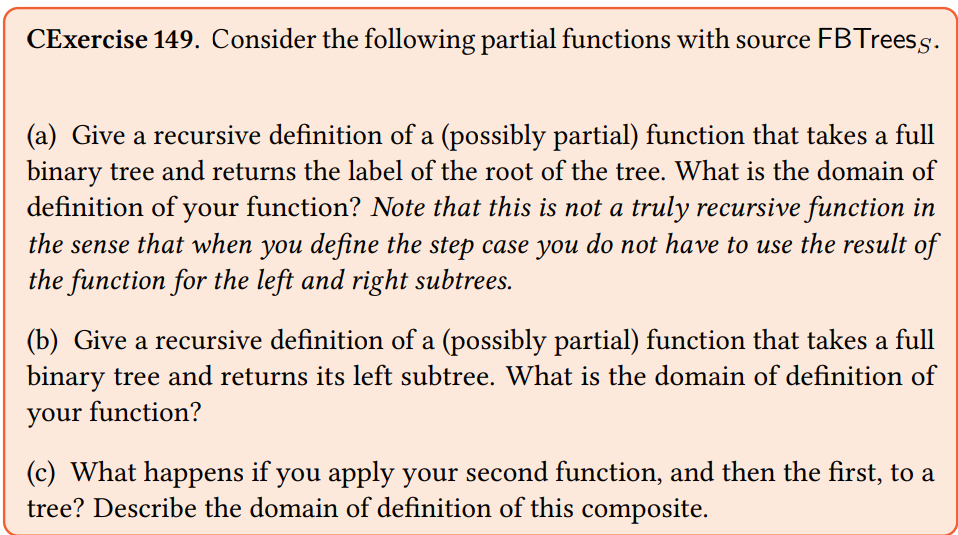
CExercise 149. Consider the following partial functions with source FB Treess. (a) Give a recursive definition of a (possibly partial) function that takes a full binary tree and returns the label of the root of the tree. What is the domain of definition of your function? Note that this is not a truly recursive function in the sense that when you define the step case you do not have to use the result of the function for the left and right subtrees. (b) Give a recursive definition of a (possibly partial) function that takes a full binary tree and returns its left subtree. What is the domain of definition of your function? (c) What happens if you apply your second function, and then the first, to a tree? Describe the domain of definition of this composite. CExercise 149. Consider the following partial functions with source FB Treess. (a) Give a recursive definition of a (possibly partial) function that takes a full binary tree and returns the label of the root of the tree. What is the domain of definition of your function? Note that this is not a truly recursive function in the sense that when you define the step case you do not have to use the result of the function for the left and right subtrees. (b) Give a recursive definition of a (possibly partial) function that takes a full binary tree and returns its left subtree. What is the domain of definition of your function? (c) What happens if you apply your second function, and then the first, to a tree? Describe the domain of definition of this composite
Step by Step Solution
There are 3 Steps involved in it

Get step-by-step solutions from verified subject matter experts
 Study Help