





Question: cf) 4. Continue with the setup in Question 3. However, now we do not observe wages con- ditional on types. Rather, we observe college going
cf) 4. Continue with the setup in Question 3.

cf)

cf) 4. Continue with the setup in Question 3.

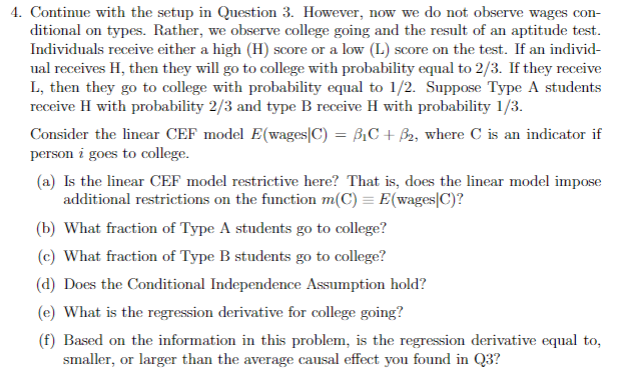
4. Continue with the setup in Question 3. However, now we do not observe wages con- ditional on types. Rather, we observe college going and the result of an aptitude test. Individuals receive either a high (H) score or a low (L) score on the test. If an individ- ual receives H, then they will go to college with probability equal to 2/3. If they receive L, then they go to college with probability equal to 1/2. Suppose Type A students receive H with probability 2/3 and type B receive H with probability 1/3. Consider the linear CEF model Ewages|C) = BC + B2, where C is an indicator if person i goes to college. (a) Is the linear CEF model restrictive here? That is, does the linear model impose additional restrictions on the function m(C)=E(wages|C)? (b) What fraction of Type A students go to college? c) What fraction of Type B students go to college? (d) Does the Conditional Independence Assumption hold? (e) What is the regression derivative for college going? (f) Based on the information in this problem, is the regression derivative equal to, smaller, or larger than the average causal effect you found in Q3? 3. Suppose there are two types of individuals in the population, A and B. Fifty percent of individuals in the population are type A. Type A individuals earn $15 as a high school graduate and $30 as a college graduate. Type B individuals earn $8 as a high school graduate and $12 as a college graduate

Step by Step Solution

There are 3 Steps involved in it

1 Expert Approved Answer
Step: 1 Unlock blur-text-image

Question Has Been Solved by an Expert!

Get step-by-step solutions from verified subject matter experts

Step: 2 Unlock
Step: 3 Unlock

Students Have Also Explored These Related General Management Questions!