







Question: Ch 0 3 : Assignment - Risk and Return: Part II 3 . The basics of the Capital Asset Pricing Model Which of the following
Ch : Assignment Risk and Return: Part II
The basics of the Capital Asset Pricing Model
Which of the following are assumptions of the Capital Asset Pricing Model CAPM Check all that apply.
Asset quantities are given and fixed.
Investors have homogeneous expectations.
Expected returns are based on individual investor risk sensitivity
All investors focus on a single holding period.
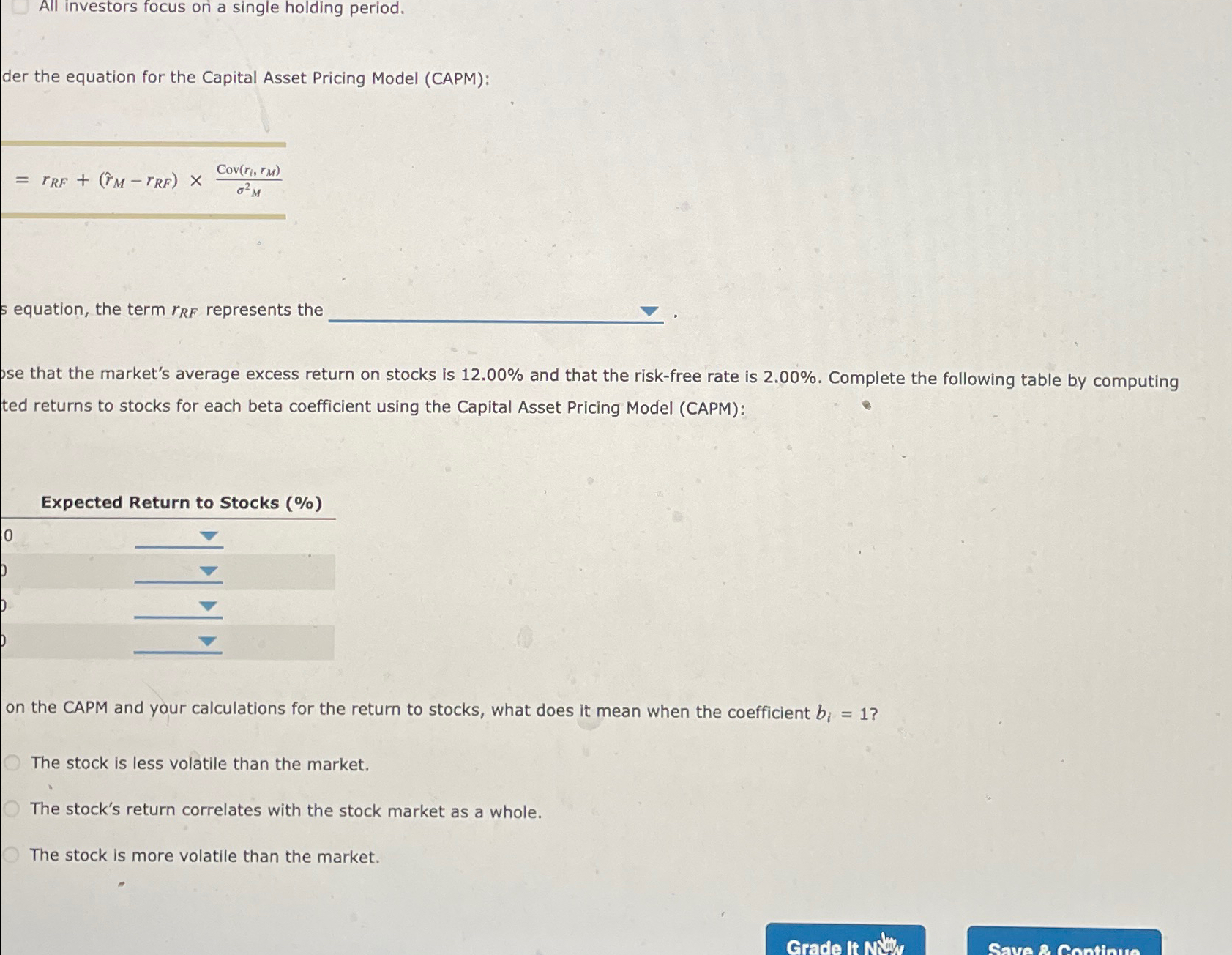
Consider the equation for the Capital Asset Pricing Model CAPM:
hat
In this equation, the term represents the
Suppose that the market's average excess return on stocks is and that the riskfree rate is Complete the following table by computing expected returns to stocks for each beta coefficient using the Capital Asset Pricing Model CAPM:
table Expected Return to Stocks
Based on the CAPM and your calculations for the return to stocks, what does it mean when the coefficient
All investors focus on a single holding period.
der the equation for the Capital Asset Pricing Model CAPM:
S equation, the term represents the
pse that the market's average excess return on stocks is and that the riskfree rate is Complete the following table by computing ted returns to stocks for each beta coefficient using the Capital Asset Pricing Model CAPM:
Expected Return to Stocks
on the CAPM and your calculations for the return to stocks, what does it mean when the coefficient
The stock is less volatile than the market.
The stock's return correlates with the stock market as a whole.
The stock is more volatile than the market.
Grade it Ndin,
Step by Step Solution
There are 3 Steps involved in it
1 Expert Approved Answer
Step: 1 Unlock

Question Has Been Solved by an Expert!
Get step-by-step solutions from verified subject matter experts
Step: 2 Unlock
Step: 3 Unlock
 Study Help