







Question: Ch 07: Assignment - Bonds and Their Valuation 2. Characteristics of bonds To be effective issuing and investing in bonds, knowledge of their terminology, characteristics,
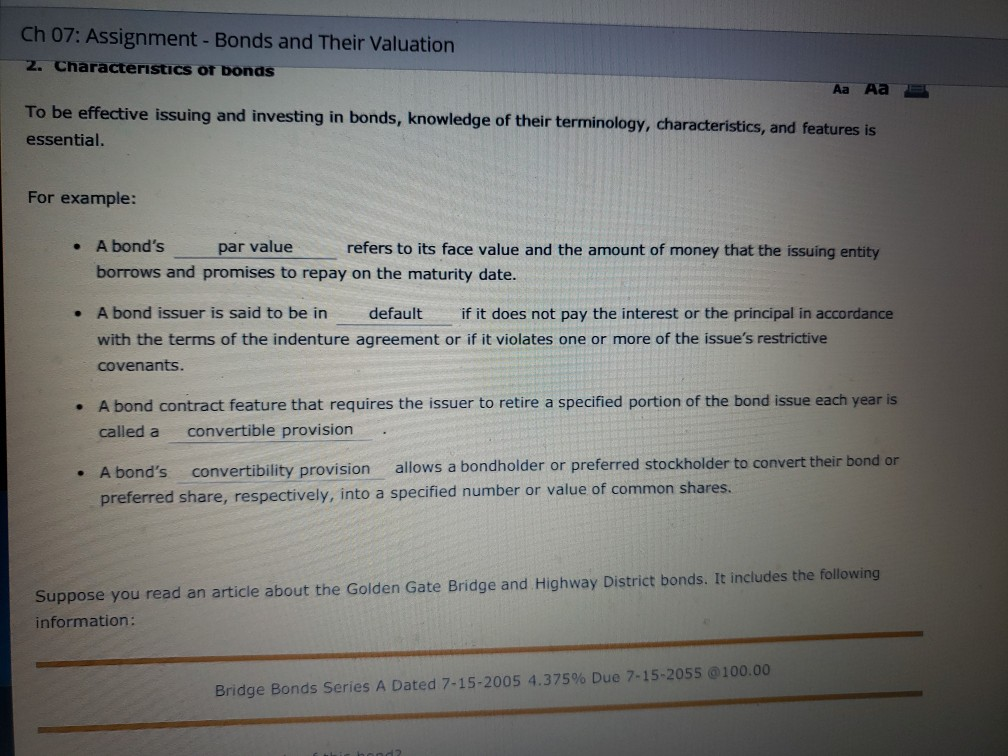
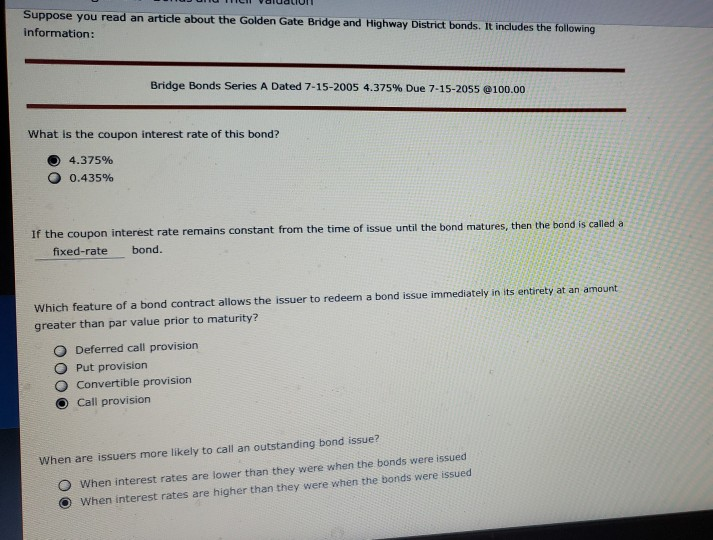
Ch 07: Assignment - Bonds and Their Valuation 2. Characteristics of bonds To be effective issuing and investing in bonds, knowledge of their terminology, characteristics, and features is essential. For example: par value A bond's refers to its face value and the amount of money that the issuing entity borrows and promises to repay on the maturity date. A bond issuer is said to be in default if it does not pay the interest or the principal in accordance with the terms of the indenture agreement or if it violates one or more of the issue's restrictive covenants. A bond contract feature that requires the issuer to retire a specified portion of the bond issue each year is called a convertible provision A bond's convertibility provision allows a bondholder or preferred stockholder to convert their bond or preferred share, respectively, into a specified number or value of common shares. Suppose you read an article about the Golden Gate Bridge and Highway District bonds. It includes the following information: Bridge Bonds Series A Dated 7-15-2005 4.375% Due 7-15-2055 @ 100.00 Suppose you read an article about the Golden Gate Bridge and Highway District bonds. It includes the following information: Bridge Bonds Series A Dated 7-15-2005 4.375% Due 7-15-2055 @100.00 What is the coupon interest rate of this bond? 4.375% 0.435% If the coupon interest rate remains constant from the time of issue until the bond matures, then the bond is called a fixed-rate bond. Which feature of a bond contract allows the issuer to redeem a bond issue immediately in its entirety at an amount greater than par value prior to maturity? Deferred call provision Put provision Convertible provision Call provision When are issuers more likely to call an outstanding bond issue? When interest rates are lower than they were when the bonds were issued When interest rates are higher than they were when the bonds were issued Ch 07: Assignment - Bonds and Their Valuation 2. Characteristics of bonds To be effective issuing and investing in bonds, knowledge of their terminology, characteristics, and features is essential. For example: par value A bond's refers to its face value and the amount of money that the issuing entity borrows and promises to repay on the maturity date. A bond issuer is said to be in default if it does not pay the interest or the principal in accordance with the terms of the indenture agreement or if it violates one or more of the issue's restrictive covenants. A bond contract feature that requires the issuer to retire a specified portion of the bond issue each year is called a convertible provision A bond's convertibility provision allows a bondholder or preferred stockholder to convert their bond or preferred share, respectively, into a specified number or value of common shares. Suppose you read an article about the Golden Gate Bridge and Highway District bonds. It includes the following information: Bridge Bonds Series A Dated 7-15-2005 4.375% Due 7-15-2055 @ 100.00 Suppose you read an article about the Golden Gate Bridge and Highway District bonds. It includes the following information: Bridge Bonds Series A Dated 7-15-2005 4.375% Due 7-15-2055 @100.00 What is the coupon interest rate of this bond? 4.375% 0.435% If the coupon interest rate remains constant from the time of issue until the bond matures, then the bond is called a fixed-rate bond. Which feature of a bond contract allows the issuer to redeem a bond issue immediately in its entirety at an amount greater than par value prior to maturity? Deferred call provision Put provision Convertible provision Call provision When are issuers more likely to call an outstanding bond issue? When interest rates are lower than they were when the bonds were issued When interest rates are higher than they were when the bonds were issued
Step by Step Solution
There are 3 Steps involved in it

Get step-by-step solutions from verified subject matter experts
 Study Help