







Question: Ch. 11 Transfer Pricing Example Division S and Division B are divisions within the same company. Both divisions are evaluated based on their own division's
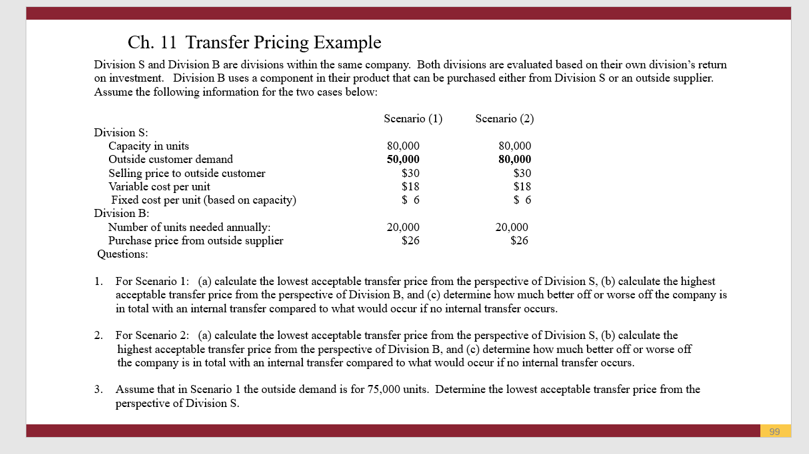
Ch. 11 Transfer Pricing Example Division S and Division B are divisions within the same company. Both divisions are evaluated based on their own division's return on investment. Division B uses a component in their product that can be purchased either from Division S or an outside supplier Assume the following information for the two cases below Scenario (1) Scenario (2) Division S Capacity in units Outside customer demand Selling price to outside customer Variable cost per unit Fixed cost per unit (based on capacity) 80,000 50,000 $30 80,000 80,000 S30 S18 S 6 $ 6 Division B Number of units needed annually: Purchase price from outside supplier 20,000 $26 20,000 $26 1. For Seenario 1: acceptable transfer price from the perspective of Division B, and (c) determine how much better off or worse off the company is in total with an internal transfer compared to what would occur if no internal transfer occurs. (a) calculate the lowest acceptable transfer price from the perspective of Division S, (b) caleulate the highest 2. For Scenario 2: highest acceptable transfer price from the perspective of Division B, and (c) determine how much better off or worse off the company is in total with an internal transfer compared to what would occur if no internal transfer occurs. (a) calculate the lowest acceptable transfer price from the perspective of Division S, (b) caleulate the 3. Assume that in Seenario 1 the outside demand is for 75,000 units. Determine the lowest acceptable transfer price from the perspective of Division S
Step by Step Solution
There are 3 Steps involved in it

Get step-by-step solutions from verified subject matter experts
 Study Help