







Question: Ch 14- End-of-Chapter Problems - Capital Structure and Leverage Rece uIE 3. Problem 14.05 (Financial Leverage Effects) eBook Firms HL and LL are identical except
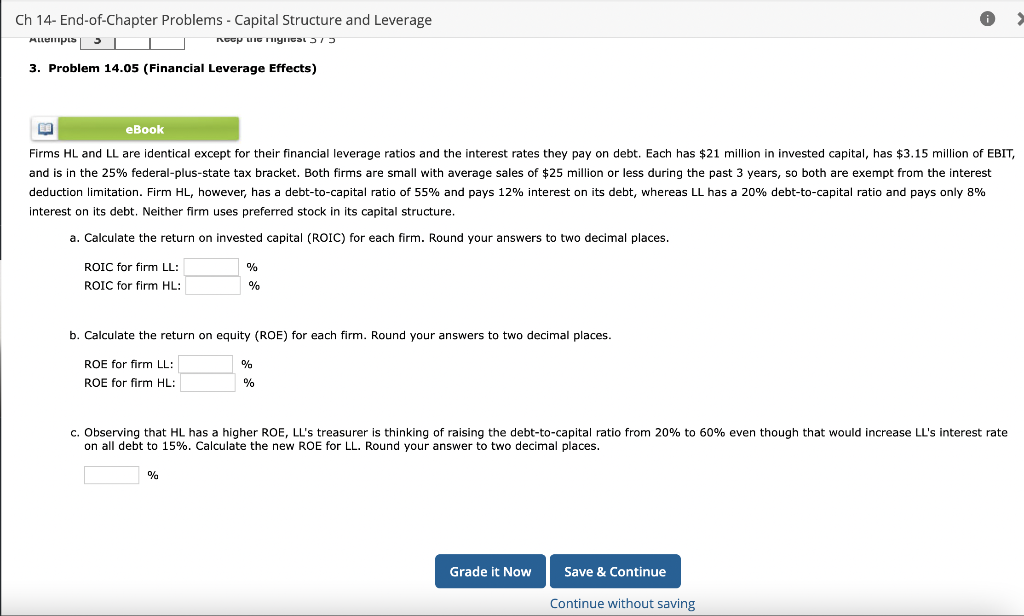
Ch 14- End-of-Chapter Problems - Capital Structure and Leverage Rece uIE 3. Problem 14.05 (Financial Leverage Effects) eBook Firms HL and LL are identical except for their financial leverage ratios and the interest rates they pay on debt. Each has $21 million in invested capital, has $3.15 million of EBIT, and is in the 25% federal-plus-state tax bracket. Both firms are small with average sales of $25 million or less during the past 3 years, so both are exempt from the interest deduction limitation. Firm HL, however, has a debt-to-capital ratio of 55% and pays 12% interest on its debt, whereas LL has a 20% debt-to-capital ratio and pays only 8% interest on its debt. Neither firm uses preferred stock in its capital structure. a. Calculate the return on invested capital (ROIC) for each firm. Round your answers to two decimal places. % ROIC for firm LL: ROIC for firm HL: % b. Calculate the return on equity (ROE) for each firm. Round your answers to two decimal places. % ROE for firm LL: ROE for firm HL: % c. Observing that HL has a higher ROE, LL's treasurer is thinking of raising the debt-to-capital ratio from 20% to 60% even though that would increase LL's interest rate on all debt to 15%. Calculate the new ROE for LL. Round your answer to two decimal places. % Grade it Now Save & Continue Continue without saving
Step by Step Solution
There are 3 Steps involved in it

Get step-by-step solutions from verified subject matter experts
 Study Help