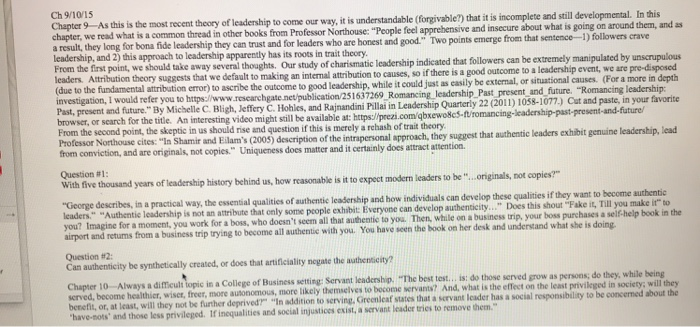
Ch 9/10/15 Chapter 9 As this is the most recent theory of leadership to come our way, it is understandable (forgivable?) that it is incomplete and still developmental. In this chapter, we read what is a common thread in other books from Professor Northouse: "People feel apprehensive and insecure about what is going on around them, and as a result, they long for bona fide leadership they can trust and for leaders who are honest and good. Two points emerge from that sentence-1) followers crave leadership, and 2) this approach to leadership apparently has its roots in trait theory From the first point, we should take away several thoughts. Our study of charismatic leadership indicated that followers can be extremely manipulated by unscrupulous leaders. Attribution theory suggests that we default to making an internal attribution to causes, so if there is a good outcome to a leadership event, we are pre-disposed (due to the fundamental attribution crror) to ascribe the outcome to good leadership, while it could just as easily be external, or situational causes. (For a more in depth investigation, I would refer you to https://www.researchgate.net/publication/251637269 Romancing, leadership Past_present_and_future. "Romancing leadership Past, present and future." By Michelle C. Bligh, Jeffery C. Hohles, and Rajnandini Pillai in Leadership Quarterly 22 (2011) 1058-1077.) Cut and paste, in your favorite browser, or search for the title. An interesting video might still be available at: https://prezi.com/qbxewo8c5-ft/romancing-leadership-past-present and future From the second point, the deepte in us should rise and question if this is merely a rehash of trail theory Professor Northouse cites: "In Shamir and Filam's (2005) description of the intrapersonal approach, they suggest that authentic leaders exhibit genuine leadership, lead from conviction, and are originals, not copies. Uniqueness does matter and it certainly does attract attention Question 1: With five thousand years of leadership history behind us, how reasonable is it to expect modern leaders to be " originals, not copies?" "George describes, in a practical way, the essential qualities of authentic leadership and how individuals can develop these qualities if they want to become authentic leaders. "Authentic leadership is not an attribute that only some people exhibit: Everyone can develop authenticity..." Does this shout "Fake it, Till you make it to you? Imagine for a moment, you work for a boss, who doesn't seem all that authentie to you. Then, while on a business trip your boss purchases a self-help book in the airport and returns from a business trip trying to become all authentic with you. You have seen the book on her desk and understand what she is doing Question 2: Can authenticity be synthetically created, or does that artificiality negate the authenticity? Chapter 10 - Always a difficult topic in a College of Business setting Servant leadership. "The best test... I do those served grow as persons; do they, while being served, become healthier, wiser, freer, more autonomous, more likely themselves to become ant? And, what is the effect on the least privileged in society, will they benefit, or, at least, will they not be further deprived" "In addition to serving Greenleaf states that a servant leader has a social responsibility to be concerned about the "have-bots and those less privileged. Ir inequalities and social injustices exista servant leder tries to remove them