







Question: (Ch12-prob set-Q10) Background info: This study has 21 kids without sleep apnea, 21 children w/untreated sleep apnea, & 21 children who have been surgically treated
(Ch12-prob set-Q10) Background info: This study has 21 kids without sleep apnea, 21 children w/untreated sleep apnea, & 21 children who have been surgically treated for sleep apnea. Note: lack of attention is measured using the "Conners rating scales". (1) answer selections for 1st & 2nd blue drop down: 0.17/ 0.00/ 0.13(2) answer selections for the 4th, 5th, & 6th drop down: cannot / can Answer all questions (7 total).
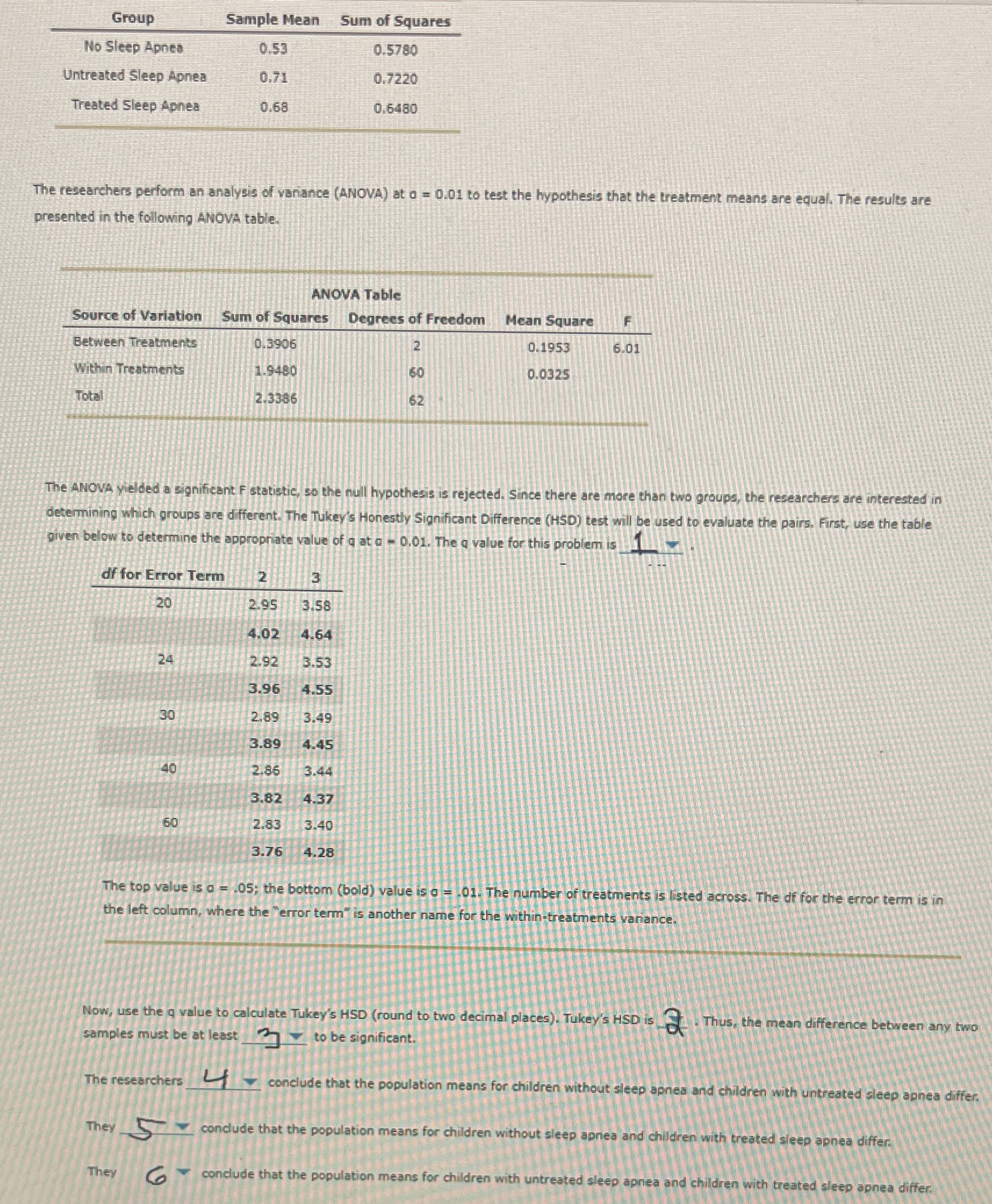
Group Sample Mean Sum of Squares No Sleep Apnea 0.53 0.5780 Untreated Sleep Apnea 0.71 0.7220 Treated Sleep Apnea 0.68 0.6480 The researchers perform an analysis of variance (ANOVA) at o = 0.01 to test the hypothesis that the treatment means are equal. The results are presented in the following ANOVA table. ANOVA Table Source of Variation Sum of Squares Degrees of Freedom Mean Square Between Treatments 0.3906 2 0.1953 6/01 Within Treatments 1.9480 60 0.0325 Total 2.3386 62 The ANOVA yielded a significant F statistic, so the null hypothesis is rejected. Since there are more than two groups, the researchers are interested in determining which groups are different. The Tukey's Honestly Significant Difference (HSD) test will be used to evaluate the pairs. First, use the table given below to determine the appropriate value of a at a - 0.01. The a value for this problem Is df for Error Term 2 13 20 2.95 3.58 1.02 4.64 24 2192 3.53 3.96 1.55 30 2.89 3.49 3.89 4.45 40 2.86 3.44 3.82 4.37 60 2.83 3.40 3.76 4.28 The top value is a = .05; the bottom (bold) value is o - 1 01. The number of treatments is the left column, where the "error term" is another name for Now, use the q value to calculate Tukey's HSD (round to two decimal places). Tukey's HSD S LE Thus. t samples must be at least 2to be significant. The researchers conclude that the pop lation means for childr iffer. They conclude that the p They conclude that the population means for children with untreated sleep apnea and children with treated sleep apnea differ
Step by Step Solution
There are 3 Steps involved in it

Get step-by-step solutions from verified subject matter experts
 Study Help