







Question: CH3Cl (solv) + Br (solv) = CH3Br (solv) + Cl (solv) This reaction is a common example of an organic substitution reaction, typically carried out
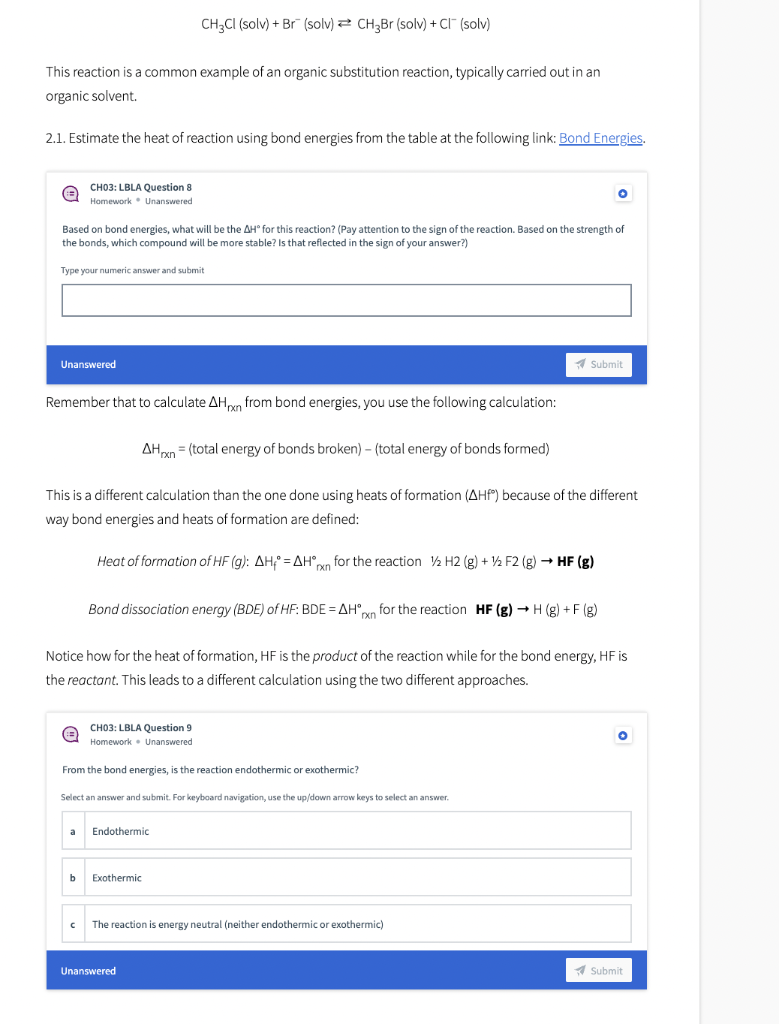
CH3Cl (solv) + Br" (solv) = CH3Br (solv) + Cl (solv) This reaction is a common example of an organic substitution reaction, typically carried out in an organic solvent 2.1. Estimate the heat of reaction using bond energies from the table at the following link: Bond Energies. CH03: LBLA Question 8 Homework.Unanswered o Based on bond energies, what will be the AH for this reaction? (Pay attention to the sign of the reaction. Based on the strength of the bonds, which compound will be more stable? Is that reflected in the sign of your answer?) Type your numeric answer and submit Unanswered Submit Remember that to calculate AH,xn from bond energies, you use the following calculation: AHrxn = (total energy of bonds broken) (total energy of bonds formed) This is a different calculation than the one done using heats of formation (AHP) because of the different way bond energies and heats of formation are defined: Heat of formation of HF (g): AH' =AHxn for the reaction 7 H2(g) + 1 F2 (g) + HF (g) Bond dissociation energy (BDE) of HE: BDE = AH/xn for the reaction HF (g) H(g) +F (g) Notice how for the heat of formation, HF is the product of the reaction while for the bond energy, HF is the reactant. This leads to a different calculation using the two different approaches. CH03: LBLA Question 9 Homework. Unanswered o From the bond energies, is the reaction endothermic or exothermic? Select an answer and submit. For keyboard navigation, use the up/down arrow keys to select an answer. a Endothermic b Exothermic The reaction is energy neutral (neither endothermic or exothermic) Unanswered Submit
Step by Step Solution
There are 3 Steps involved in it

Get step-by-step solutions from verified subject matter experts
 Study Help