Question: Ch5 Tax Return Assignment (Part 2) Required information [The following information applies to the questions displayed below.] XYZ is a calendar-year corporation that began business
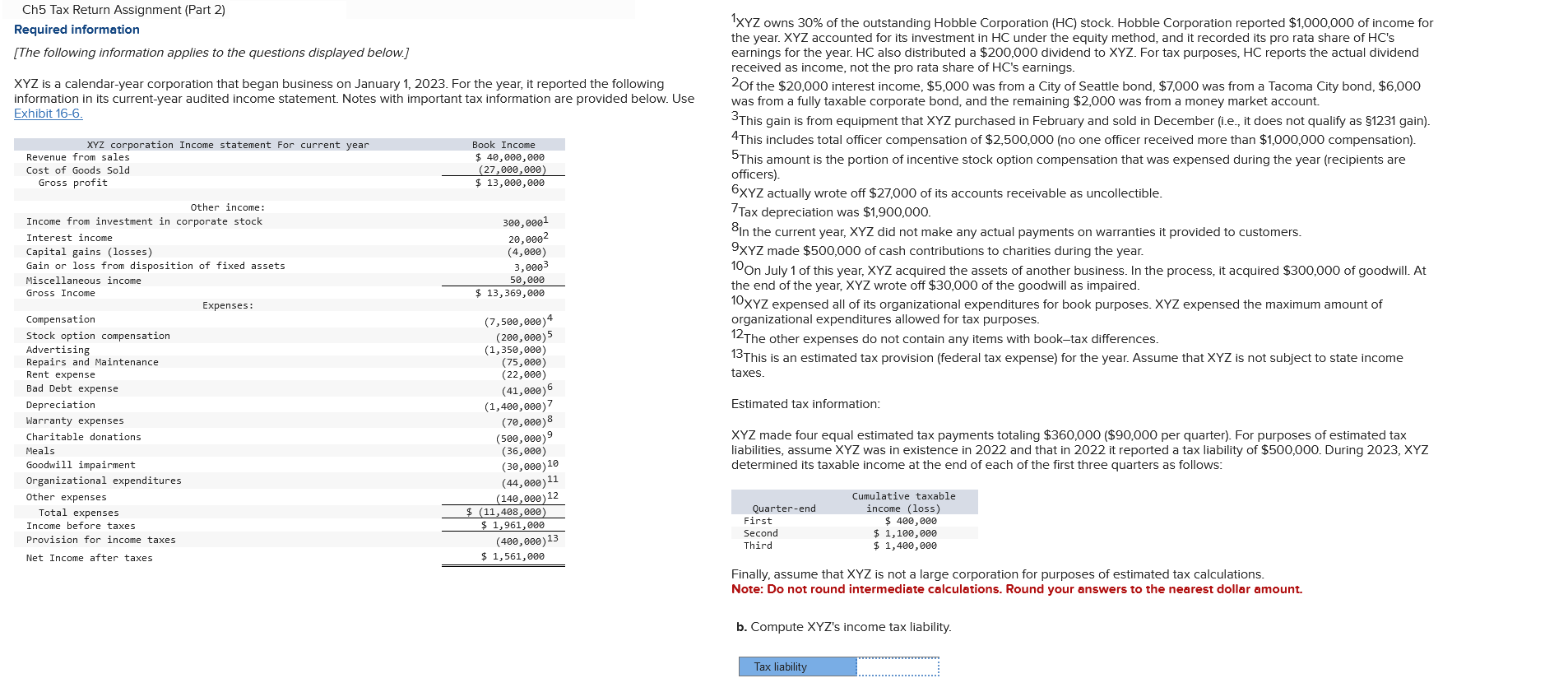
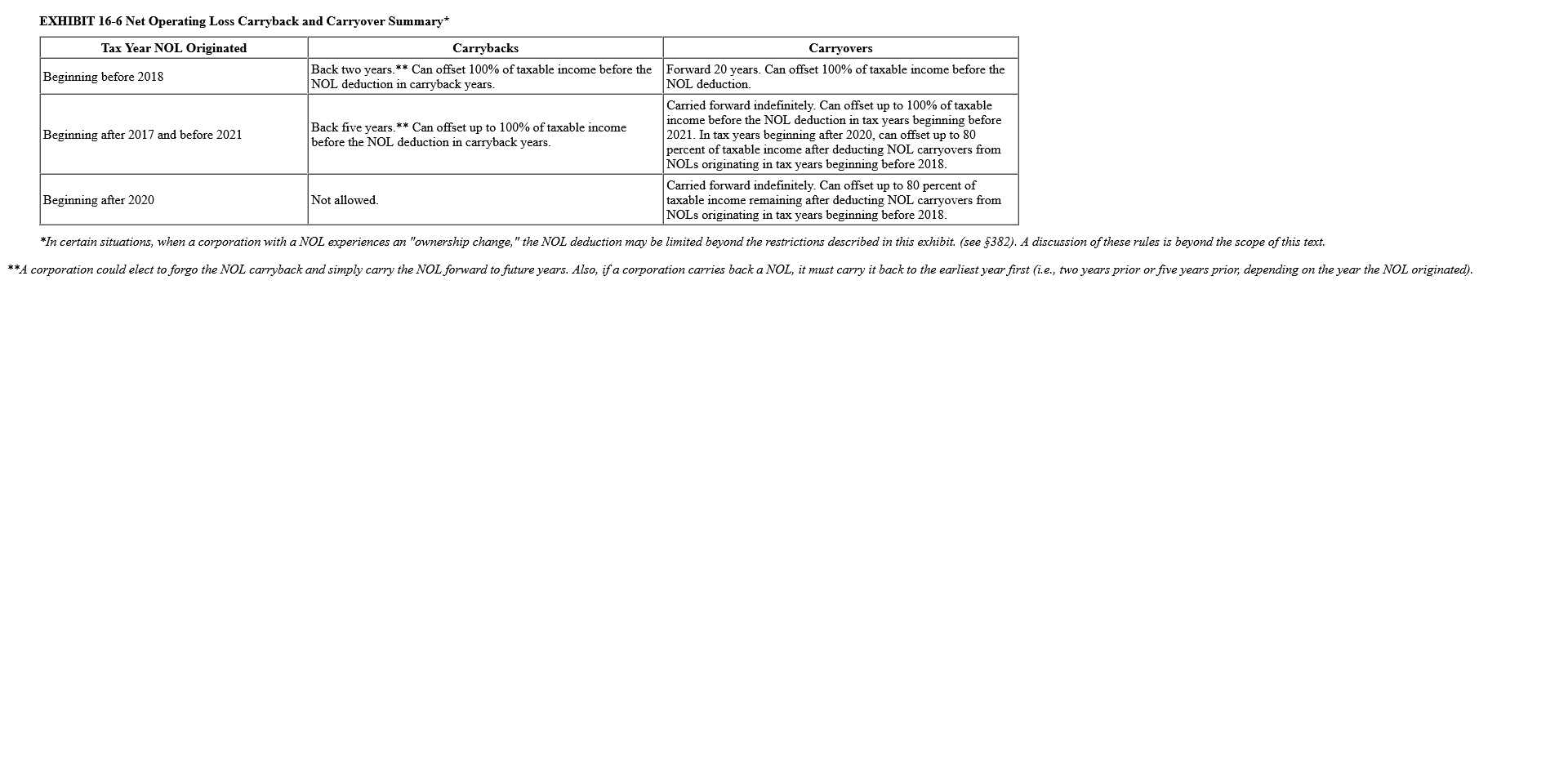
Ch5 Tax Return Assignment (Part 2) Required information [The following information applies to the questions displayed below.] XYZ is a calendar-year corporation that began business on January 1, 2023. For the year, it reported the following information in its current-year audited income statement. Notes with important tax information are provided below. Use Exhibit 16-6. XYZ corporation Income statement For current year Revenue from sales Cost of Goods Sold Gross profit Other income: Income from investment in corporate stock Interest income Capital gains (losses) Gain or loss from disposition of fixed assets Miscellaneous income Gross Income Expenses: Compensation Stock option compensation Advertising Repairs and Maintenance Rent expense Bad Debt expense Depreciation uarranty expenses Charitable donations Meals Goodwill impairment Organizational expenditures Other expenses Total expenses Income before taxes Provision for income taxes Net Income after taxes Book Income $ 48,000,000 27,000,000) $ 13,000,000 300, 6061 20, 0007 (4,000) 3,e00% 50,008 $ 13,369,000 (7,580, 800)* (200,000)> (1,350,400) (75,000) (22,000) (41,000) (1,408,800)7 (70,000)8 (500,000)% (35,000) (30,000)12 (a4,000) 11 (140,000)12 5 (11,405,000) 5 1,961,000 (400, 000) 13 5 1,561,000 1XYZ owns 30% of the outstanding Hobble Corporation (HC) stock. Hobble Corporation reported $1,000,000 of income for the year. XYZ accounted for its investment in HC under the equity method, and it recorded its pro rata share of HC's. earnings for the year. HC also distributed a $200,000 dividend to XYZ. For tax purposes, HC reports the actual dividend received as income, not the pro rata share of HC's earnings. 20f the $20.000 interest income, $5.000 was from a City of Seattle bond, $7.000 was from a Tacoma City bond, $6.000 was from a fully taxable corporate bond, and the remaining $2,000 was from a meney market account. 3This gain is from equipment that XYZ purchased in February and sold in December (i, it does not qualify as 1231 gain). 4This includes total efficer compensation of $2,500,000 (no one officer received more than $1,000,000 compensation). SThis amount is the portion of incentive stock option compensation that was expensed during the year (recipients are officers). Sxyz actually wrote off $27,000 of its accounts receivable as uncollectible. TTax depreciation was $1,900,000. 81 the current year, XYZ did not make any actual payments on warranties it provided to customers. 9%YZ made $500,000 of cash contributions to charities during the year. 100n July 1 of this year, XYZ acquired the assets of another business. In the process, it acquired $300,000 of goodwill. At the end of the year, XYZ wrote off $30,000 of the goodwill as impaired. 10xvz expensed all of its organizational expenditures for book purposes. XYZ expensed the maximum amount of organizational expenditures allowed for tax purposes. 12The other expenses do not contain any items with booktax differences. 13This is an estimated tax provision (federal tax expense) for the year. Assume that XYZ is not subject to state income taxes. Estimated tax information: XYZ made four equal estimated tax payments totaling $360,000 ($90,000 per quarter). For purposes of estimated tax liabilities, assume XYZ was in existence in 2022 and that in 2022 it reported a tax liability of $500,000. During 2023, XYZ determined its taxable income at the end of each of the first three quarters as follows: Cumulative taxable Quarter-end income (loss) First 5 400,000 Second % 1,100,008 Third 5 1,400,000 Finally, assume that XYZ is not a large corporation for purposes of estimated tax calculations. Note: Do not round intermediate calculations. Round your answers to the nearest dollar amount. b. Compute XYZ's income tax liability. EXHIBIT 16-6 Net Operating Loss Carryback and Carryover Summary* Tax Year NOL Originated Carrybacks Carryover Beginning before 2018 Back two years.** Can offset 100% of taxable income before the Forward 20 years. Can offset 100% of taxable income before the NOL deduction in carryback years. NOL deduction Carried forward indefinitely. Can offset up to 100% of taxable Back five years.** Can offset up to 100% of taxable income income before the NOL deduction in tax years beginning before Beginning after 2017 and before 2021 before the NOL deduction in carryback years. 2021. In tax years beginning after 2020, can offset up to 80 percent of taxable income after deducting NOL carryovers from NOLs originating in tax years beginning before 2018. Carried forward indefinitely. Can offset up to 80 percent of Beginning after 2020 Not allowed. taxable income remaining after deducting NOL carryovers from NOLs originating in tax years beginning before 2018 *In certain situations, when a corporation with a NOL experiences an "ownership change, " the NOL deduction may be limited beyond the restrictions described in this exhibit. (see $382). A discussion of these rules is beyond the scope of this text. **A corporation could elect to forgo the NOL carryback and simply carry the NOL forward to future years. Also, if a corporation carries back a NOL, it must carry it back to the earliest year first (i.e., two years prior or five years prior, depending on the year the NOL originated)
Step by Step Solution
There are 3 Steps involved in it
1 Expert Approved Answer
Step: 1 Unlock
Question Has Been Solved by an Expert!
Get step-by-step solutions from verified subject matter experts
Step: 2 Unlock
Step: 3 Unlock
Students Have Also Explored These Related Accounting Questions!









 Study Help