







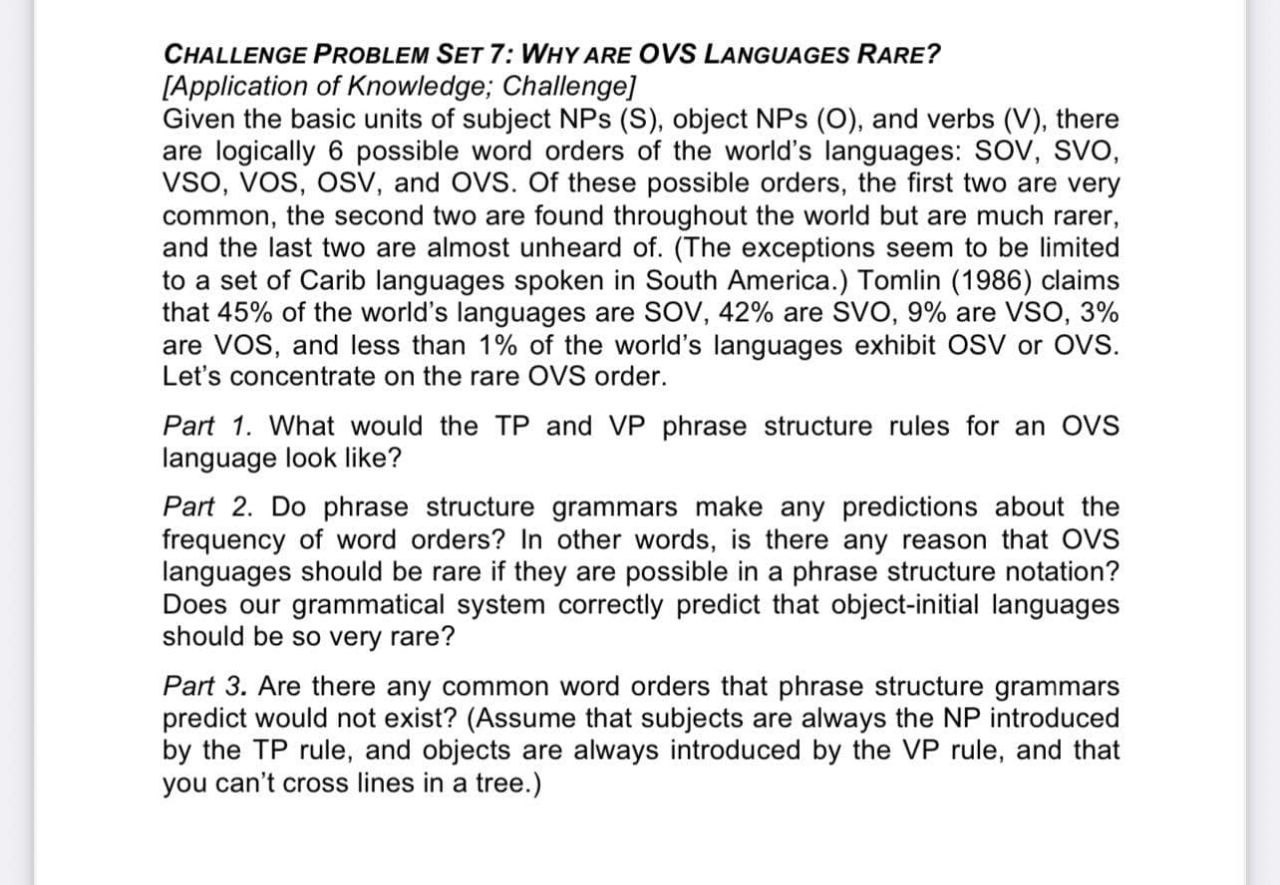
Question: Challenge Problem Set 7 : Why are OVS Languages Rare? [ Application of Knowledge; Challenge ] Given the basic units of subject NPs ( S
Challenge Problem Set : Why are OVS Languages Rare?
Application of Knowledge; Challenge Given the basic units of subject NPs S object NPs O and verbs V there are logically possible word orders of the world's languages: SOV, SVO, VSO, VOS, OSV, and OVS. Of these possible orders, the first two are very common, the second two are found throughout the world but are much rarer, and the last two are almost unheard ofThe exceptions seem to be limited to a set of Carib languages spoken in South America. Tomlin claims that of the world's languages are SOV, are SVO, are VSO, are VOS, and less than of the world's languages exhibit OSV or OVS. Let's concentrate on the rare OVS order.
Part What would the TP and VP phrase structure rules for an OVS language look like?
Part Do phrase structure grammars make any predictions about the frequency of word orders? In other words, is there any reason that OVS languages should be rare if they are possible in a phrase structure notation? Does our grammatical system correctly predict that objectinitial languages should be so very rare?
Part Are there any common word orders that phrase structure grammars predict would not exist? Assume that subjects are always the NP introduced by the TP rule, and objects are always introduced by the VP rule, and that you can't cross lines in a tree.
Step by Step Solution
There are 3 Steps involved in it
1 Expert Approved Answer
Step: 1 Unlock

Question Has Been Solved by an Expert!
Get step-by-step solutions from verified subject matter experts
Step: 2 Unlock
Step: 3 Unlock
 Study Help