







Question: Challenge Task: Process Tree Creator Example Flow User Input: If the user inputs n = 2 , the expected process tree structure would be: Descriptive
Challenge Task: Process Tree Creator Example Flow
User Input:
If the user inputs the expected process tree structure would be:
Descriptive Steps to Implement the Solution
Prompt for Input:
Start by prompting the user to enter an integer for the depth of the process tree.
Create a Recursive Function:
Define a recursive function, createprocesstree int depth that will
handle the creation of processes.
If depth is equal to this indicates a leaf process, where you will print the PID
and PPID and execute the command using execl
Forking Processes:
For nonleaf processes where depthn the output should look similar :
Enter the depth the process tree:
Process PID: Parent PID:
Process PID: Parent PID:
Process PID: Parent PID:
Note: The actual PIDs will vary with each execution.
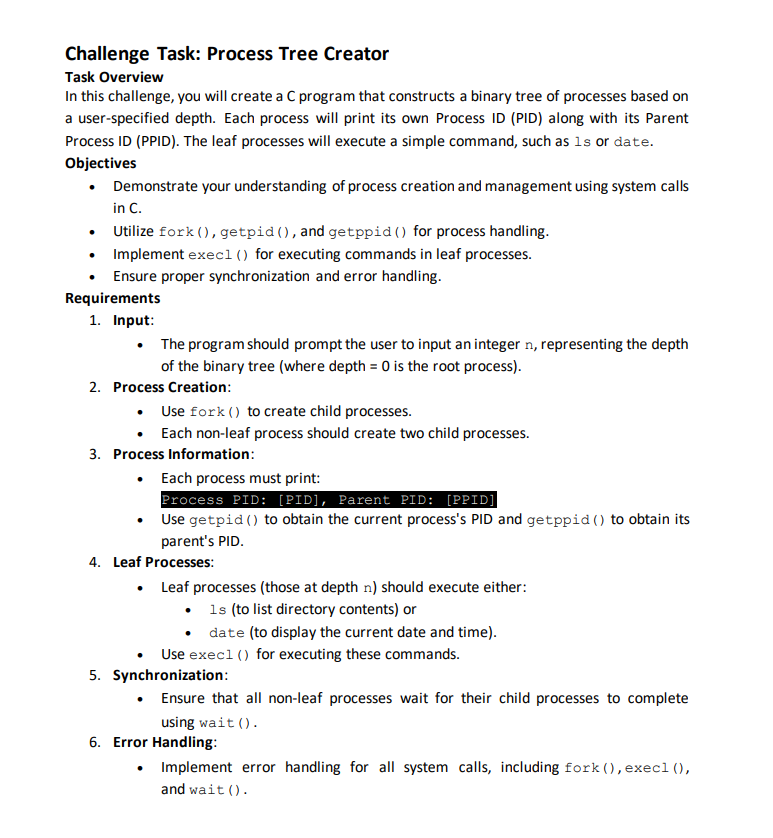
Task Overview
In this challenge, you will create a C program that constructs a binary tree of processes based on
a userspecified depth. Each process will print its own Process ID PID along with its Parent
Process ID PPID The leaf processes will execute a simple command, such as is or date.
Objectives
Demonstrate your understanding of process creation and management using system calls
in C
Utilize fork getpid and getppid for process handling.
Implement execl for executing commands in leaf processes.
Ensure proper synchronization and error handling.
Requirements
Input:
The program should prompt the user to input an integer n representing the depth
of the binary tree where depth is the root process
Process Creation:
Use fork to create child processes.
Each nonleaf process should create two child processes.
Process Information:
Each process must print:
Process PID: PID Parent PID: PPID
Use getpid to obtain the current process's PID and getppid to obtain its
parent's PID.
Leaf Processes:
Leaf processes those at depth should execute either:
Is to list directory contents or
date to display the current date and time
Use execl for executing these commands.
Synchronization:
Ensure that all nonleaf processes wait for their child processes to complete
using wait
Error Handling:
Implement error handling for all system calls, including fork execl
and wait
Step by Step Solution
There are 3 Steps involved in it
1 Expert Approved Answer
Step: 1 Unlock

Question Has Been Solved by an Expert!
Get step-by-step solutions from verified subject matter experts
Step: 2 Unlock
Step: 3 Unlock
 Study Help