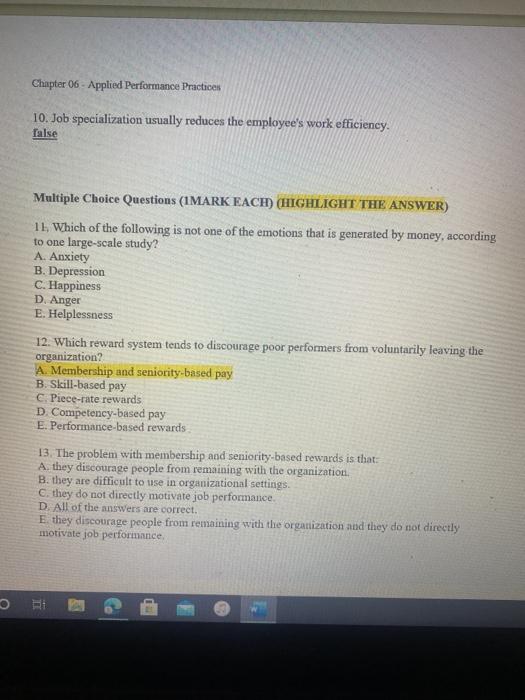
Question: Chapter 06 - Applied Performance Practices 10. Job specialization usually reduces the employee's work efficiency. false Multiple Choice Questions (IMARK EACH) (HIGHLIGHT THE ANSWER) 11.
Chapter 06 - Applied Performance Practices 10.
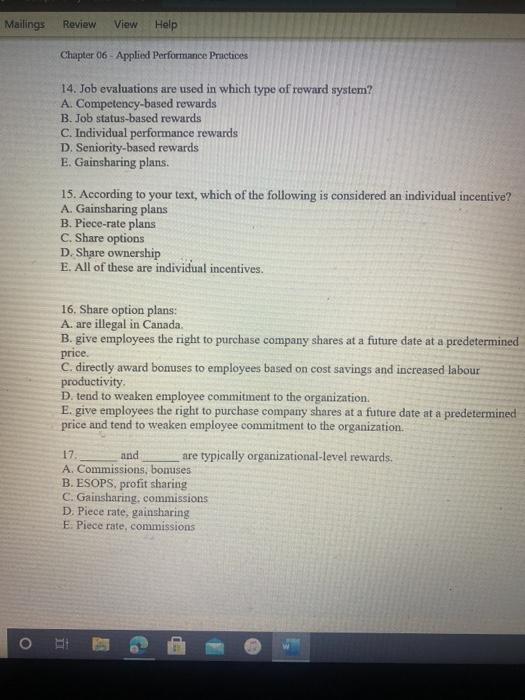
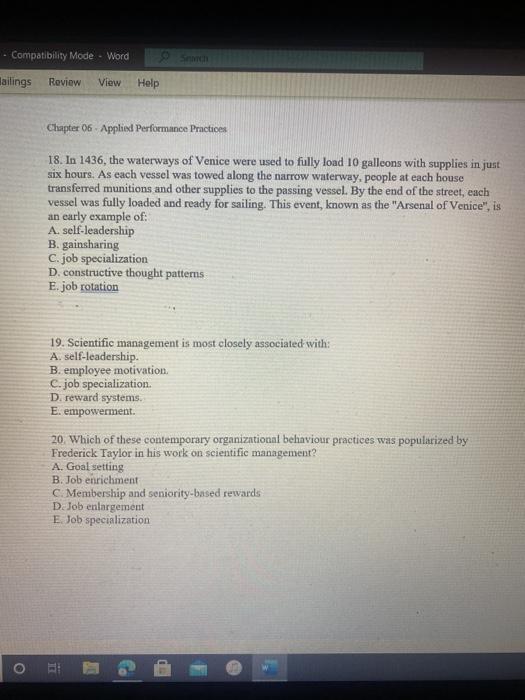
Chapter 06 - Applied Performance Practices 10. Job specialization usually reduces the employee's work efficiency. false Multiple Choice Questions (IMARK EACH) (HIGHLIGHT THE ANSWER) 11. Which of the following is not one of the emotions that is generated by money, according to one large-scale study? A. Anxiety B. Depression C. Happiness D. Anger E. Helplessness 12. Which reward system tends to discourage poor performers from voluntarily leaving the organization? A. Membership and seniority-based pay B. Skill-based pay C. Piece-rate rewards D. Competency-based pay E. Performance-based rewards 13. The problem with membership and seniority-based rewards is that: A. they discourage people from remaining with the organization. B. they are difficult to use in organizational settings. C. they do not directly motivate job performance D. All of the answers are correct. E they discourage people from remaining with the organization and they do not directly motivate job performance o D EI Mailings Review View Help Chapter 06 - Applied Performance Practices 14. Job evaluations are used in which type of reward system? A. Competency-based rewards B. Job status-based rewards C. Individual performance rewards D. Seniority-based rewards E. Gainsharing plans. 15. According to your text, which of the following is considered an individual incentive? A. Gainsbaring plans B. Piece-rate plans C. Share options D. Share ownership E. All of these are individual incentives. 16. Share option plans: A. are illegal in Canada. B. give employees the right to purchase company shares at a future date at a predetermined price. C. directly award bonuses to employees based on cost savings and increased labour productivity D. tend to weaken employee commitment to the organization. E. give employees the right to purchase company shares at a future date at a predetermined price and tend to weaken employee commitment to the organization. 17. and are typically organizational-level rewards. A. Commissions, bonuses B.ESOPS, profit sharing C. Gainsharing, commissions D. Piece rate, gainsharing E Piece rate, commissions - Compatibility Mode - Word Mailings Review View Help Chapter 06. Applied Performance Practices 18. In 1436, the waterways of Venice were used to fully load 10 galloons with supplies in just six hours. As each vessel was towed along the narrow waterway, people at each house transferred munitions and other supplies to the passing vessel. By the end of the street, each vessel was fully loaded and ready for sailing. This event, known as the "Arsenal of Venice", is an early example of: A. self-leadership B. gainsharing C.job specialization D. constructive thought patterns E.job rotation 19. Scientific management is most closely associated with: A. self-leadership B. employee motivation C.job specialization D. reward systems E. empowerment 20 Which of these contemporary organizational behaviour practices was popularized by Frederick Taylor in his work on scientific management? A. Goal setting B. Job enrichment Membership and seniority-based rewards D. Job enlargement E. Job specialization mpatibility Mode - Word 35 Review View Help 6-4 Chapter 06 - Applied Performance Practices Short Discussion Question (5 marks each) 1. How might job specialization adversely affect employee attitudes and motivation? 2. Discuss the benefits of job rotation in a manufacturing plant O
Step by Step Solution

There are 3 Steps involved in it

1 Expert Approved Answer
Step: 1 Unlock blur-text-image

Question Has Been Solved by an Expert!

Get step-by-step solutions from verified subject matter experts

Step: 2 Unlock
Step: 3 Unlock

Students Have Also Explored These Related General Management Questions!