







Question: Chapter 1 1 The Uniform Plane Wave | Problem Set | P 1 . The electric field of an electromagnetic wave propagating through air without
Chapter The Uniform Plane Wave
Problem Set
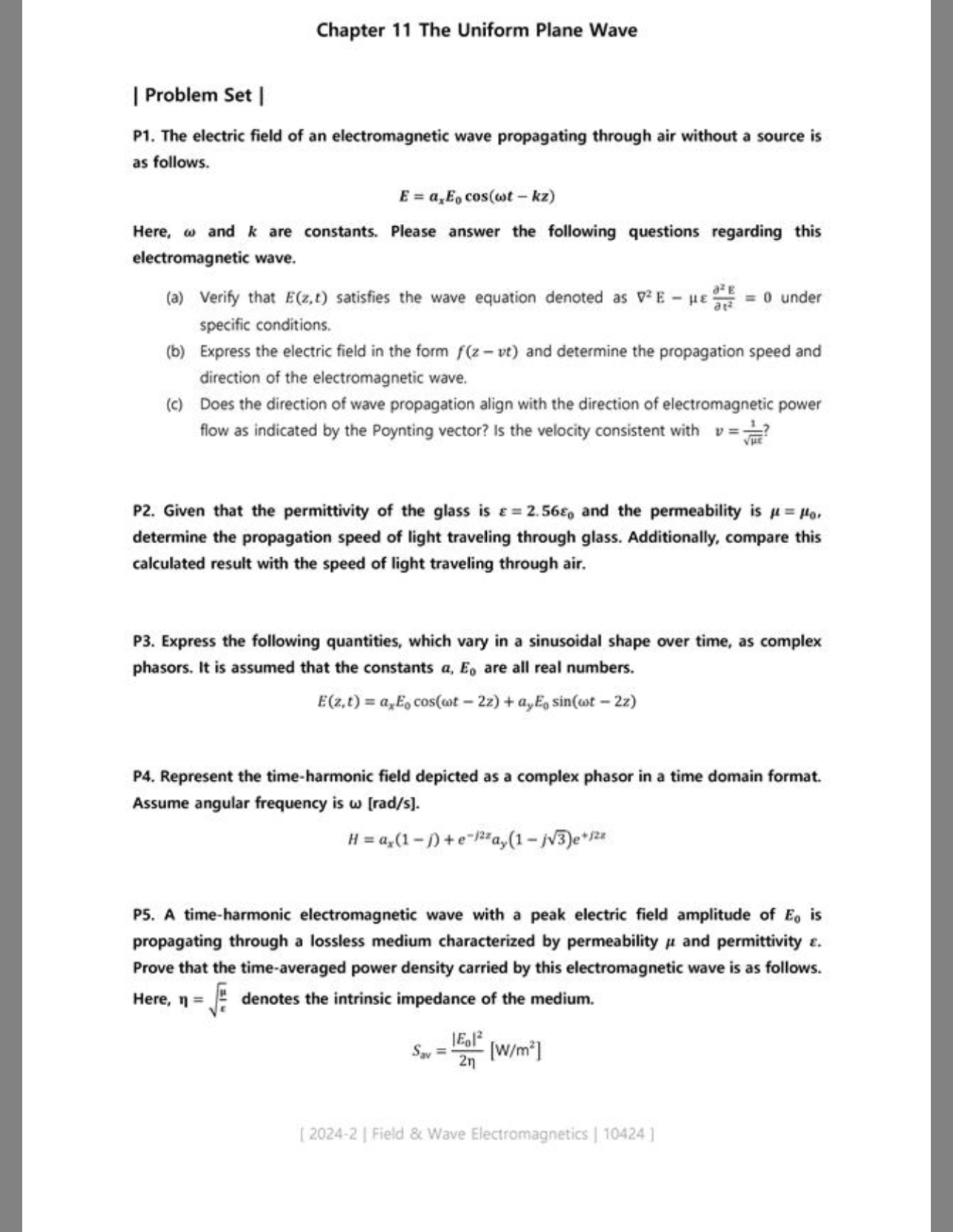
P The electric field of an electromagnetic wave propagating through air without a source is as follows.
Here, and are constants. Please answer the following questions regarding this electromagnetic wave.
a Verify that satisfies the wave equation denoted as under specific conditions.
b Express the electric field in the form and determine the propagation speed and direction of the electromagnetic wave.
c Does the direction of wave propagation align with the direction of electromagnetic power flow as indicated by the Poynting vector? Is the velocity consistent with
P Given that the permittivity of the glass is and the permeability is determine the propagation speed of light traveling through glass. Additionally, compare this calculated result with the speed of light traveling through air.
P Express the following quantities, which vary in a sinusoidal shape over time, as complex phasors. It is assumed that the constants are all real numbers.
P Represent the timeharmonic field depicted as a complex phasor in a time domain format. Assume angular frequency is
P A timeharmonic electromagnetic wave with a peak electric field amplitude of is propagating through a lossless medium characterized by permeability and permittivity Prove that the timeaveraged power density carried by this electromagnetic wave is as follows. Here, denotes the intrinsic impedance of the medium.
Field & Wave Electromagnetics
Step by Step Solution
There are 3 Steps involved in it
1 Expert Approved Answer
Step: 1 Unlock

Question Has Been Solved by an Expert!
Get step-by-step solutions from verified subject matter experts
Step: 2 Unlock
Step: 3 Unlock
 Study Help