







Question: Chapter 1 Linear Motion Review: Free Fall, Going-Up 1. In the absence of air resistance which object will hit the floor first, a heavy object,
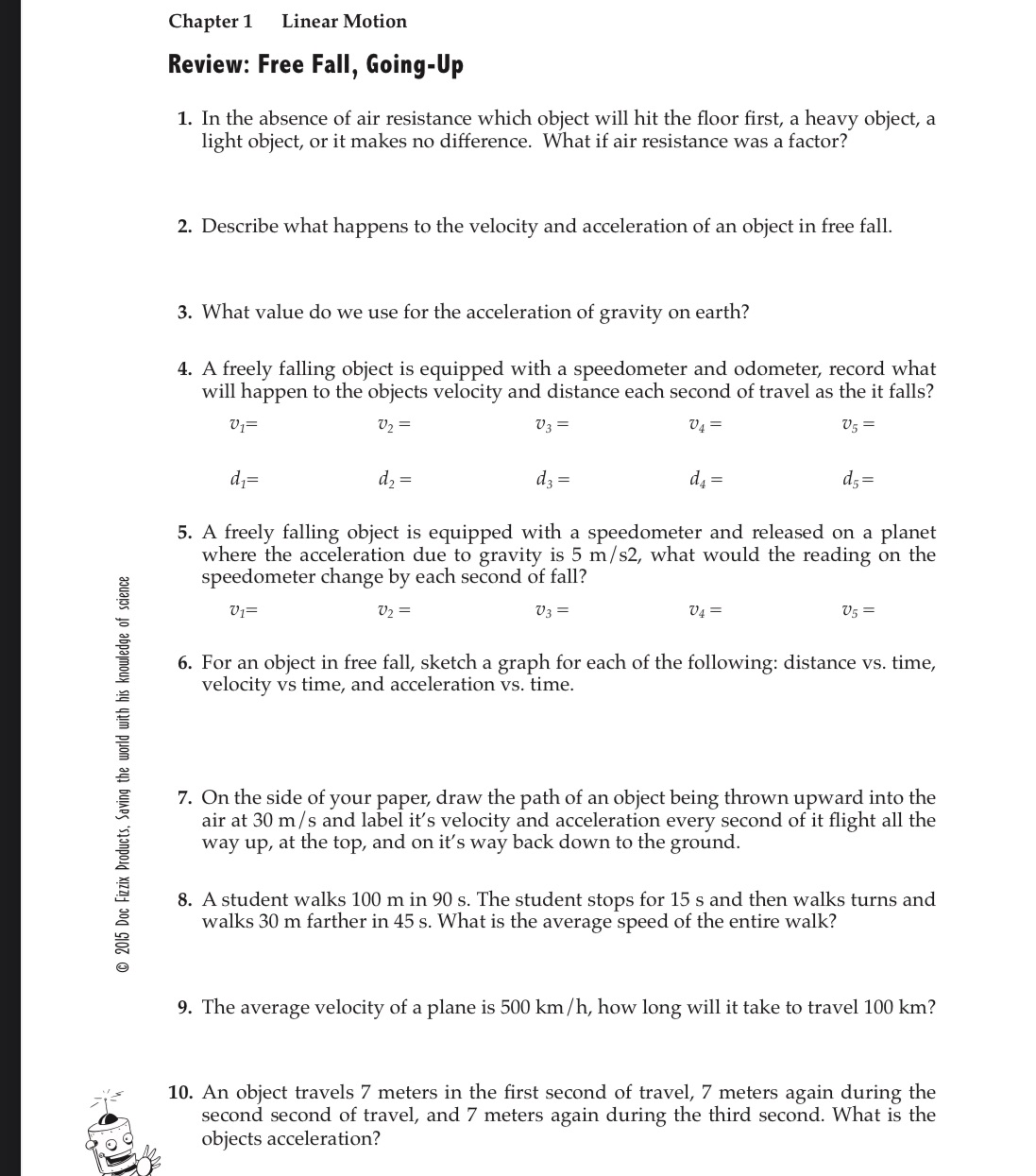
Chapter 1 Linear Motion Review: Free Fall, Going-Up 1. In the absence of air resistance which object will hit the floor first, a heavy object, a light object, or it makes no difference. What if air resistance was a factor? 2. Describe what happens to the velocity and acceleration of an object in free fall. 3. What value do we use for the acceleration of gravity on earth? 4. A freely falling object is equipped with a speedometer and odometer, record what will happen to the objects velocity and distance each second of travel as the it falls? V1= U2 = 13 = 14 = Us = d1= d2 = d3 = d4 = ds = 5. A freely falling object is equipped with a speedometer and released on a planet where the acceleration due to gravity is 5 m/s2, what would the reading on the speedometer change by each second of fall? V1= U2 = V3 = V4 = Us = 6. For an object in free fall, sketch a graph for each of the following: distance vs. time, velocity vs time, and acceleration vs. time. 2015 Doc Fizzix Products, Saving the world with his knowledge of science 7. On the side of your paper, draw the path of an object being thrown upward into the air at 30 m/s and label it's velocity and acceleration every second of it flight all the way up, at the top, and on it's way back down to the ground. 8. A student walks 100 m in 90 s. The student stops for 15 s and then walks turns and walks 30 m farther in 45 s. What is the average speed of the entire walk? 9. The average velocity of a plane is 500 km/h, how long will it take to travel 100 km? 10. An object travels 7 meters in the first second of travel, 7 meters again during the second second of travel, and 7 meters again during the third second. What is the objects acceleration
Step by Step Solution
There are 3 Steps involved in it

Get step-by-step solutions from verified subject matter experts
 Study Help