







Question: Chapter 1: Probability 3 Is It a Fair Game? OBJECTIVES: Students will learn key probability concepts as they play games with coins, dice, and spinners.
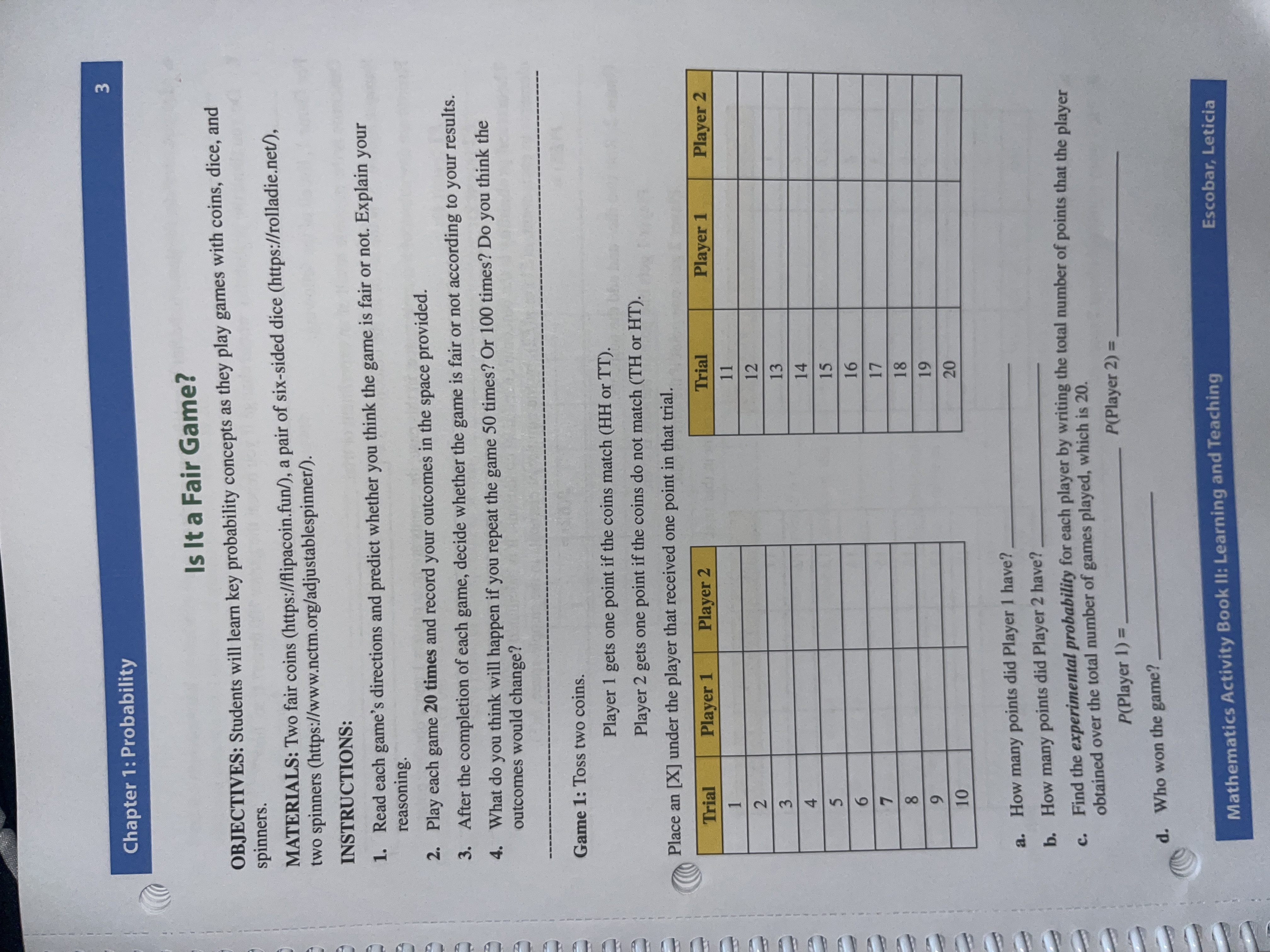
Chapter 1: Probability 3 Is It a Fair Game? OBJECTIVES: Students will learn key probability concepts as they play games with coins, dice, and spinners. MATERIALS: Two fair coins (https://flipacoin.fun/), a pair of six-sided dice (https://rolladie.net/), two spinners (https://www.nctm.org/adjustablespinner/). INSTRUCTIONS: 1. Read each game's directions and predict whether you think the game is fair or not. Explain your reasoning. 2. Play each game 20 times and record your outcomes in the space provided. 3. After the completion of each game, decide whether the game is fair or not according to your results. 4. What do you think will happen if you repeat the game 50 times? Or 100 times? Do you think the outcomes would change? Game 1: Toss two coins. Player 1 gets one point if the coins match (HH or TT). Player 2 gets one point if the coins do not match (TH or HT). Place an [X] under the player that received one point in that trial. Trial Player 1 Player 2 Trial Player 1 Player 2 1 11 2 12 3 13 14 UI A 15 6 16 17 8 18 9 19 10 20 a. How many points did Player 1 have? b. How many points did Player 2 have? c. Find the experimental probability for each player by writing the total number of points that the player obtained over the total number of games played, which is 20. P(Player 1) = P(Player 2) = d. Who won the game? Mathematics Activity Book II: Learning and Teaching Escobar, Leticia
Step by Step Solution
There are 3 Steps involved in it

Get step-by-step solutions from verified subject matter experts
 Study Help