







Question: Chapter 1: The Operations Function Learning Activity: Is your great idea worth it? Activity: You and your team came up with a plan to automate
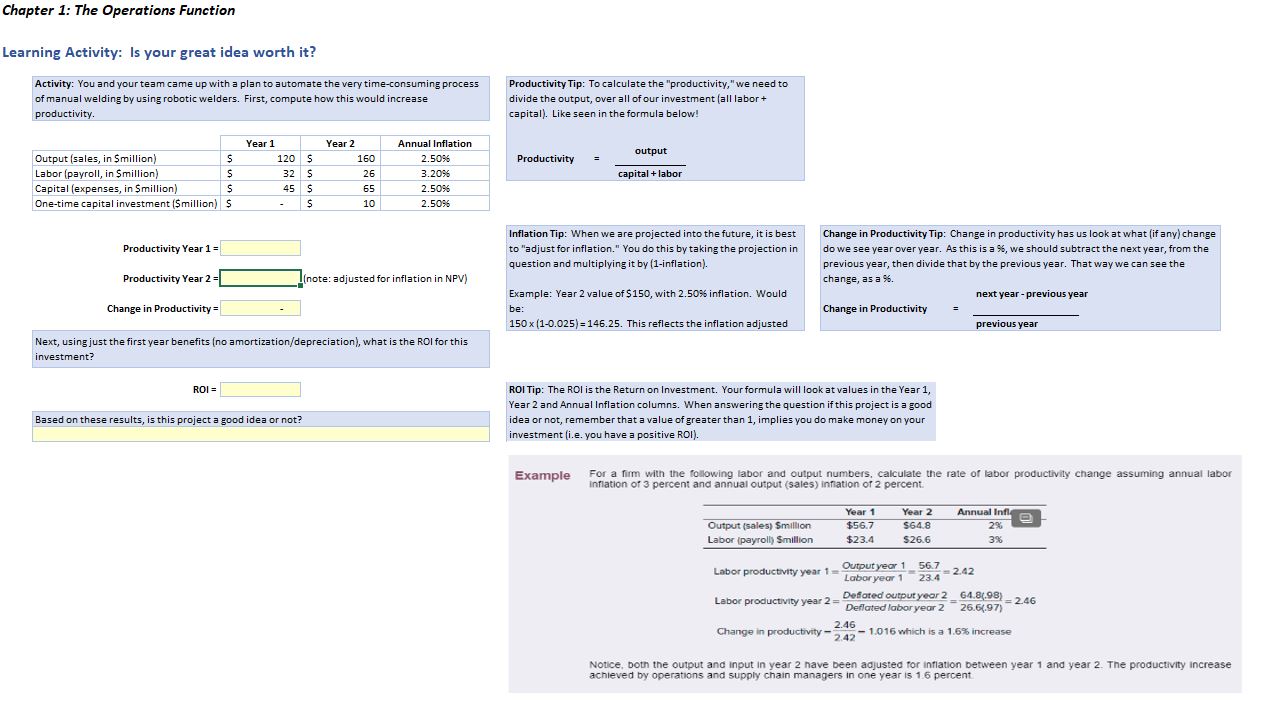
Chapter 1: The Operations Function Learning Activity: Is your great idea worth it? Activity: You and your team came up with a plan to automate the very time-consuming process Productivity Tip: To calculate the "productivity,"we need to of manual welding by using robotic welders. First, compute how this would increase divide the output, over all of our investment (all labor + productivity. capital). Like seen in the formula below! Year 1 Year 2 Annual Inflation output Output (sales, in $million) 120 5 160 2.50% Productivity Labor (payroll, in $million) 32 26 3.20% capital + labor Capital (expenses, in $million) 45 65 2.50% One-time capital investment (Smillion) 10 2.50% Inflation Tip: When we are projected into the future, it is best Change in Productivity Tip: Change in productivity has us look at what (if any) change Productivity Year 1 = to "adjust for inflation." You do this by taking the projection in do we see year over year. As this is a $%, we should subtract the next year, from the question and multiplying it by (1-inflation). previous year, then divide that by the previous year. That way we can see the Productivity Year 2 = note: adjusted for inflation in NPV) change, as a 9%. Example: Year 2 value of $150, with 2.50%% inflation. Would next year - previous year Change in Productivity = be : Change in Productivity 150x (1-0.025) = 146.25. This reflects the inflation adjusted previous year Next, using just the first year benefits (no amortization/depreciation), what is the ROI for this investment ROI = ROI Tip: The ROI is the Return on Investment. Your formula will look at values in the Year 1, Year 2 and Annual Inflation columns. When answering the question if this project is a good Based on these results, is this project a good idea or not? idea or not, remember that a value of greater than 1, implies you do make money on your investment (i.e. you have a positive ROI). Example For a firm with the following labor and output numbers, calculate the rate of labor productivity change assuming annual labor Inflation of 3 percent and annual output (sales) inflation of 2 percent. Year 1 Year 2 Annual Infle Output (sales) Smillion $56.7 $64.8 2% Labor (payroll) Smillion $23.4 $26.6 3% Labor productivity year 1= Output year 1 _56.7 -242 Laboryear 1 23.4 Labor productivity year 2= Deflated output year 2 _ 64.8(.98) _246 Deflated laboryear 2 26.6(.97) 2.46_ Change in productivity - 242 - 1.016 which is a 1.6% increase Notice, both the output and input in year 2 have been adjusted for inflation between year 1 and year 2. The productivity increase achieved by operations and supply chain managers in one year is 1 6 percent
Step by Step Solution
There are 3 Steps involved in it

Get step-by-step solutions from verified subject matter experts
 Study Help