Question: Chapter 1: The Revolution is Just Beginning Read the case: Pinterest: A Picture is Worth a Thousand Words on pages 46-49 of the text. Question:
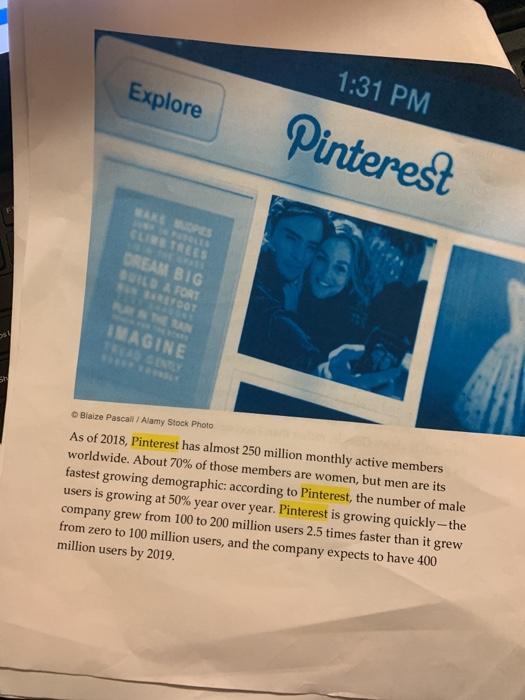
Chapter 1: The Revolution is Just Beginning Read the case: Pinterest: A Picture is Worth a Thousand Words on pages 46-49 of the text. Question: In what ways does Pinterest utilize the eight unique features of e-commerce reac Pinterest: A Picture Is Worth a Thousand Words Like all successful e-commerce companies, Pinterest taps into a simple truth. In Pinterest's case, the simple truth is that people love to collect things, and show off their collections to others. Founded in 2009 by Ben Silbermann, Evan Sharp, and Paul Sciarra and launched in March 2010, Pinterest allows you to create virtual scrapbooks of images, video, and other content that you "pin" (save) to a virtual bulletin board or pin board. Popular categories include fashion, home decor, DIY and crafts, food and drink, and animals. Find something that you particularly like? In addition to saving and perhaps commenting on it, you can re-pin it to your own board or follow a link back to the original source. Find someone whose taste you admire or who shares your passions? You can follow one or more of that pinner's boards to keep track of everything she or he pins. As of April 2018, there were over 100 billion pins on Pinterest on more than 1.5 billion different boards. Pinterest originally positioned itself as a social network. However, it has changed its tune and now describes itself as a visual search tool for discovering and saving creative ideas (and potential purchases), with less emphasis on sharing with friends. Search has become the core part of its mission. It views Google, rather than Facebook, Twitter, or Instagram, as its primary competition. Explore 1:31 PM Pinterest DREAM BIG BUILD & FORT IMAGINE Blaize Pascall/Alamy Stock Photo As of 2018, Pinterest has almost 250 million monthly active members worldwide. About 70% of those members are women, but men are its fastest growing demographic according to Pinterest, the number of male users is growing at 50% year over year. Pinterest is growing quickly - the company grew from 100 to 200 million users 2.5 times faster than it grew from zero to 100 million users, and the company expects to have 400 million users by 2019. Prisc Thus far, investors such as well-known Silicon Valley venture capital firms Andreessen Horowitz and Bessemer Venture Partners, hedge fund Valiant Capital Partners, and Japanese e-commerce company Rakuten have poured over $1.3 billion in venture capital into Pinterest, with its most recent round of funding of $150 million in June 2017 valuing the company at $12.3 billion. Like Facebook, Twitter, and many other startup companies, Pinterest focused initially on refining its product and building its user base, but not surprisingly, its investors began to push it to begin generating revenue. Pinterest's first step was to offer business accounts that provided additional resources for brands. In 2013, it introduced Rich Pins, which allowed companies to embed information, such as current pricing and availability, as well as a direct link to a product page. In 2014, Pinterest took the official leap into the advertising arena, launching a beta version of ads it called Promoted Pins that appear in search results and category feeds. Around the same time, Pinterest also introduced a search engine, called Guided Search, which suggests related terms to refine a search. Guided Search is based on user metadata, such as gender, board titles, captions, and comments related to pins, to create different categories and subcategories. In the last several years, Pinterest has gotten serious about monetization. The company has rolled out a wide variety of advertising formats and features in the last few years, including Cinematic Pins, highly targeted ads customized for mobile devices that show a brief animation and then display a full video when clicked by a user, several ad targeting options for advertisers, including custom list targeting, visitor targeting (serving ads to customers that have visited a specific company's website), and lookalike targeting (serving ads to customers who share traits with a company's existing customers); Search Ads, advertisements that appear when users search for certain items and keywords in the same way Google displays search advertising and Pinterest Shopping Ads, which sert automatically convert a company's product catalog into advertisements that link directly to the point of purchase. Pinterest typically pilots these formats with larger businesses first before expanding the feature to small- and mid-sized businesses. For example, in 2017, Pinterest made Search Ads available to anyone via its Ads Manager ad marketplace, and hopes to soon do the same with its Shopping Ads, which are proving increasingly effective for brands. For example, home goods retailer Lowes reported a 20% increase in click-through rate for its Pinterest Shopping Ads in 2017 compared to its other formats of Pinterest ads from the previous year. Pinterest has now turned its sights to the search advertising market. Pinterest search differs from other types of search because it is visual and typically happens at the early stages of a person's decision process. Pinterest believes search advertising revenue will drive the company to profitability and that it can challenge Google in the mobile search arena, not by outperforming Google in traditional search, but rather by outperforming it in visual search. To that end, Pinterest is making significant investments in search technology, such as deep- learning assisted visual search and its visual search engine, Lens. Lens can automatically isolate the different objects in an image stored on a user's camera, and gives users the ability to start searching for similar elements on Pinterest. Lens is used to complete 600 million searches per month for things like clothing styles, home dcor elements, and recipes for various dishes and baked goods, and has proven so effective that Pinterest began using the underlying technology to power its text-based searches as well. Pinterest collaborated with Samsung to integrate Lens directly in its Galaxy S8 series of smartphones, and the company has partnered with retail outlets like Home Depot and Target to allow customers to use Lens to take pictures of objects and find similar items at nearby stores. Pinterest also used Lens to improve its Shop the Look feature, allows the home page to load much more quickly, scales to the different number of iOS screens more efficiently, and is readable in all 31 languages in which Pinterest is available. According to Pinterest co-founder Evan Sharp, the smartphone is the platform Pinterest focuses on when it develops new features and products. International expansion continues to be a major area of focus and has been the primary driver of Pinterest's rapid growth to 200 million users. Pinterest introduced its first localized site, for the United Kingdom, in 2013, and it is now available in 31 different languages. Pinterest is aiming to make its platform feel more regional, focusing specifically on the United Kingdom, France, Germany, Japan, and Brazil. In 2017, about 60% of its monthly active users are located outside the United States. Looking to the future, Pinterest believes that international expansion will provide it with the greatest growth opportunities. Despite all the good news for Pinterest, there are some issues lurking just behind the scenes that may cloud its future, such as the issue of copyright infringement. The basis of Pinterest's business model involves users potentially violating others' copyrights by posting images without permission and/or attribution. Although Pinterest's Terms of Service puts the onus on its users to avoid doing so, the site knowingly facilitates such actions by, for example, providing a Pin It tool embedded in the user's browser toolbar. Much of the content on the site reportedly violates its Terms of Service. Pinterest has provided an opt-out code to enable other sites to bar their content from being shared on Pinterest, but some question why they should have to take any action when Pinterest is creating the problem. Another thing Pinterest has done to try to ameliorate the problem is to automatically add citations attribution) to content coming from certain specified sources, such as Flickr, YouTube, Vimeo, Etsy, Kickstarter, and SlideShare, among others. In 2013, it entered










 Study Help