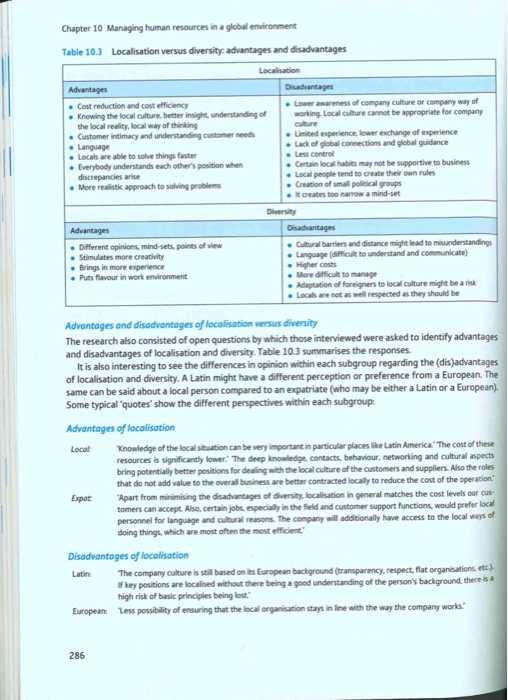
Question: Chapter 10 Managing human resources in a global environment Table 10.3 Localisation versus diversity, advantages and disadvantages Localisation Advantages Disadvantages Cost reduction and cost efficiency
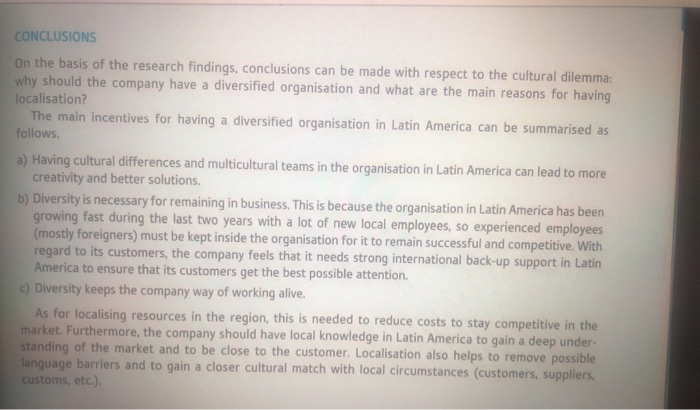
Chapter 10 Managing human resources in a global environment Table 10.3 Localisation versus diversity, advantages and disadvantages Localisation Advantages Disadvantages Cost reduction and cost efficiency Lower awareness of company culture or company way of Knowing the local culture better insight, understanding of working local culture cannot be appropriate for company the local reality, local way of thinking culture Customer intimacy and understanding customer needs . Limited experience, lower exchange of experience Language Lack of global connections and global guidance Locals are able to solve things faster Les control Everybody understands each other's position when . Certain local habits may not be supportive to business discrepancies arise Local people tend to create their own rules More realistic approach to solving problems Creation of small political groups creates too narrow a mind-set Advantages . Different opinions, mind-sets, points of view Stimulates more creativity Brings in more experience Puts flavour in work environment Disadvantages . Cultural barriers and distance might lead to misunderstandings Language (difficult to understand and communicate) Higher costs More difficult to manage Adaptation of foreigners to local culture might be a risk Locals are not as well respected as they should be Advantages and disadvantages of localisation versus diversity The research also consisted of open questions by which those interviewed were asked to identify advantages and disadvantages of localisation and diversity. Table 10.3 summarises the responses. It is also interesting to see the differences in opinion within each subgroup regarding the (dis)advantages of localisation and diversity. A Latin might have a different perception or preference from a European. The same can be said about a local person compared to an expatriate (who may be either a Latin or a European). Some typical quotes show the different perspectives within each subgroup: Advantages of localisation Locat Knowledge of the local situation can be very important in particular places like Latin America. The cost of these resources is significantly lower. The deep knowledge, contacts behaviour, networking and cultural aspects bring potentially better positions for dealing with the local culture of the customers and suppliers. Also the roles that do not add value to the overall business are better contracted locally to reduce the cost of the operation Expat "Apart from minimising the disadvantages of diversity, localisation in general matches the cost levels our cus tomers can accept. Also, certain jobs, especially in the field and customer support functions, would prefer local personnel for language and cultural reasons. The company will additionally have access to the local ways of doing things, which are most often the most efficient Disadvantages of localisation Latin: The company culture is still based on its European background (transparency respect, flat organisations, etc) if key positions are localised without there being a good understanding of the person's background, there is a high risk of basic principles being lost European less possibility of ensuring that the local organisation stays in line with the way the company works 286 3. Read the quotes from the different sub-groups and then decide which (dis)advantages of localisation and diversity are most referred to. CONCLUSIONS On the basis of the research findings, conclusions can be made with respect to the cultural dilemma: why should the company have a diversified organisation and what are the main reasons for having localisation? The main incentives for having a diversified organisation in Latin America can be summarised as follows. a) Having cultural differences and multicultural teams in the organisation in Latin America can lead to more creativity and better solutions. b) Diversity is necessary for remaining in business. This is because the organisation in Latin America has been growing fast during the last two years with a lot of new local employees, so experienced employees (mostly foreigners) must be kept inside the organisation for it to remain successful and competitive. With regard to its customers, the company feels that it needs strong international back-up support in Latin America to ensure that its customers get the best possible attention. c) Diversity keeps the company way of working alive. As for localising resources in the region, this is needed to reduce costs to stay competitive in the market. Furthermore, the company should have local knowledge in Latin America to gain a deep under- standing of the market and to be close to the customer. Localisation also helps to remove possible language barriers and to gain a closer cultural match with local circumstances (customers, suppliers. customs, etc.). 4. Read the conclusions given by the author at the end of the case study. Why should the company have a diversified organisation and what are the main reasons for having localisation











 Study Help