







Question: CHAPTER 10: Planning MULTIPLE CHOICE 13. Strategizing is achieving equilibrium between the organization and its external environment. a. True b. False 14. System theory is
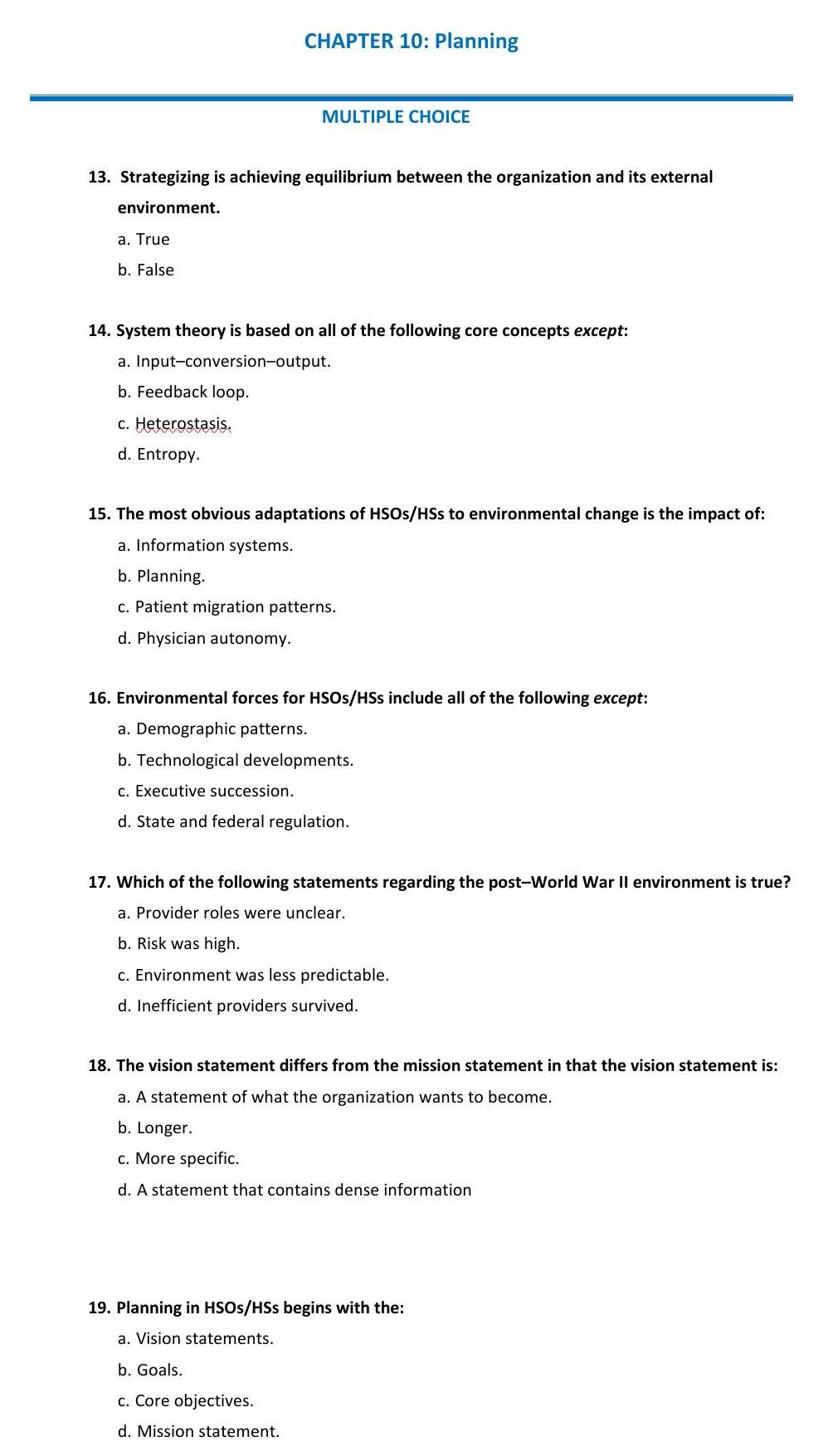
CHAPTER 10: Planning MULTIPLE CHOICE 13. Strategizing is achieving equilibrium between the organization and its external environment. a. True b. False 14. System theory is based on all of the following core concepts except: a. Input-conversion-output. b. Feedback loop. c. Heterostasis. d. Entropy. 15. The most obvious adaptations of HSOs/HSs to environmental change is the impact of: a. Information systems. b. Planning c. Patient migration patterns. d. Physician autonomy. 16. Environmental forces for HSOs/HSs include all of the following except: a. Demographic patterns. b. Technological developments. c. Executive succession. d. State and federal regulation. 17. Which of the following statements regarding the post-World War II environment is true? a. Provider roles were unclear. b. Risk was high. c. Environment was less predictable. d. Inefficient providers survived. 18. The vision statement differs from the mission statement in that the vision statement is: a. A statement of what the organization wants to become. b. Longer. c. More specific. d. A statement that contains dense information 19. Planning in HSOs/HSs begins with the: a. Vision statements. b. Goals. c. Core objectives. d. Mission statement
Step by Step Solution
There are 3 Steps involved in it
1 Expert Approved Answer
Step: 1 Unlock

Question Has Been Solved by an Expert!
Get step-by-step solutions from verified subject matter experts
Step: 2 Unlock
Step: 3 Unlock
 Study Help