Question: Chapter 10 pp. 169201 presents a case study of utilizing Evidence Based Management in a critical situation resulting from a natural disaster, hurricane Katrina. The
Chapter 10 pp. 169201 presents a case study of utilizing Evidence Based Management in a critical situation resulting from a natural disaster, hurricane Katrina. The dilemma facing the team of care providers and managers was, should the hospital be evacuated, relocating all of the patients, including critically ill patients on life support apparatus, or remain in place and care for the patients as effectively as possible? Dealing with the flooding and loss of electrical services required the care givers to rely on emergency back-up power systems, uncertain of continued electricity availability.
Read through the case study and answer the Case Study Questions 15 on pp. 197198. Be complete and thorough in your response, referencing information and specific case discussions that support your answer.
Each answer must be at least one paragraph long; reflect chapter terminology and content/theory, and adhere to the current APA Style. (A paragraph is five to seven complete sentences long.)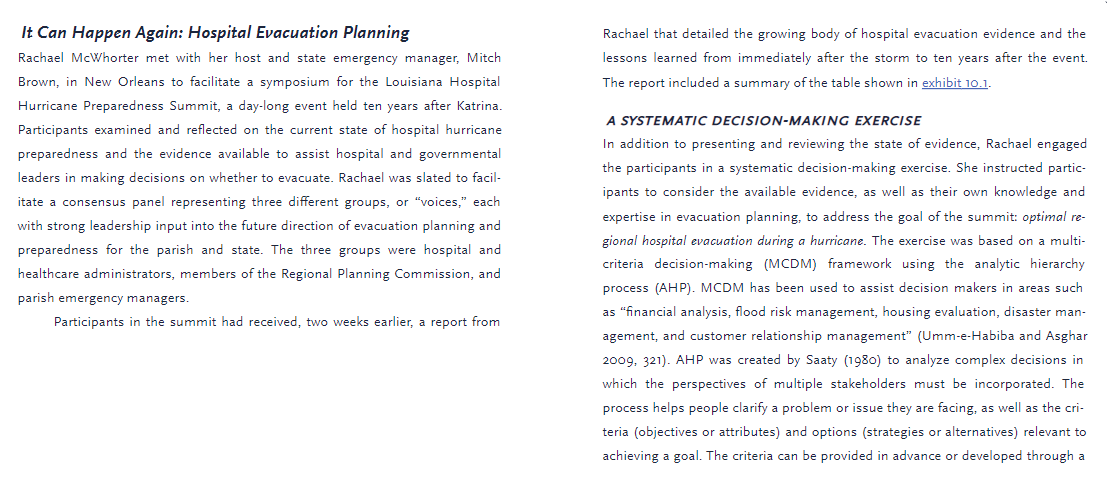
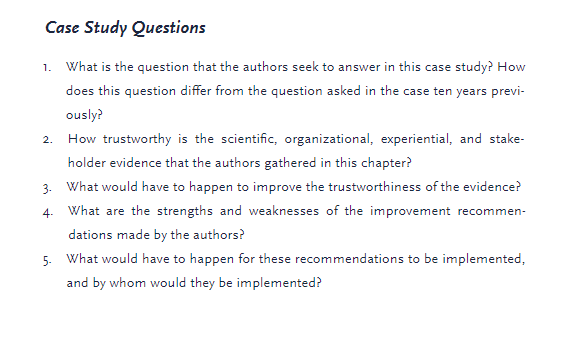
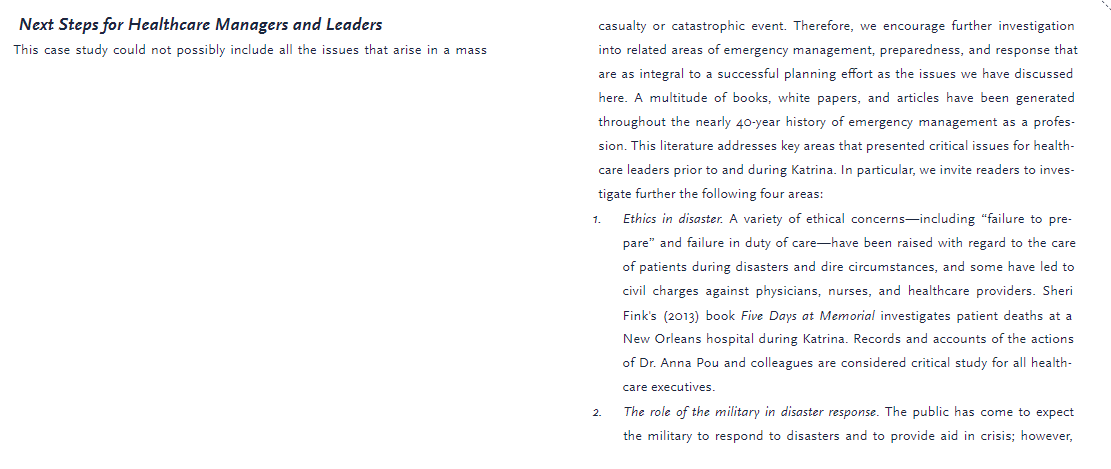
Rachael that detailed the growing body of hospital evacuation evidence and the lessons learned from immediately after the storm to ten years after the event. The report included a summary of the table shown in exhibit 10.1. It Can Happen Again: Hospital Evacuation Planning Rachael McWhorter met with her host and state emergency manager, Mitch Brown, in New Orleans to facilitate a symposium for the Louisiana Hospital Hurricane Preparedness Summit, a day-long event held ten years after Katrina. Participants examined and reflected on the current state of hospital hurricane preparedness and the evidence available to assist hospital and governmental leaders in making decisions on whether to evacuate. Rachael was slated to facil- itate a consensus panel representing three different groups, or "voices." each with strong leadership input into the future direction of evacuation planning and preparedness for the parish and state. The three groups were hospital and healthcare administrators, members of the Regional Planning Commission, and parish emergency managers. Participants in the summit had received, two weeks earlier, a report from A SYSTEMATIC DECISION-MAKING EXERCISE In addition to presenting and reviewing the state of evidence, Rachael engaged the participants in a systematic decision-making exercise. She instructed partic- ipants to consider the available evidence, as well as their own knowledge and expertise in evacuation planning, to address the goal of the summit: optimal re- gional hospital evacuation during a hurricane. The exercise was based on a multi- criteria decision-making (MCDM) framework using the analytic hierarchy process (AHP). MCDM has been used to assist decision makers in areas such as "financial analysis, flood risk management, housing evaluation, disaster man- agement, and customer relationship management (Umm-e-Habiba and Asghar 2009, 321). AHP was created by Saaty (1980) to analyze complex decisions in which the perspectives of multiple stakeholders must be incorporated. The process helps people clarify a problem or issue they are facing, as well as the cri- teria (objectives or attributes) and options (strategies or alternatives) relevant to achieving a goal. The criteria can be provided in advance or developed through a Case Study Questions 2. 1. What is the question that the authors seek to answer in this case study? How does this question differ from the question asked in the case ten years previ- ously? How trustworthy is the scientific, organizational, experiential, and stake- holder evidence that the authors gathered in this chapter? 3. What would have to happen to improve the trustworthiness of the evidence? What are the strengths and weaknesses of the improvement recommen- dations made by the authors? 5. What would have to happen for these recommendations to be implemented, and by whom would they be implemented? 4 Next Steps for Healthcare Managers and Leaders This case study could not possibly include all the issues that arise in a mass 1. casualty or catastrophic event. Therefore, we encourage further investigation into related areas of emergency management, preparedness, and response that are as integral to a successful planning effort as the issues we have discussed here. A multitude of books, white papers, and articles have been generated throughout the nearly 40-year history of emergency management as a profes- sion. This literature addresses key areas that presented critical issues for health- care leaders prior to and during Katrina. In particular, we invite readers to inves- tigate further the following four areas: Ethics in disaster. A variety of ethical concernsincluding "failure to pre- pare" and failure in duty of carehave been raised with regard to the care of patients during disasters and dire circumstances, and some have led to civil charges against physicians, nurses, and healthcare providers. Sheri Fink's (2013) book Five Days at Memorial investigates patient deaths at a New Orleans hospital during Katrina. Records and accounts of the actions of Dr. Anna Pou and colleagues are considered critical study for all health- care executives. 2. The role of the military in disaster response. The public has come to expect the military to respond to disasters and to provide aid in crisis; however









 Study Help