







Question: Chapter 11: Problem 1 7 (Chapter 11: Problem 23 in 2 Edition) Develop and analyze a simulation model for Koehler Vision Associates (KVA) in Problem
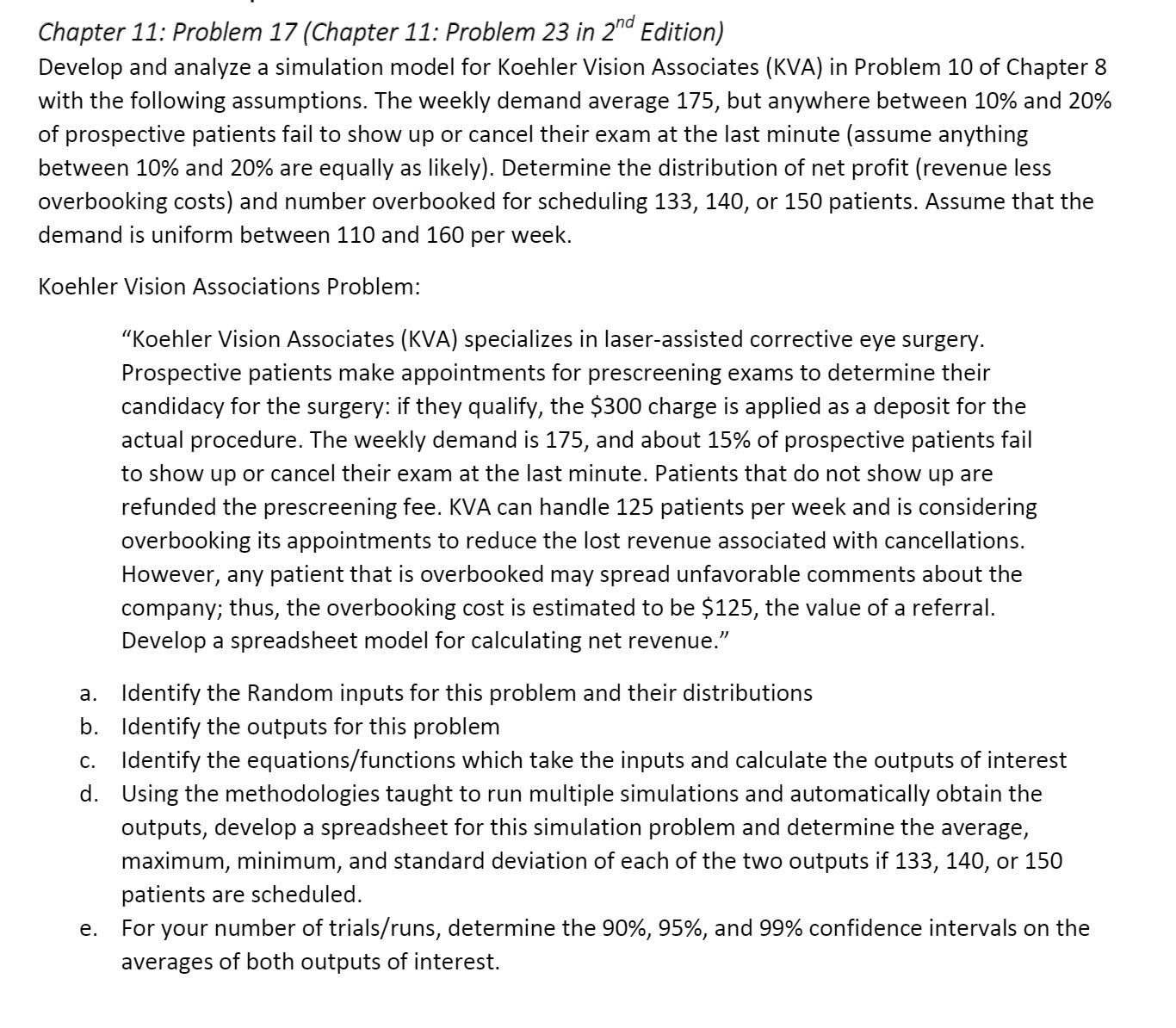
Chapter 11: Problem 1 7 (Chapter 11: Problem 23 in 2\"\" Edition) Develop and analyze a simulation model for Koehler Vision Associates (KVA) in Problem 10 of Chapter 8 with the following assumptions. The weekly demand average 175, but anywhere between 10% and 20% of prospective patients fail to show up or cancel their exam at the last minute (assume anything between 10% and 20% are equally as likely). Determine the distribution of net profit (revenue less overbooking costs) and number overbooked for scheduling 133, 140, or 150 patients. Assume that the demand is uniform between 110 and 160 per week. Koehler Vision Associations Problem: ape-5:: "Koehler Vision Associates (KVA) specializes in laserassisted corrective eye surgery. Prospective patients make appointments for prescreening exams to determine their candidacy for the surgery: if they qualify, the S300 charge is applied as a deposit for the actual procedure. The weekly demand is 175, and about 15% of prospective patients fail to show up or cancel their exam at the last minute. Patients that do not show up are refunded the prescreening fee. KVA can handle 125 patients per week and is considering overbooking its appointments to reduce the lost revenue associated with cancellations. However, any patient that is overbooked may spread unfavorable comments about the company; thus, the overbooking cost is estimated to be $125, the value of a referral. Develop a spreadsheet model for calculating net revenue.\" Identify the Random inputs for this problem and their distributions Identify the outputs for this problem Identify the equations/functions which take the inputs and calculate the outputs of interest Using the methodologies taught to run multiple simulations and automatically obtain the outputs, develop a spreadsheet for this simulation problem and determine the average, maximum, minimum, and standard deviation of each of the two outputs if 133, 140, or 150 patients are scheduled. For your number of trials/runs, determine the 90%, 95%, and 99% confidence intervals on the averages of both outputs of interest
Step by Step Solution
There are 3 Steps involved in it

Get step-by-step solutions from verified subject matter experts
 Study Help