







Question: Chapter 11 Solving Team Challenges as Doc Systems Read the DocSystems Billing case, including the briefing document and four scenes, and consider the following questions:
Chapter 11 Solving Team Challenges as Doc Systems
Read the DocSystems Billing case, including the briefing document and four scenes, and consider the following questions:
Question 1.What problems exist in this organization? How do these problems differ based on the employees roles? Why do employees object to Jims proposed solution?
Question 2 .Make a recommendation to the client about what could be done next based on the data included. Summarize your observations for Jim, offer possible interpretations, and suggest an approach for next steps.
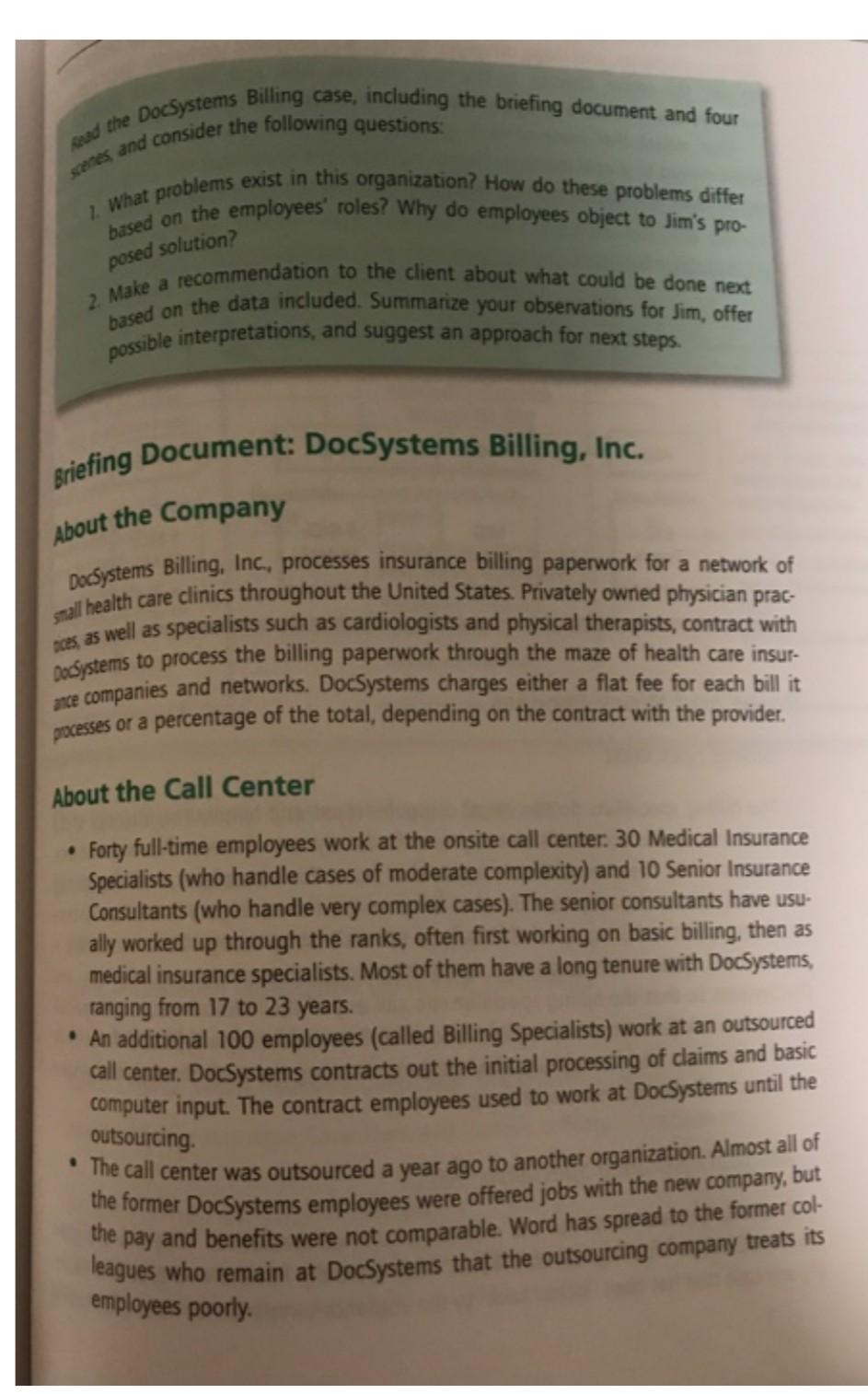
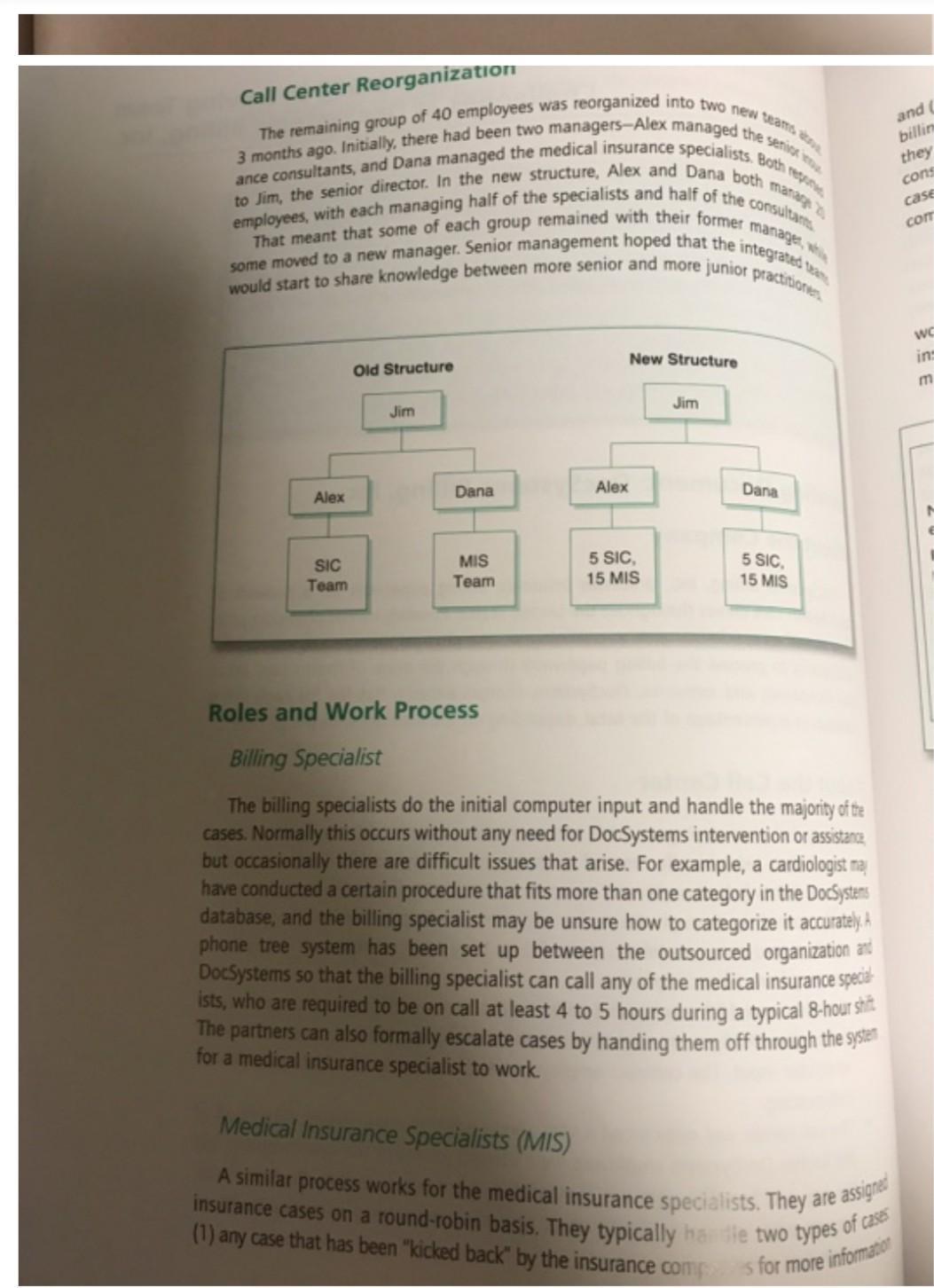
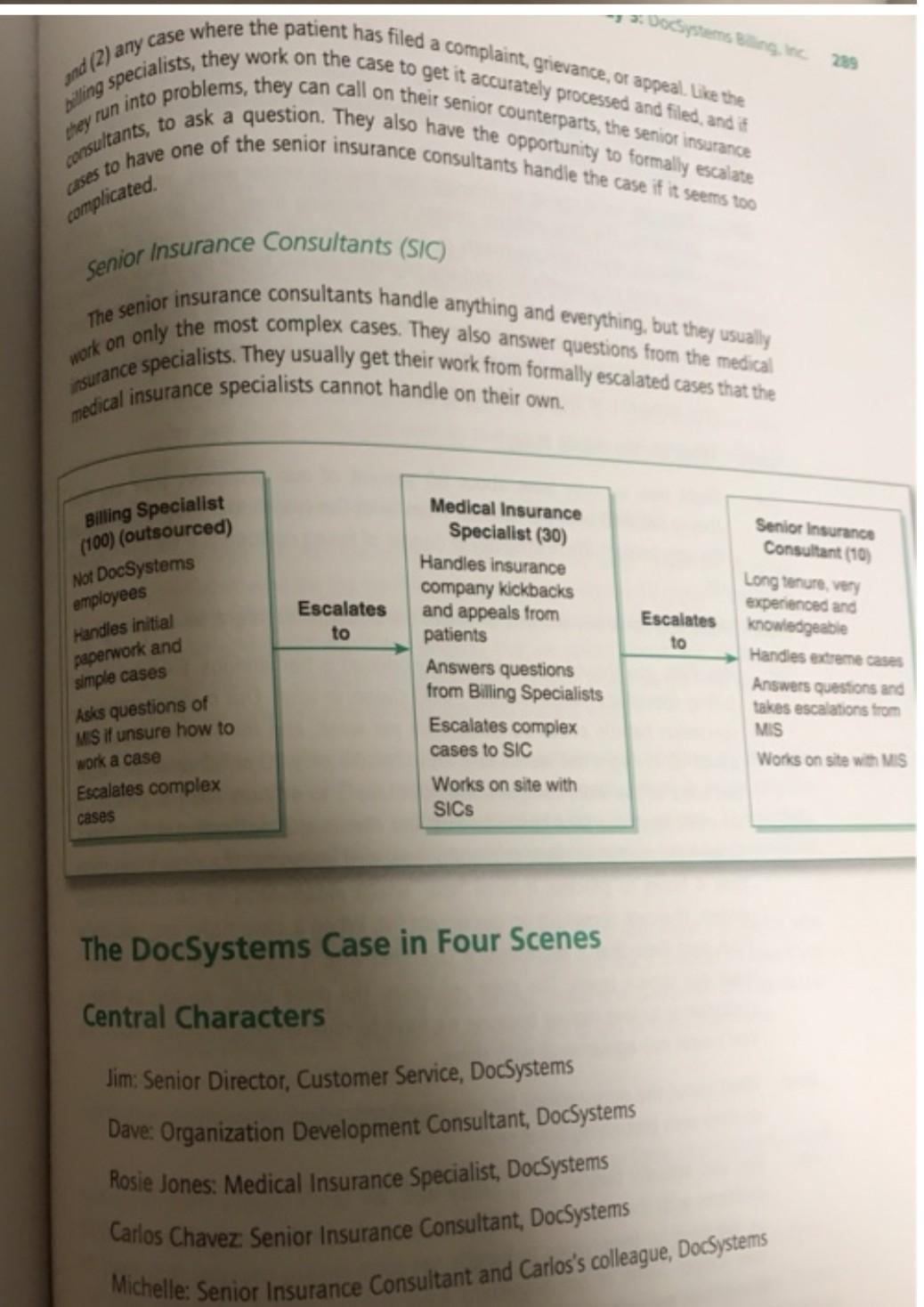
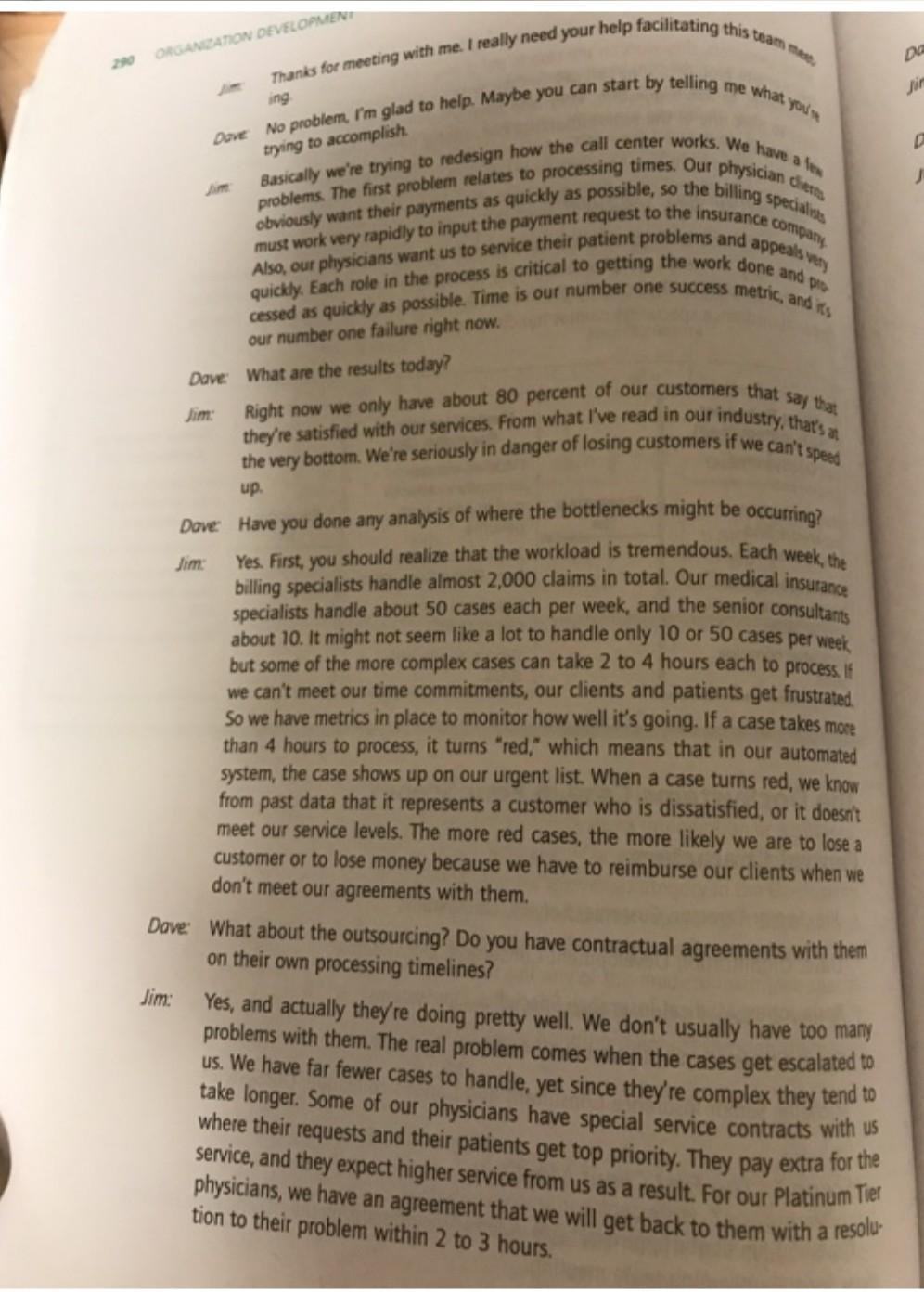
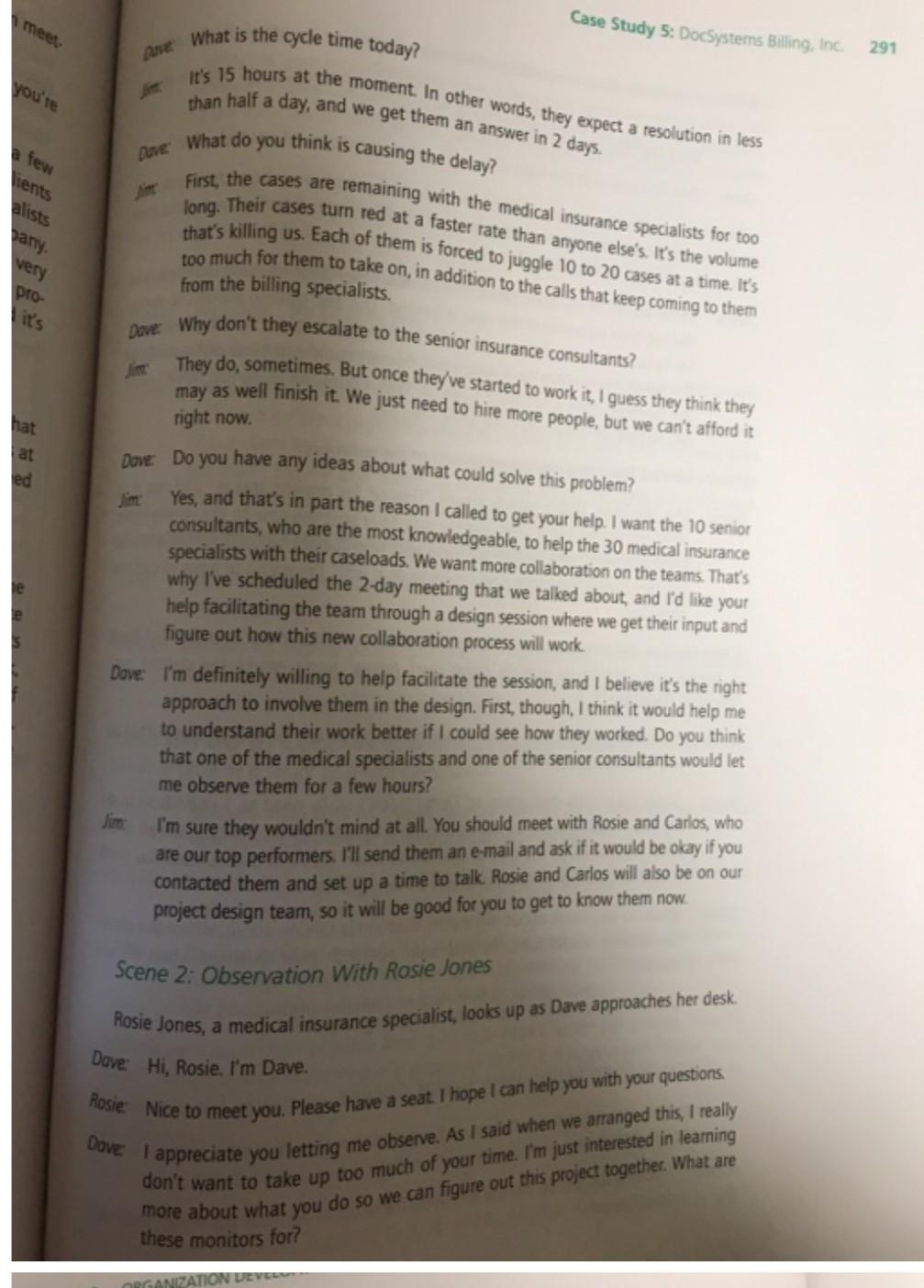
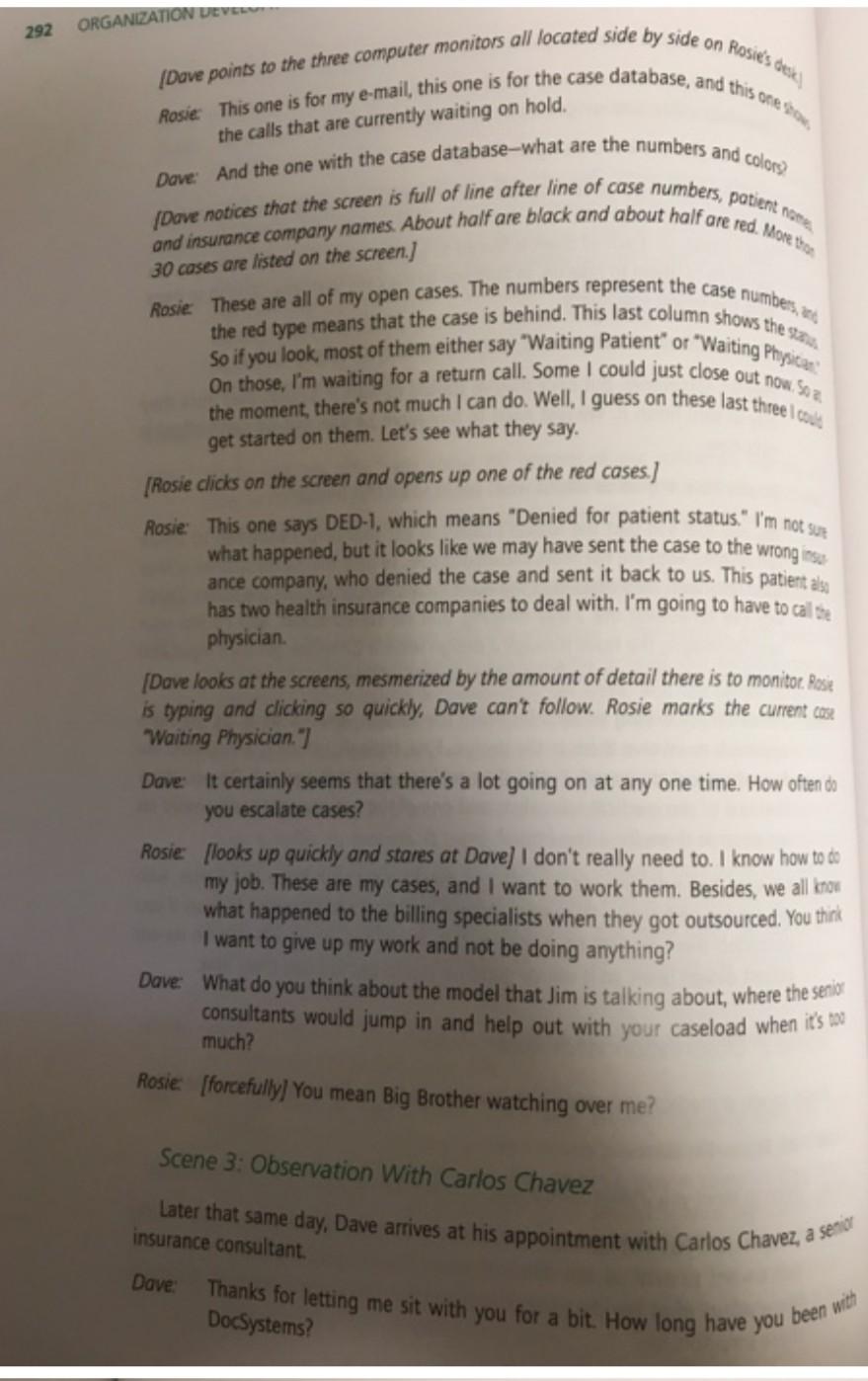
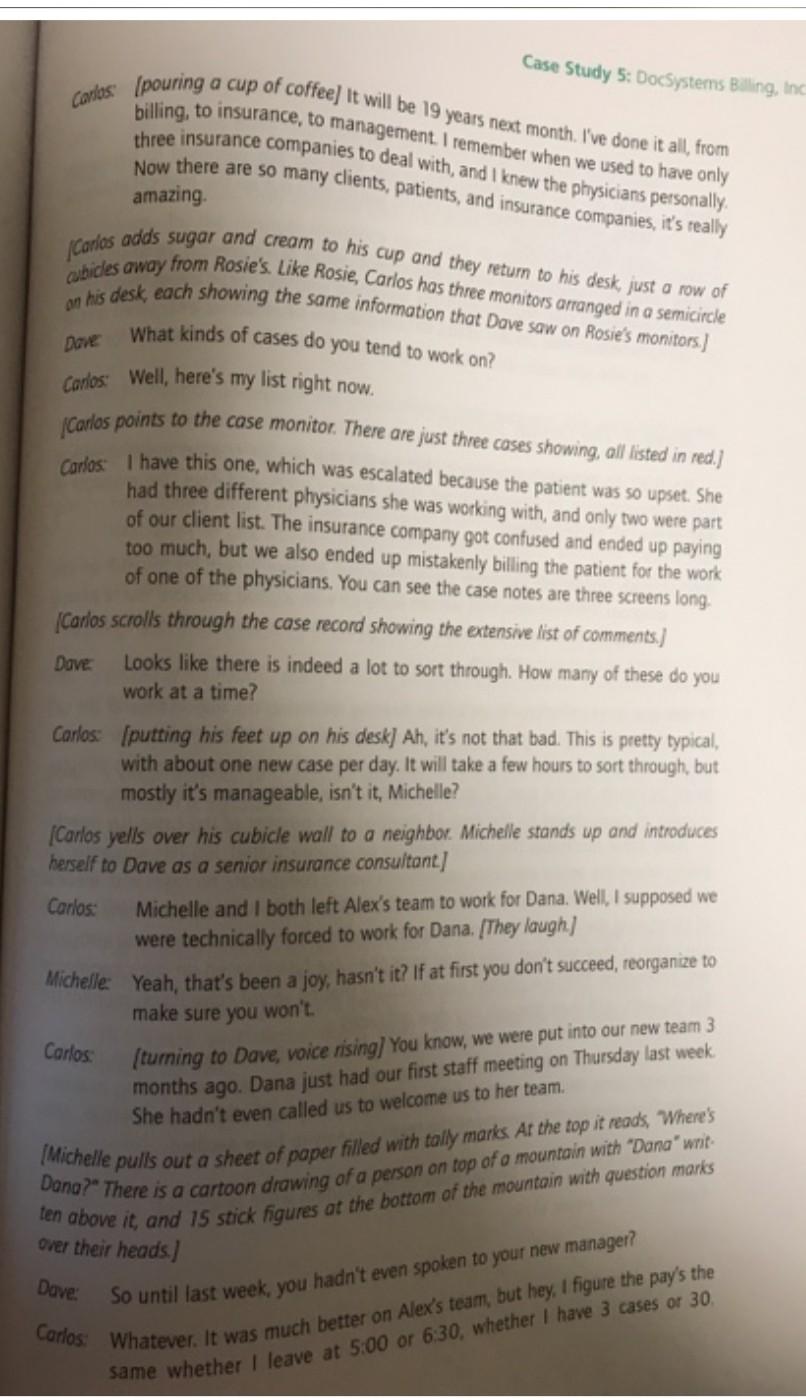
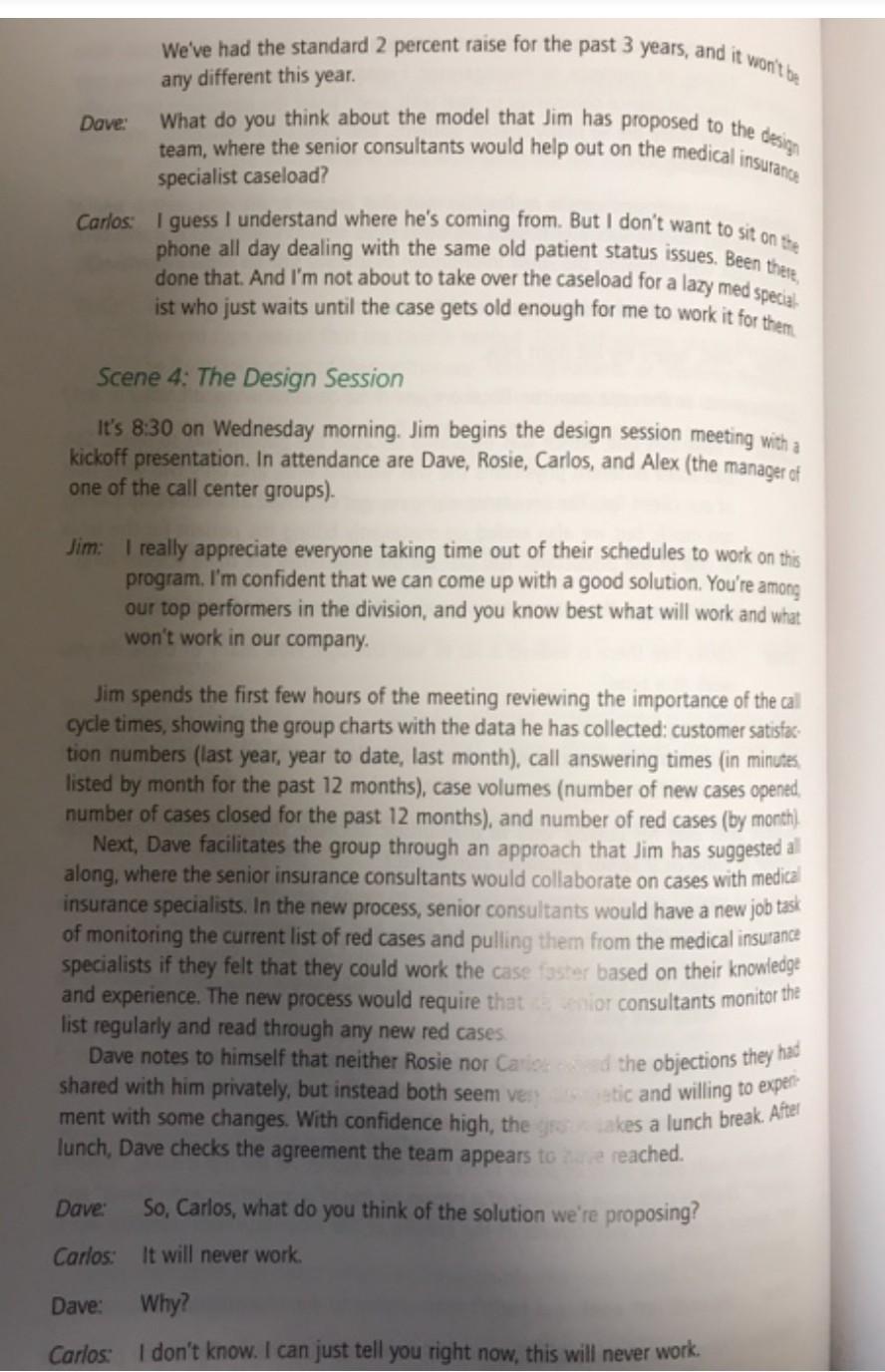
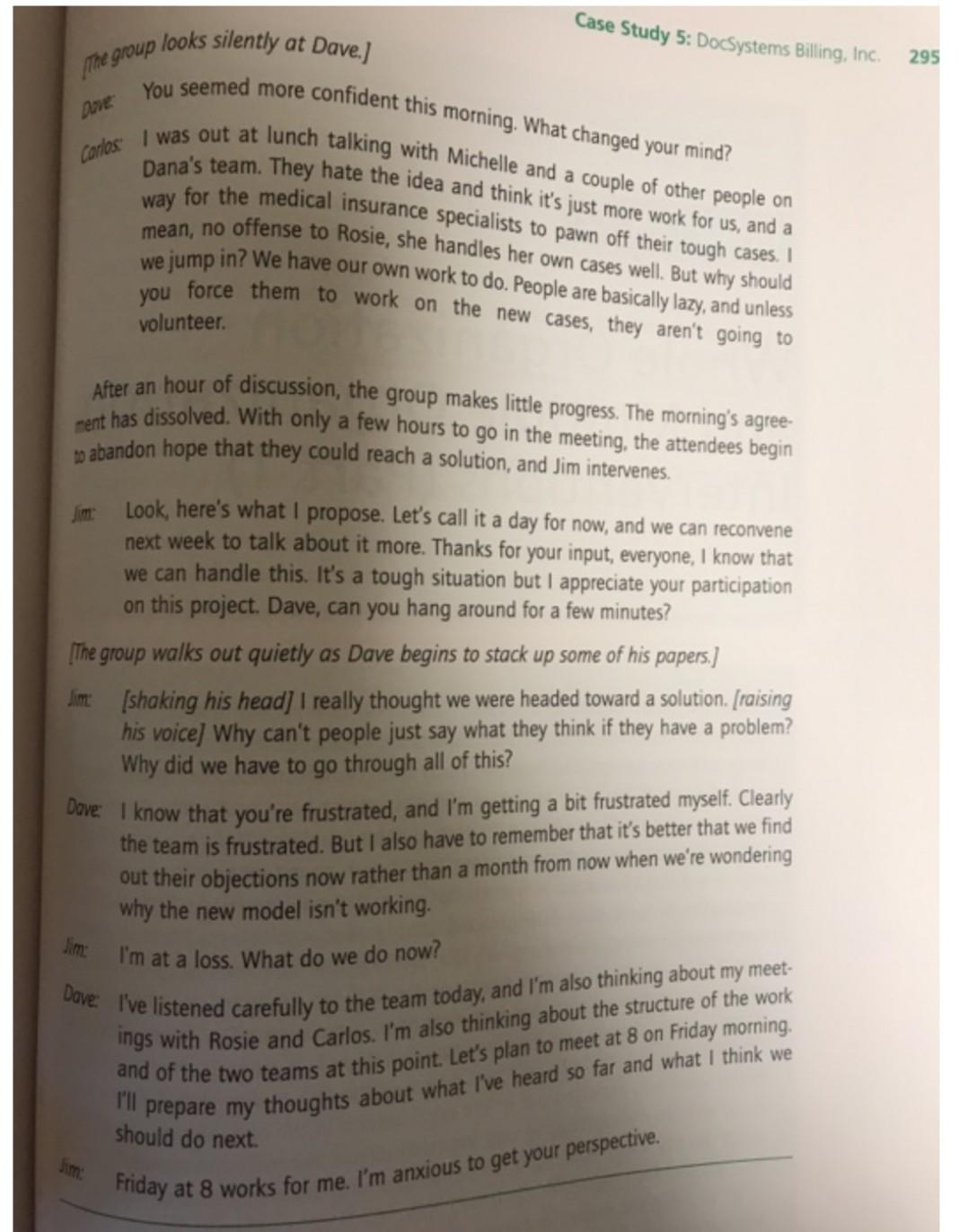
aud the DocSystems Billing case, including the briefing document and four scenes and consider the following questions: 1. What problems exist in this organization? How do these problems differ based on the employees' roles? Why do employees object to Jim's pro- 2. Make a recommendation to the client about what could be done next possible interpretations, and suggest an approach for next steps. based on the data included. Summarize your observations for Jim, offer posed solution? Briefing Document: DocSystems Billing, Inc. About the Company Docsystems Billing, Inc, processes insurance billing paperwork for a network of small health care clinics throughout the United States. Privately owned physician prac ses as well as specialists such as cardiologists and physical therapists, contract with Dosystems to process the billing paperwork through the maze of health care insur- ance companies and networks. DocSystems charges either a flat fee for each bill it pocesses or a percentage of the total, depending on the contract with the provider. About the Call Center Forty full-time employees work at the onsite call center: 30 Medical Insurance Specialists (who handle cases of moderate complexity) and 10 Senior Insurance Consultants (who handle very complex cases). The senior consultants have usu- ally worked up through the ranks, often first working on basic billing, then as medical insurance specialists. Most of them have a long tenure with DocSystems, ranging from 17 to 23 years. . An additional 100 employees (called Billing Specialists) work at an outsourced call center. DocSystems contracts out the initial processing of claims and basic computer input. The contract employees used to work at DocSystems until the outsourcing The call center was outsourced a year ago to another organization. Almost all of the former DocSystems employees were offered jobs with the new company, but the pay and benefits were not comparable. Ward has spread to the former col- leagues who remain at DocSystems that the outsourcing company treats its employees poorly. Call Center Reorganization and billin they cons The remaining group of 40 employees was reorganized into two new tam ance consultants, and Dana managed the medical insurance specialists. Both 3 months ago. Initially, there had been two managers-Alex managed the se to Jim, the senior director. In the new structure, Alex and Dana both mama employees, with each managing half of the specialists and half of the consulta That meant that some of each group remained with their former manager would start to share knowledge between more senior and more junior practions some moved to a new manager. Senior management hoped that the integrated case com WC in New Structure Old Structure m Jim Jim Dana Alex Alex Dana SIC Team MIS Team 5 SIC, 15 MIS 5 SIC 15 MIS Roles and Work Process Billing Specialist The billing specialists do the initial computer input and handle the majority of the cases. Normally this occurs without any need for DocSystems intervention or assistance but occasionally there are difficult issues that arise. For example, a cardiologist may have conducted a certain procedure that fits more than one category in the DocSystems database, and the billing specialist may be unsure how to categorize it accurately. A phone tree system has been set up between the outsourced organization and DotSystems so that the billing specialist can call any of the medical insurance specie ists, who are required to be on call at least 4 to 5 hours during a typical 8-hour shit The partners can also formally escalate cases by handing them off through the system for a medical insurance specialist to work Medical Insurance Specialists (MIS) A similar process works for the medical insurance specialists. They are assigned insurance cases on a round-robin basis. They typically hale two types of cases (1) any case that has been "kicked back" by the insurance com s for more informazio 15. Systems Bling, Inc 289 Dilling complicated. und (2) any case where the patient has filed a complaint, grievance, or appeal. Like the specialists, they work on the case to get it accurately processed and filed, and if consultants, to ask a question. They also have the opportunity to formally escalate they run into problems, they can call on their senior counterparts, the senior insurance uses to have one of the senior insurance consultants handle the case if it seems too Senior Insurance Consultants (SIC) The senior insurance consultants handle anything and everything, but they usually work on only the most complex cases. They also answer questions from the medical insurance specialists. They usually get their work from formally escalated cases that the medical insurance specialists cannot handle on their own Billing Specialist (100) (outsourced) Not DocSystems Senior Insurance Consultant (10) employees Escalates to Escalates to Handles initial paperwork and simple cases Asks questions of MS if unsure how to work a case Medical Insurance Specialist (30) Handles insurance company kickbacks and appeals from patients Answers questions from Billing Specialists Escalates complex cases to SIC Works on site with SICS Long tenure, very experienced and knowledgeable Handles extreme cases Answers questions and takes escalations from MIS Works on site with MS Escalates complex cases The DocSystems Case in Four Scenes Central Characters Jim: Senior Director, Customer Service, DocSystems Dave: Organization Development Consultant, DocSystems Rosie Jones: Medical Insurance Specialist, DocSystems Carlos Chavez Senior Insurance Consultant, DocSystems Michelle: Senior Insurance Consultant and Carlos's colleague, DocSystems 200 ORGANIZATION DEVELOPMENT ing you trying to accomplish Thanks for meeting with me. I really need your help facilitating this team Dove No problem. I'm glad to help. Maybe you can start by telling me what Basically we're trying to redesign how the call center works. We have a les problems. The first problem relates to processing times. Our physician ditt must work very rapidly to input the payment request to the insurance company obviously want their payments as quickly as possible, so the billing specialistes Also, our physicians want us to service their patient problems and appeals cessed as quickly as possible. Time is our number one success metric, and is quickly. Each role in the process is critical to getting the work done and it our number one failure right now. Dave: What are the results today? Right now we only have about 80 percent of our customers that say that Jim: they're satisfied with our services. From what I've read in our industry, that's a the very bottom. We're seriously in danger of losing customers if we can't speed up. Dave Have you done any analysis of where the bottlenecks might be occurring Yes. First, you should realize that the workload is tremendous. Each week, the Jim billing specialists handle almost 2,000 claims in total. Our medical insurance specialists handle about 50 cases each per week, and the senior consultants about 10. It might not seem like a lot to handle only 10 or 50 cases per week but some of the more complex cases can take 2 to 4 hours each to process . If we can't meet our time commitments, our clients and patients get frustrated So we have metrics in place to monitor how well it's going. If a case takes more than 4 hours to process, it turns "red," which means that in our automated system, the case shows up on our urgent list. When a case turns red, we know from past data that it represents a customer who is dissatisfied, or it doesn't meet our service levels. The more red cases, the more likely we are to lose a customer or to lose money because we have to reimburse our clients when we don't meet our agreements with them. Dave What about the outsourcing? Do you have contractual agreements with them on their own processing timelines? Jim: Yes, and actually they're doing pretty well. We don't usually have too many problems with them. The real problem comes when the cases get escalated to us. We have far fewer cases to handle, yet since they're complex they tend to take longer. Some of our physicians have special service contracts with us where their requests and their patients get top priority. They pay extra for the service, and they expect higher service from us as a result . For our Platinum Tier physicians, we have an agreement that we will get back to them with a resolu. tion to their problem within 2 to 3 hours. Case Study 5: DocSystems Billing, Inc What is the cycle time today? ane 291 you're few DOVE It's 15 hours at the moment. In other words, they expect a resolution in less than half a day, and we get them an answer in 2 days What do you think is causing the delay? First, the cases are remaining with the medical insurance specialists for too long. Their cases turn red at a faster rate than anyone else's. It's the volume that's killing us. Each of them is forced to juggle 10 to 20 cases at a time. It's ents alists Tany too much for them to take on, in addition to the calls that keep coming to them very pro it's from the billing specialists. Dave Why don't they escalate to the senior insurance consultants? im They do, sometimes. But once they've started to work it, I guess they think they may as well finish it. We just need to hire more people, but we can't afford it hat at ed right now. Dave Do you have any ideas about what could solve this problem? Jim Yes, and that's in part the reason I called to get your help. I want the 10 senior consultants, who are the most knowledgeable, to help the 30 medical insurance specialists with their caseloads. We want more collaboration on the teams. That's why I've scheduled the 2-day meeting that we talked about, and I'd like your help facilitating the team through a design session where we get their input and figure out how this new collaboration process will work Dove: I'm definitely willing to help facilitate the session, and I believe it's the right approach to involve them in the design. First, though, I think it would help me to understand their work better if I could see how they worked. Do you think that one of the medical specialists and one of the senior consultants would let me observe them for a few hours? I'm sure they wouldn't mind at all. You should meet with Rosie and Carlos, who are our top performers. I'll send them an e-mail and ask if it would be okay if you contacted them and set up a time to talk Rosie and Carlos will also be on our project design team, so it will be good for you to get to know them now. Scene 2: Observation With Rosie Jones Rosie Jones, a medical insurance specialist, looks up as Dave approaches her desk. Dave Hi, Rosie. I'm Dave. Rosie Nice to meet you. Please have a seat. I hope I can help you with your questions Dave I appreciate you letting me observe. As I said when we arranged this, I really don't want to take up too much of your time. I'm just interested in learning more about what you do so we can figure out this project together . What are these monitors for? ORGANIZATION DE 292 ORGANIZATION DE the calls that are currently waiting on hold. 30 cases are listed on the screen.) [Dave points to the three computer monitors all located side by side on Rosies ek Rosie This one is for my e-mail, this one is for the case database, and this Dave And the one with the case database what are the numbers and colors and insurance company names. About half are black and about half are red. More the (Dave notices that the screen is full of line after line of case numbers, patient Rosie These are all of my open cases. The numbers represent the case numbers the red type means that the case is behind. This last column shows the On those, I'm waiting for a return call. Some I could just close out now.52 So if you look, most of them either say "Waiting Patient or "Waiting Physical the moment, there's not much I can do. Well, I guess on these last three.com get started on them. Let's see what they say. [Rosie click on the screen and opens up one of the red cases.) Rosie: This one says DED-1, which means "Denied for patient status." I'm not sur what happened, but it looks like we may have sent the case to the wrong ina ance company, who denied the case and sent it back to us. This patient also has two health insurance companies to deal with. I'm going to have to call se physician [Dave looks at the screens, mesmerized by the amount of detail there is to monitor. Posia is typing and clicking so quickly, Dave can't follow. Rosie marks the current case Waiting Physician." Dave It certainly seems that there's a lot going on at any one time. How often do you escalate cases? Rosie flooks up quickly and stares at Dave) I don't really need to. I know how to do my job. These are my cases, and I want to work them. Besides, we all know what happened to the billing specialists when they got outsourced. You think I want to give up my work and not be doing anything? Dave What do you think about the model that Jim is talking about, where the senior consultants would jump in and help out with your caseload when it's 180 much? Rosie [forcefully] You mean Big Brother watching over me? Scene 3: Observation With Carlos Chavez insurance consultant. Later that same day, Dave arrives at his appointment with Carlos Chavez, a senior Dave Thanks for letting me sit with you for a bit. How long have you been with DocSystems? Case Study 5: DocSystems Biling, Inc Cambos pouring a cup of coffee) It will be 19 years next month. I've done it all, from billing, to insurance, to management. I remember when we used to have only three insurance companies to deal with, and I knew the physicians personally Dave Now there are so many clients, patients, and insurance companies, it's really amazing Canios adds sugar and cream to his cup and they return to his desk, just a row of cubides away from Rosie's Like Rosie, Carlos has three monitors arranged in a semicircle on his desk, each showing the same information that Dave saw on Rosie's monitors.) What kinds of cases do you tend to work on? Contos. Well, here's my list right now. Carlos points to the case monitor. There are just three cases showing, all listed in red.) Carlos: I have this one, which was escalated because the patient was so upset. She had three different physicians she was working with and only two were part of our client list. The insurance company got confused and ended up paying too much, but we also ended up mistakenly billing the patient for the work of one of the physicians. You can see the case notes are three screens long Carlos scrolls through the case record showing the extensive list of comments) Dave Looks like there is indeed a lot to sort through. How many of these do you work at a time? Carlos: (putting his feet up on his desk) Ah, it's not that bad. This is pretty typical, with about one new case per day. It will take a few hours to sort through, but mostly it's manageable, isn't it, Michelle? [Carlos yells over his cubicle wall to a neighbor. Michelle stands up and introduces herself to Dave as a senior insurance consultant Carlos Michelle and I both left Alex's team to work for Dana. Well, I supposed we were technically forced to work for Dana. [They laugh) Michelle: Yeah, that's been a joy, hasn't it? If at first you don't succeed, reorganize to make sure you won't (turning to Dave, voice rising] You know, we were put into our new team 3 months ago. Dana just had our first staff meeting on Thursday last week She hadn't even called us to welcome us to her team. (Michelle pulls out a sheet of paper filled with tally marks At the top it reads, Where's Dono?" There is a cartoon drawing of a person on top of a mountain with "Dana" wnt Carlos ten above it, and 15 stick figures at the bottom of the mountain with question marks over their heads) Dave: So until last week, you hadn't even spoken to your new manager? Carlos Whatever. It was much better on Alex's team, but hey, I figure the pay's the same whether I leave at 5:00 or 6:30, whether I have 3 cases or 30 We've had the standard 2 percent raise for the past 3 years, and it won't be any different this year. What do you think about the model that Jim has proposed to the design Dove: team, where the senior consultants would help out on the medical insurance specialist caseload? Carlos I guess I understand where he's coming from. But I don't want to sit on the phone all day dealing with the same old patient status issues. Been there, done that. And I'm not about to take over the caseload for a lazy med special ist who just waits until the case gets old enough for me to work it for them Scene 4: The Design Session It's 8:30 on Wednesday morning. Jim begins the design session meeting with a kickoff presentation. In attendance are Dave, Rosie, Carlos, and Alex (the manager of one of the call center groups). Jim: I really appreciate everyone taking time out of their schedules to work on this program. I'm confident that we can come up with a good solution. You're among our top performers in the division, and you know best what will work and what won't work in our company. Jim spends the first few hours of the meeting reviewing the importance of the cal cycle times, showing the group charts with the data he has collected: customer satisfac: tion numbers (last year, year to date, last month), call answering times in minutes. listed by month for the past 12 months), case volumes (number of new cases opened. number of cases closed for the past 12 months), and number of red cases (by month) Next, Dave facilitates the group through an approach that Jim has suggested al along, where the senior insurance consultants would collaborate on cases with medical insurance specialists. In the new process, senior consultants would have a new job task of monitoring the current list of red cases and pulling them from the medical insurance specialists if they felt that they could work the case foster based on their knowledge and experience. The new process would require that or consultants monitor the list regularly and read through any new red cases Dave notes to himself that neither Rosie nor Card the objections they had shared with him privately, but instead both seem ves ment with some changes. With confidence high, the ja kes a lunch break. After lunch, Dave checks the agreement the team appears to reached. stic and willing to expen Dave: So, Carlos, what do you think of the solution we're proposing? Carlos: It will never work Dave: Why? Carlos: I don't know. I can just tell you right now, this will never work. Case Study 5: DocSystems Billing, Inc. 295 ane the group looks silently at Dave.] You seemed more confident this morning. What changed your mind? I was out at lunch talking with Michelle and a couple of other people on Dana's team. They hate the idea and think it's just more work for us, and a way for the medical insurance specialists to pawn off their tough cases. I mean, no offense to Rosie, she handles her own cases well. But why should Carlos we jump in? We have our own work to do. People are basically lazy , and unless you force them to work on the new cases, they aren't going to volunteer After an hour of discussion, the group makes little progress. The morning's agree- ment has dissolved. With only a few hours to go in the meeting, the attendees begin abandon hope that they could reach a solution, and Jim intervenes. Jim Look, here's what I propose. Let's call it a day for now, and we can reconvene next week to talk about it more. Thanks for your input, everyone, I know that we can handle this. It's a tough situation but I appreciate your participation on this project. Dave, can you hang around for a few minutes? The group walks out quietly as Dave begins to stack up some of his papers.) din (shaking his head] I really thought we were headed toward a solution. [raising his voice] Why can't people just say what they think if they have a problem? Why did we have to go through all of this? Dave I know that you're frustrated, and I'm getting a bit frustrated myself. Clearly the team is frustrated. But I also have to remember that it's better that we find out their objections now rather than a month from now when we're wondering why the new model isn't working. I'm at a loss. What do we do now? Dove I've listened carefully to the team today, and I'm also thinking about my meet ings with Rosie and Carlos. I'm also thinking about the structure of the work prepare my thoughts about what I've heard so far and what I think we should do next Friday at 8 works for me. I'm anxious to get your perspective. Jim: Jim
Step by Step Solution
There are 3 Steps involved in it
1 Expert Approved Answer
Step: 1 Unlock

Question Has Been Solved by an Expert!
Get step-by-step solutions from verified subject matter experts
Step: 2 Unlock
Step: 3 Unlock
 Study Help