







Question: Chapter 12 Review Additional Transmission Modalities 1. Sampling rate is a measurement of how often the an analog signal is measured during a specific period.
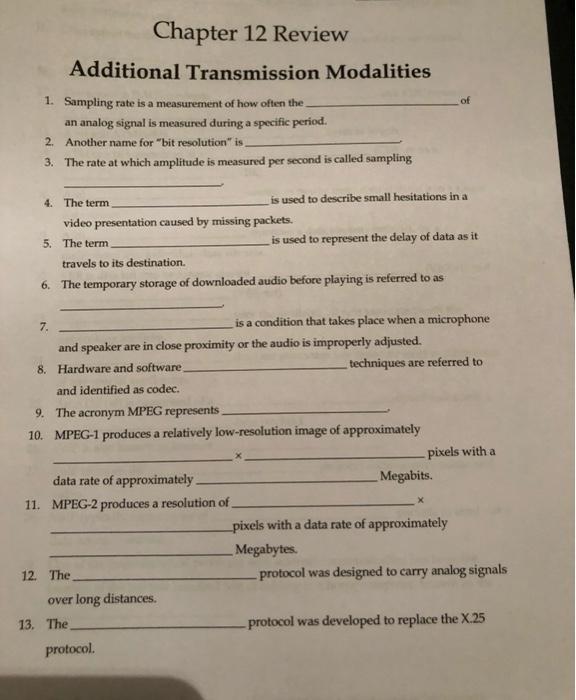
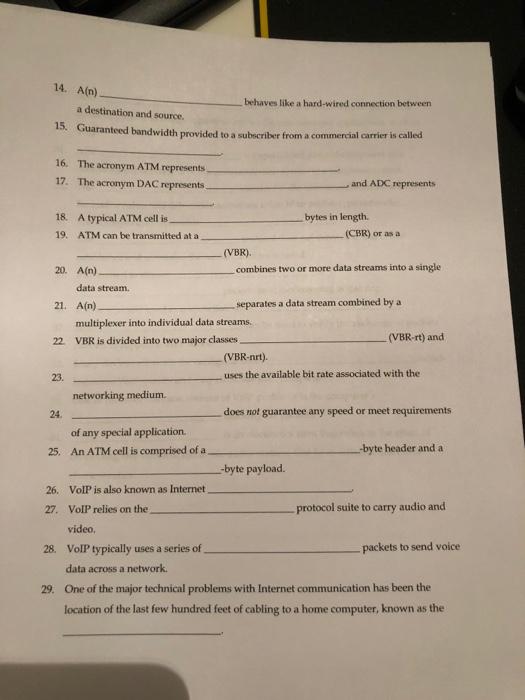
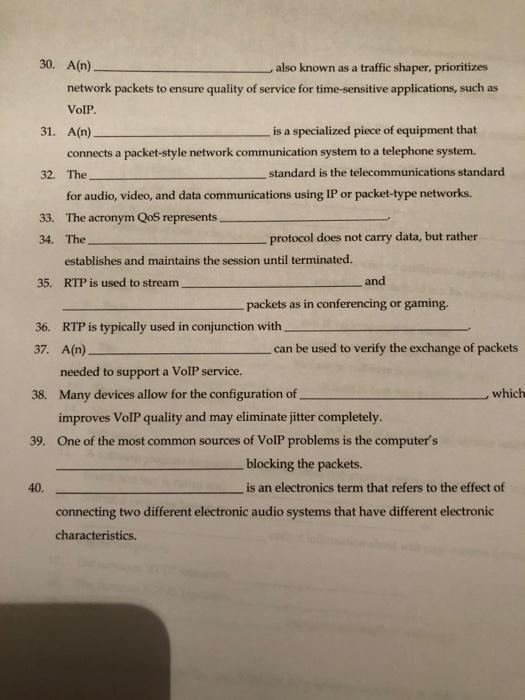
Chapter 12 Review Additional Transmission Modalities 1. Sampling rate is a measurement of how often the an analog signal is measured during a specific period. 2. Another name for "bit resolution" is 3. The rate at which amplitude is measured per second is called sampling of 4. The term is used to describe small hesitations in a video presentation caused by missing packets. 5. The term is used to represent the delay of data as it travels to its destination. 6. The temporary storage of downloaded audio before playing is referred to as 7. is a condition that takes place when a microphone and speaker are in close proximity or the audio is improperly adjusted. 8. Hardware and software techniques are referred to and identified as codec. 9. The acronym MPEG represents 10. MPEG-1 produces a relatively low-resolution image of approximately pixels with a data rate of approximately Megabits. 11. MPEG-2 produces a resolution of pixels with a data rate of approximately Megabytes. 12. The protocol was designed to carry analog signals over long distances. 13. The protocol was developed to replace the X.25 protocol. 14. A(n) a destination and source. behaves like a hard-wired connection between 15. Guaranteed bandwidth provided to a subscriber from a commercial carrier is called 16. The acronym ATM represents 17. The acronym DAC represents and ADC represents 23. 18. A typical ATM cell is bytes in length 19. ATM can be transmitted at a (CBR) or as a (VBR) 20. A(n) combines two or more data streams into a single data stream 21. A(n) separates a data stream combined by a multiplexer into individual data streams. 22 VBR is divided into two major classes (VBR-rt) and (VBR-nrt). uses the available bit rate associated with the networking medium 24 does not guarantee any speed or meet requirements of any special application 25. An ATM cell is comprised of a -byte header and a --byte payload. 26. VoIP is also known as Internet 27. VoIP relies on the -protocol suite to carry audio and video, 28. VoIP typically uses a series of packets to send voice data across a network 29. One of the major technical problems with Internet communication has been the location of the last few hundred feet of cabling to a home computer, known as the 30. A(n) also known as a traffic shaper, prioritizes network packets to ensure quality of service for time-sensitive applications, such as VoIP. 31. A(n) is a specialized piece of equipment that connects a packet-style network communication system to a telephone system. 32. The standard is the telecommunications standard for audio, video, and data communications using IP or packet-type networks. 33. The acronym QoS represents 34. The protocol does not carry data, but rather establishes and maintains the session until terminated. 35. RTP is used to stream and packets as in conferencing or gaming. 36. RTP is typically used in conjunction with 37. A(n) can be used to verify the exchange of packets needed to support a VoIP service. 38. Many devices allow for the configuration of which improves VoIP quality and may eliminate jitter completely. 39. One of the most common sources of VoIP problems is the computer's blocking the packets. 40. is an electronics term that refers to the effect of connecting two different electronic audio systems that have different electronic characteristics
Step by Step Solution
There are 3 Steps involved in it
Sure Lets fill in the blanks Sampling rate is a measurement of how often the sampling of an analog signal is measured during a specific period Another name for bit resolution is bit depth The rate at ... View full answer

Get step-by-step solutions from verified subject matter experts
 Study Help