







Question: Chapter 1-3 case study for project below: Did you need more information or need more time? Based on the case study background information for Chapters
Chapter 1-3 case study for project below:
Did you need more information or need more time?
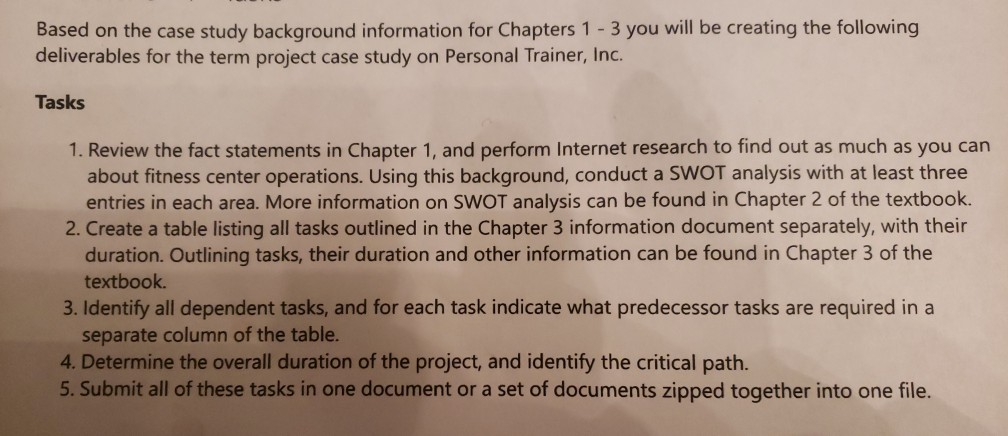
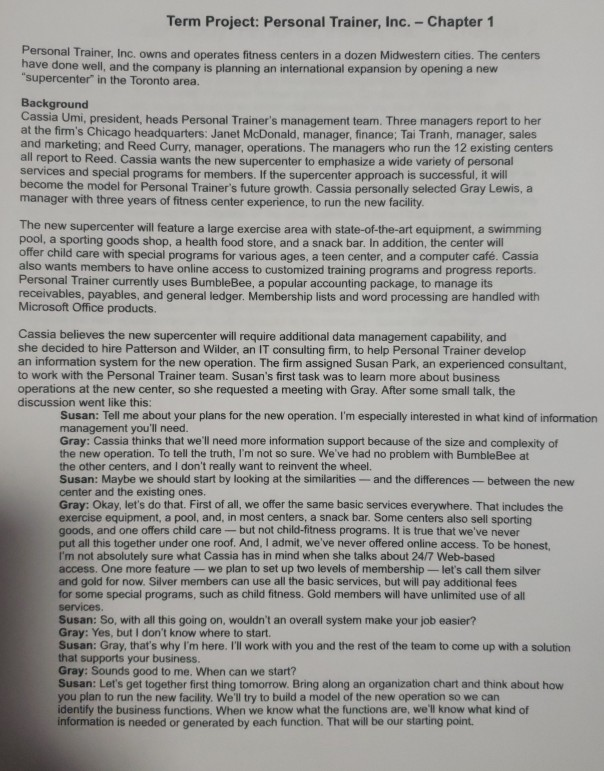
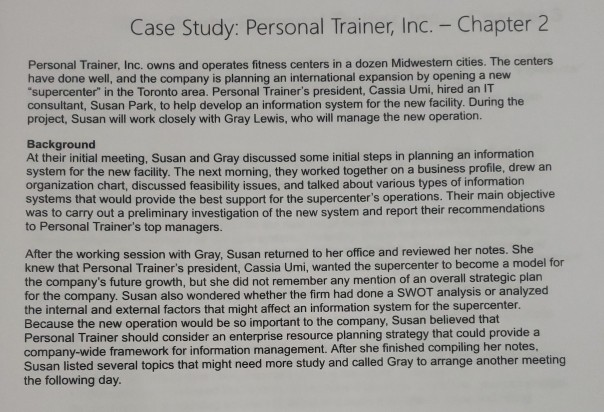
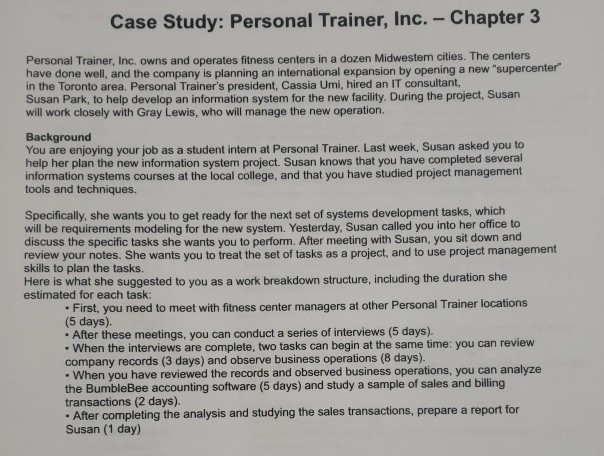
Based on the case study background information for Chapters 1 - 3 you will be creating the following deliverables for the term project case study on Personal Trainer, Inc. Tasks 1. Review the fact statements in Chapter 1, and perform Internet research to find out as much as you can about fitness center operations. Using this background, conduct a SWOT analysis with at least three entries in each area. More information on SWOT analysis can be found in Chapter 2 of the textbook. 2. Create a table listing all tasks outlined in the Chapter 3 information document separately, with their duration. Outlining tasks, their duration and other information can be found in Chapter 3 of the textbook 3. Identify all dependent tasks, and for each task indicate what predecessor tasks are required in a separate column of the table. 4. Determine the overall duration of the project, and identify the critical path. 5. Submit all of these tasks in one document or a set of documents zipped together into one file. Term Project: Personal Trainer, Inc. - Chapter 1 Personal Trainer, Inc. owns and operates fitness centers in a dozen Midwestern cities. The centers have done well, and the company is planning an international expansion by opening a new "supercenter in the Toronto area. Background Cassia Umi, president, heads Personal Trainer's management team. Three managers report to her at the firm's Chicago headquarters: Janet McDonald, manager, finance, Tai Tranh, manager, sales and marketing, and Reed Curry, manager, operations. The managers who run the 12 existing centers all report to Reed. Cassia wants the new supercenter to emphasize a wide variety of personal services and special programs for members. If the supercenter approach is successful, it will become the model for Personal Trainer's future growth. Cassia personally selected Gray Lewis, a manager with three years of fitness center experience, to run the new facility. The new supercenter will feature a large exercise area with state-of-the-art equipment, a swimming pool, a sporting goods shop, a health food store, and a snack bar. In addition, the center will offer child care with special programs for various ages, a teen center, and a computer cafe. Cassia also wants members to have online access to customized training programs and progress reports Personal Trainer currently uses BumbleBee, a popular accounting package, to manage its receivables, payables, and general ledger. Membership lists and word processing are handled with Microsoft Office products. Cassia believes the new supercenter will require additional data management capability, and she decided to hire Patterson and Wilder, an IT consulting firm, to help Personal Trainer develop ew operation. The firm assigned Susan Park, an experienced consultant, to work with the Personal Trainer team. Susan's first task was to leam more about business operations at the new center, so she requested a meeting with Gray. After some small talk, the discussion went like this: Susan: Tell me about your plans for the new operation. I'm especially interested in what kind of information management you'll need. Gray: Cassia thinks that we'll need more information support because of the size and complexity of the new operation. To tell the truth, I'm not so sure. We've had no problem with BumbleBee at the other centers, and I don't really want to reinvent the wheel. Susan: Maybe we should start by looking at the similarities and the differences between the new center and the existing ones. Gray: Okay, let's do that. First of all, we offer the same basic services everywhere. That includes the exercise equipment, a pool, and, in most centers, a snack bar. Some centers also sell sporting goods, and one offers child care-but not child-fitness programs. It is true that we've never put all this together under one roof. And, I admit, we've never offered online access. To be honest, I'm not absolutely sure what Cassia has in mind when she talks about 24/7 Web-based access. One more feature - we plan to set up two levels of membership - let's call them silver and gold for now. Silver members can use all the basic services, but will pay additional fees for some special programs, such as child fitness. Gold members will have unlimited use of all services. Susan: So, with all this going on, wouldn't an overall system make your job easier? Gray: Yes, but I don't know where to start. Susan: Gray, that's why I'm here. I'll work with you and the rest of the team to come up with a solution that supports your business. Gray: Sounds good to me. When can we start? Susan: Let's get together first thing tomorrow. Bring along an organization chart and think about how you plan to run the new facility. We'll try to build a model of the new operation so we can identify the business functions. When we know what the functions are, we'll know what kind of information is needed or generated by each function. That will be our starting point Case Study: Personal Trainer, Inc. - Chapter 2 Personal Trainer, Inc. owns and operates fitness centers in a dozen Midwestern cities. The centers have done well, and the company is planning an international expansion by opening a new "supercenter" in the Toronto area. Personal Trainer's president, Cassia Umi, hired an IT consultant, Susan Park, to help develop an information system for the new facility. During the project, Susan will work closely with Gray Lewis, who will manage the new operation. Background At their initial meeting, Susan and Gray discussed some initial steps in planning an information ed together on a business profile, drew an organization chart, discussed feasibility issues, and talked about various types of information systems that would provide the best support for the supercenter's operations. Their main objective was to carry out a preliminary investigation of the new system and report their recommendations to Personal Trainer's top managers. After the working session with Gray, Susan returned to her office and reviewed her notes. She knew that Personal Trainer's president, Cassia Umi, wanted the supercenter to become a model for the company's future growth, but she did not remember any mention of an overall strategic plan for the company. Susan also wondered whether the firm had done a SWOT analysis or analyzed the internal and external factors that might affect an information system for the supercenter Because the new operation would be so important to the company, Susan believed that Personal Trainer should consider an enterprise resource planning strategy that could provide a company-wide framework for information management. After she finished compiling her notes. Susan listed several topics that might need more study and called Gray to arrange another meeting the following day. Case Study: Personal Trainer, Inc. - Chapter 3 Personal Trainer, Inc. owns and operates fitness centers in a dozen Midwestern cities. The centers have done well, and the company is planning an international expansion by opening a new "supercenter" in the Toronto area. Personal Trainer's president. Cassia Umi, hired an IT consultant. Susan Park, to help develop an information system for the new facility. During the project, Susan will work closely with Gray Lewis, who will manage the new operation. Background You are enjoying your job as a student intern at Personal Trainer. Last week, Susan asked you to help her plan the new information system project. Susan knows that you have completed several information systems courses at the local college, and that you have studied project management tools and techniques. Specifically, she wants you to get ready for the next set of systems development tasks, which sling for the new system. Yesterday, Susan called you into her office to discuss the specific tasks she wants you to perform. After meeting with Susan, you sit down and review your notes. She wants you to treat the set of tasks as a project, and to use project management skills to plan the tasks. Here is what she suggested to you as a work breakdown structure, including the duration she estimated for each task: . First, you need to meet with fitness center managers at other Personal Trainer locations (5 days). After these meetings, you can conduct a series of interviews (5 days). When the interviews are complete, two tasks can begin at the same time: you can review company records (3 days) and observe business operations (8 days). . When you have reviewed the records and observed business operations, you can analyze the BumbleBee accounting software (5 days) and study a sample of sales and billing transactions (2 days). After completing the analysis and studying the sales transactions, prepare a report for Susan (1 day) Based on the case study background information for Chapters 1 - 3 you will be creating the following deliverables for the term project case study on Personal Trainer, Inc. Tasks 1. Review the fact statements in Chapter 1, and perform Internet research to find out as much as you can about fitness center operations. Using this background, conduct a SWOT analysis with at least three entries in each area. More information on SWOT analysis can be found in Chapter 2 of the textbook. 2. Create a table listing all tasks outlined in the Chapter 3 information document separately, with their duration. Outlining tasks, their duration and other information can be found in Chapter 3 of the textbook 3. Identify all dependent tasks, and for each task indicate what predecessor tasks are required in a separate column of the table. 4. Determine the overall duration of the project, and identify the critical path. 5. Submit all of these tasks in one document or a set of documents zipped together into one file. Term Project: Personal Trainer, Inc. - Chapter 1 Personal Trainer, Inc. owns and operates fitness centers in a dozen Midwestern cities. The centers have done well, and the company is planning an international expansion by opening a new "supercenter in the Toronto area. Background Cassia Umi, president, heads Personal Trainer's management team. Three managers report to her at the firm's Chicago headquarters: Janet McDonald, manager, finance, Tai Tranh, manager, sales and marketing, and Reed Curry, manager, operations. The managers who run the 12 existing centers all report to Reed. Cassia wants the new supercenter to emphasize a wide variety of personal services and special programs for members. If the supercenter approach is successful, it will become the model for Personal Trainer's future growth. Cassia personally selected Gray Lewis, a manager with three years of fitness center experience, to run the new facility. The new supercenter will feature a large exercise area with state-of-the-art equipment, a swimming pool, a sporting goods shop, a health food store, and a snack bar. In addition, the center will offer child care with special programs for various ages, a teen center, and a computer cafe. Cassia also wants members to have online access to customized training programs and progress reports Personal Trainer currently uses BumbleBee, a popular accounting package, to manage its receivables, payables, and general ledger. Membership lists and word processing are handled with Microsoft Office products. Cassia believes the new supercenter will require additional data management capability, and she decided to hire Patterson and Wilder, an IT consulting firm, to help Personal Trainer develop ew operation. The firm assigned Susan Park, an experienced consultant, to work with the Personal Trainer team. Susan's first task was to leam more about business operations at the new center, so she requested a meeting with Gray. After some small talk, the discussion went like this: Susan: Tell me about your plans for the new operation. I'm especially interested in what kind of information management you'll need. Gray: Cassia thinks that we'll need more information support because of the size and complexity of the new operation. To tell the truth, I'm not so sure. We've had no problem with BumbleBee at the other centers, and I don't really want to reinvent the wheel. Susan: Maybe we should start by looking at the similarities and the differences between the new center and the existing ones. Gray: Okay, let's do that. First of all, we offer the same basic services everywhere. That includes the exercise equipment, a pool, and, in most centers, a snack bar. Some centers also sell sporting goods, and one offers child care-but not child-fitness programs. It is true that we've never put all this together under one roof. And, I admit, we've never offered online access. To be honest, I'm not absolutely sure what Cassia has in mind when she talks about 24/7 Web-based access. One more feature - we plan to set up two levels of membership - let's call them silver and gold for now. Silver members can use all the basic services, but will pay additional fees for some special programs, such as child fitness. Gold members will have unlimited use of all services. Susan: So, with all this going on, wouldn't an overall system make your job easier? Gray: Yes, but I don't know where to start. Susan: Gray, that's why I'm here. I'll work with you and the rest of the team to come up with a solution that supports your business. Gray: Sounds good to me. When can we start? Susan: Let's get together first thing tomorrow. Bring along an organization chart and think about how you plan to run the new facility. We'll try to build a model of the new operation so we can identify the business functions. When we know what the functions are, we'll know what kind of information is needed or generated by each function. That will be our starting point Case Study: Personal Trainer, Inc. - Chapter 2 Personal Trainer, Inc. owns and operates fitness centers in a dozen Midwestern cities. The centers have done well, and the company is planning an international expansion by opening a new "supercenter" in the Toronto area. Personal Trainer's president, Cassia Umi, hired an IT consultant, Susan Park, to help develop an information system for the new facility. During the project, Susan will work closely with Gray Lewis, who will manage the new operation. Background At their initial meeting, Susan and Gray discussed some initial steps in planning an information ed together on a business profile, drew an organization chart, discussed feasibility issues, and talked about various types of information systems that would provide the best support for the supercenter's operations. Their main objective was to carry out a preliminary investigation of the new system and report their recommendations to Personal Trainer's top managers. After the working session with Gray, Susan returned to her office and reviewed her notes. She knew that Personal Trainer's president, Cassia Umi, wanted the supercenter to become a model for the company's future growth, but she did not remember any mention of an overall strategic plan for the company. Susan also wondered whether the firm had done a SWOT analysis or analyzed the internal and external factors that might affect an information system for the supercenter Because the new operation would be so important to the company, Susan believed that Personal Trainer should consider an enterprise resource planning strategy that could provide a company-wide framework for information management. After she finished compiling her notes. Susan listed several topics that might need more study and called Gray to arrange another meeting the following day. Case Study: Personal Trainer, Inc. - Chapter 3 Personal Trainer, Inc. owns and operates fitness centers in a dozen Midwestern cities. The centers have done well, and the company is planning an international expansion by opening a new "supercenter" in the Toronto area. Personal Trainer's president. Cassia Umi, hired an IT consultant. Susan Park, to help develop an information system for the new facility. During the project, Susan will work closely with Gray Lewis, who will manage the new operation. Background You are enjoying your job as a student intern at Personal Trainer. Last week, Susan asked you to help her plan the new information system project. Susan knows that you have completed several information systems courses at the local college, and that you have studied project management tools and techniques. Specifically, she wants you to get ready for the next set of systems development tasks, which sling for the new system. Yesterday, Susan called you into her office to discuss the specific tasks she wants you to perform. After meeting with Susan, you sit down and review your notes. She wants you to treat the set of tasks as a project, and to use project management skills to plan the tasks. Here is what she suggested to you as a work breakdown structure, including the duration she estimated for each task: . First, you need to meet with fitness center managers at other Personal Trainer locations (5 days). After these meetings, you can conduct a series of interviews (5 days). When the interviews are complete, two tasks can begin at the same time: you can review company records (3 days) and observe business operations (8 days). . When you have reviewed the records and observed business operations, you can analyze the BumbleBee accounting software (5 days) and study a sample of sales and billing transactions (2 days). After completing the analysis and studying the sales transactions, prepare a report for Susan (1 day)Step by Step Solution
There are 3 Steps involved in it
1 Expert Approved Answer
Step: 1 Unlock

Question Has Been Solved by an Expert!
Get step-by-step solutions from verified subject matter experts
Step: 2 Unlock
Step: 3 Unlock
 Study Help