







Question: Chapter 16 covers Financial Statement Analysis. As you noted in the chapter, there are 3 common analytical techniques used to analyze a company's financial statements:
Chapter 16 covers Financial Statement Analysis. As you noted in the chapter, there are 3 common analytical techniques used to analyze a company's financial statements:
1) Horizontal Analysis
2) Vertical Analysis
3) Ratio Analysis
Each technique can be used to assess the financial health and future prospects of a company.
The ratios that can be used fall into the following categories (see page 752):
1) Liquidity
2) Asset Management
3) Debt Management
4) Profitability
5) Market Performance
In the text the authors state that an analyst should not rely solely on financial statement analysis when evaluating a company? Do you agree or disagree? Why?
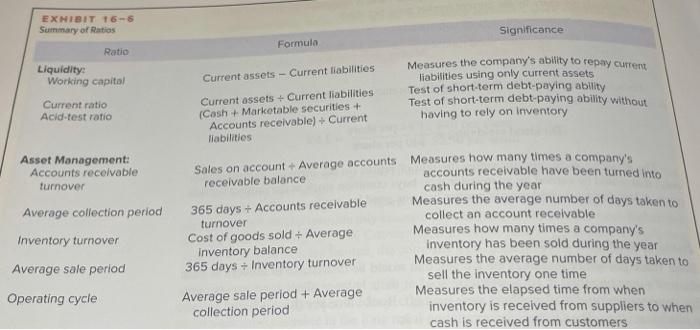
EXHIBIT 16 -6 Summary of Ratios Significance Formula Ratio Current assets - Current liabilities Liquidity: Working capital Current ratio Acid-test ratio Measures the company's ability to repay current liabilities using only current assets Test of short-term debt-paying ability Test of short-term debt-paying ability without having to rely on Inventory Current assets + Current liabilities (Cash Marketable securities + Accounts receivable) + Current liabilities Asset Management: Accounts receivable turnover Average collection period Sales on account - Average accounts receivable balance 365 days + Accounts receivable turnover Cost of goods sold - Average Inventory balance 365 days + Inventory turnover Inventory turnover Measures how many times a company's accounts receivable have been turned into cash during the year Measures the average number of days taken to collect an account receivable Measures how many times a company's inventory has been sold during the year Measures the average number of days taken to sell the inventory one time Measures the elapsed time from when inventory is received from suppliers to when cash is received from customers Average sale period Operating cycle Average sale period + Average collection period
Step by Step Solution
There are 3 Steps involved in it

Get step-by-step solutions from verified subject matter experts
 Study Help