







Question: Chapter 16 Help Save & Exit Submit Saved Check my work A 30-year maturity bond making annual coupon payments with a coupon rate of 8.2%
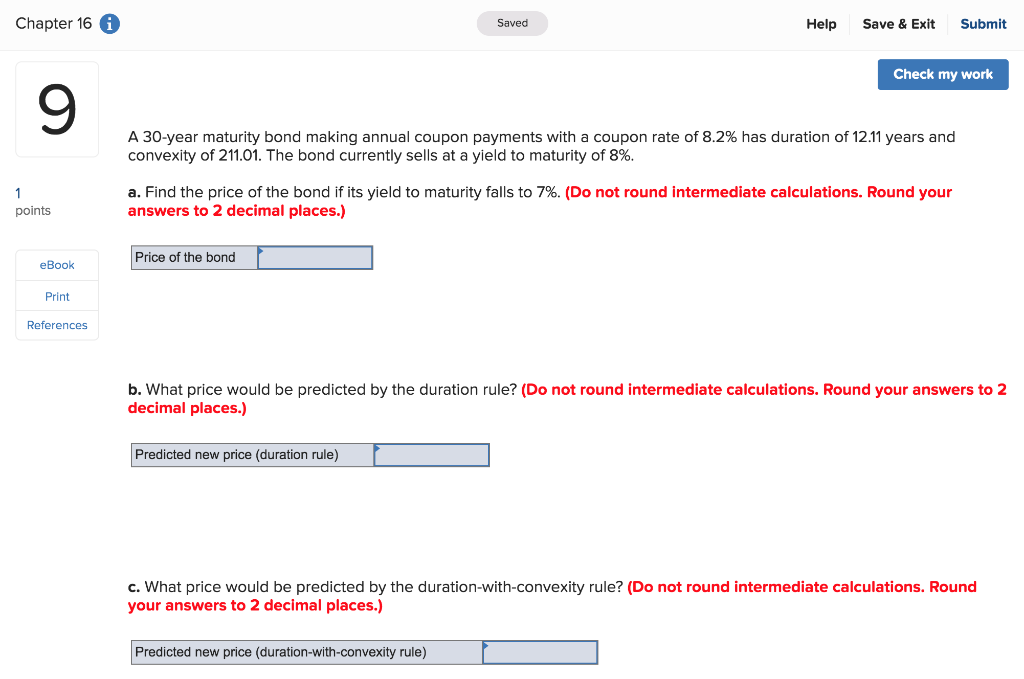
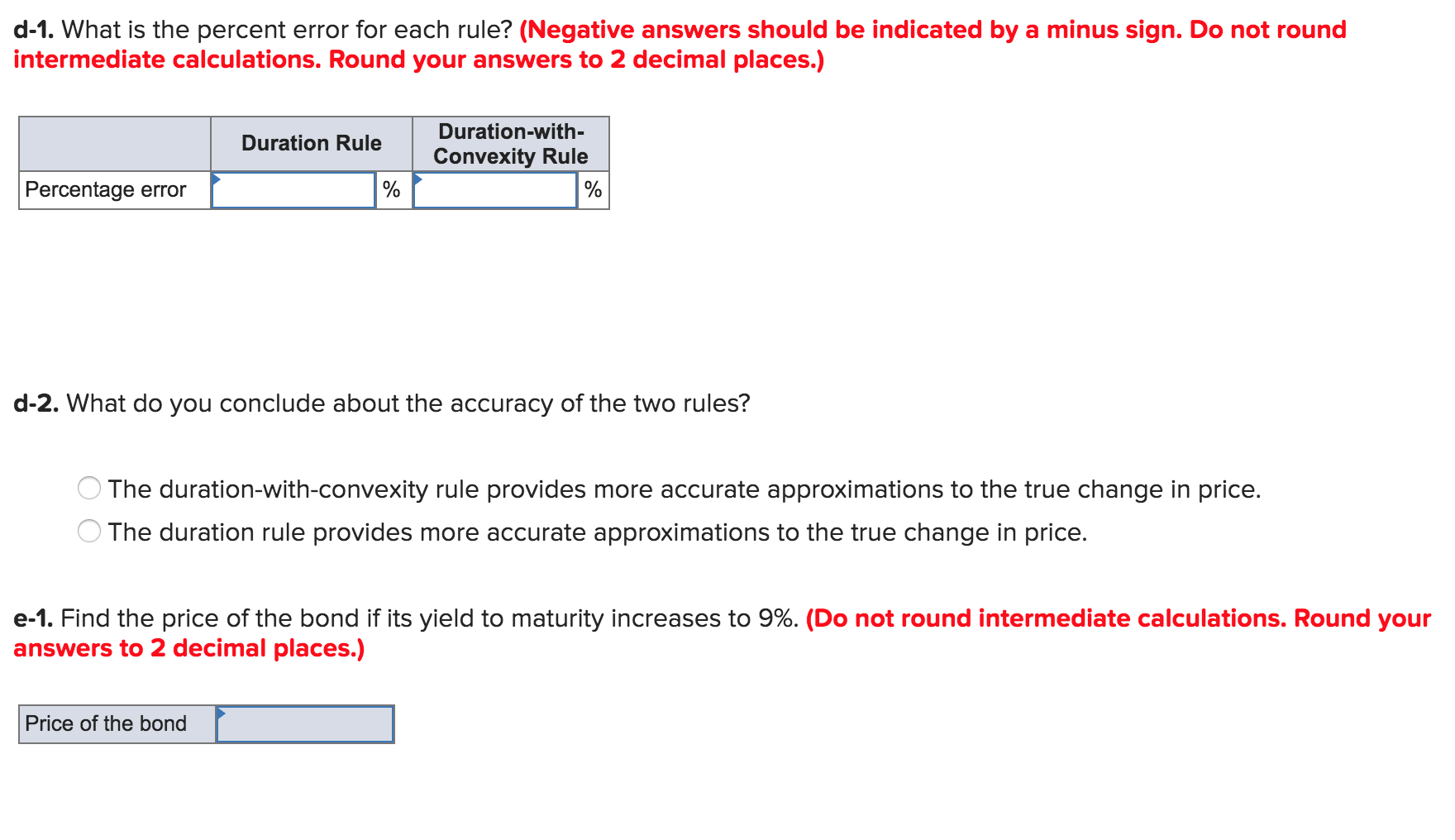
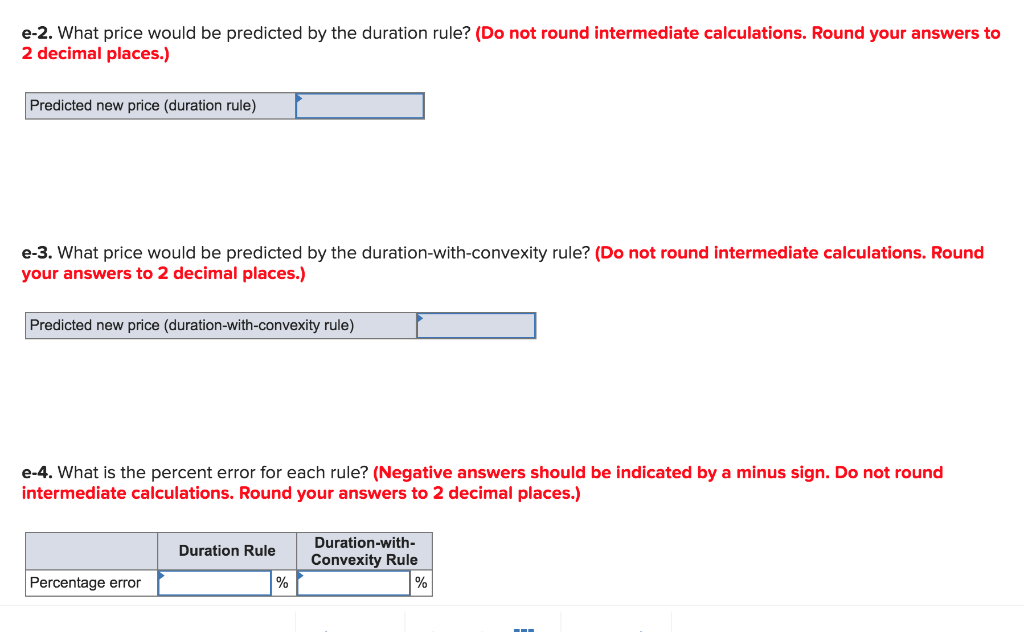
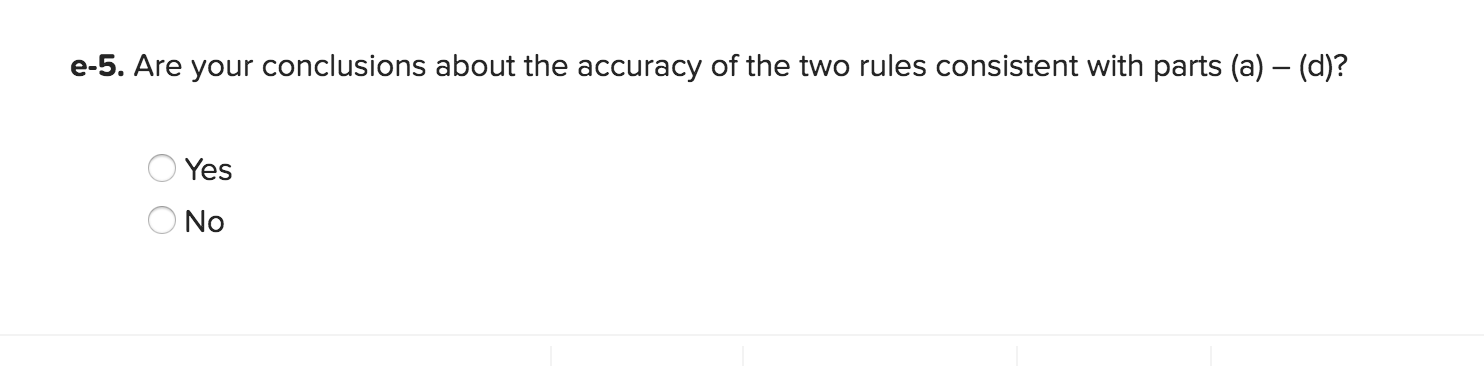
Chapter 16 Help Save & Exit Submit Saved Check my work A 30-year maturity bond making annual coupon payments with a coupon rate of 8.2% has duration of 12.11 years and convexity of 211.01. The bond currently sells at a yield to maturity of 8%. a. Find the price of the bond if its yield to maturity falls to 7%. (Do not round intermediate calculations. Round your answers to 2 decimal places.) 1 points Price of the bond ook Print References b. What price would be predicted by the duration rule? (Do not round intermediate calculations. Round your answers to 2 decimal places.) Predicted new price (duration rule) c. What price would be predicted by the duration-with-convexity rule? (Do not round intermediate calculations. Round your answers to 2 decimal places.) Predicted new price (duration-with-convexity rule) d-1. What is the percent error for each rule? (Negative answers should be indicated by a minus sign. Do not round intermediate calculations. Round your answers to 2 decimal places.) Duration-with- Duration Rule Convexity Rule Percentage error d-2. What do you conclude about the accuracy of the two rules? The duration-with-convexity rule provides more accurate approximations to the true change in price. The duration rule provides more accurate approximations to the true change in price. e-1. Find the price of the bond if its yield to maturity increases to 9%. (Do not round intermediate calculations. Round your answers to 2 decimal places.) Price of the bond e-2. What price would be predicted by the duration rule? (Do not round intermediate calculations. Round your answers to 2 decimal places.) Predicted new price (duration rule) e-3. What price would be predicted by the duration-with-convexity rule? (Do not round intermediate calculations. Round your answers to 2 decimal places.) Predicted new price (duration-with-convexity rule) e-4. What is the percent error for each rule? (Negative answers should be indicated by a minus sign. Do not round intermediate calculations. Round your answers to 2 decimal places.) Duration-with- Duration Rule Convexity Rule Percentage error e-5. Are your conclusions about the accuracy of the two rules consistent with parts (a) - (d)? Yes No Chapter 16 Help Save & Exit Submit Saved Check my work A 30-year maturity bond making annual coupon payments with a coupon rate of 8.2% has duration of 12.11 years and convexity of 211.01. The bond currently sells at a yield to maturity of 8%. a. Find the price of the bond if its yield to maturity falls to 7%. (Do not round intermediate calculations. Round your answers to 2 decimal places.) 1 points Price of the bond ook Print References b. What price would be predicted by the duration rule? (Do not round intermediate calculations. Round your answers to 2 decimal places.) Predicted new price (duration rule) c. What price would be predicted by the duration-with-convexity rule? (Do not round intermediate calculations. Round your answers to 2 decimal places.) Predicted new price (duration-with-convexity rule) d-1. What is the percent error for each rule? (Negative answers should be indicated by a minus sign. Do not round intermediate calculations. Round your answers to 2 decimal places.) Duration-with- Duration Rule Convexity Rule Percentage error d-2. What do you conclude about the accuracy of the two rules? The duration-with-convexity rule provides more accurate approximations to the true change in price. The duration rule provides more accurate approximations to the true change in price. e-1. Find the price of the bond if its yield to maturity increases to 9%. (Do not round intermediate calculations. Round your answers to 2 decimal places.) Price of the bond e-2. What price would be predicted by the duration rule? (Do not round intermediate calculations. Round your answers to 2 decimal places.) Predicted new price (duration rule) e-3. What price would be predicted by the duration-with-convexity rule? (Do not round intermediate calculations. Round your answers to 2 decimal places.) Predicted new price (duration-with-convexity rule) e-4. What is the percent error for each rule? (Negative answers should be indicated by a minus sign. Do not round intermediate calculations. Round your answers to 2 decimal places.) Duration-with- Duration Rule Convexity Rule Percentage error e-5. Are your conclusions about the accuracy of the two rules consistent with parts (a) - (d)? Yes No
Step by Step Solution
There are 3 Steps involved in it

Get step-by-step solutions from verified subject matter experts
 Study Help