Question: CHAPTER 17 - TECHNICAL CASE CALCULATE SYSTEM RELIABILITY - For each of the following set up and graph the system, complete the calculations, and provide
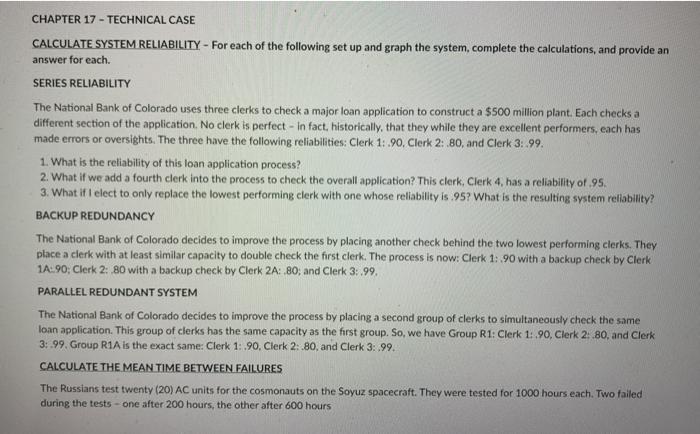
CHAPTER 17 - TECHNICAL CASE CALCULATE SYSTEM RELIABILITY - For each of the following set up and graph the system, complete the calculations, and provide an answer for each. SERIES RELIABILITY The National Bank of Colorado uses three clerks to check a major loan application to construct a $500 million plant. Each checks a different section of the application. No clerk is perfect - In fact, historically, that they while they are excellent performers, each has made errors or oversights. The three have the following reliabilities: Clerk 1:.90, Clerk 2: 80, and Clerk 3: 99. 1. What is the reliability of this loan application process? 2. What if we add a fourth clerk into the process to check the overall application? This clerk, Clerk 4, has a reliability of 95. 3. What if I elect to only replace the lowest performing clerk with one whose reliability is .95? What is the resulting system reliability? BACKUP REDUNDANCY The National Bank of Colorado decides to improve the process by placing another check behind the two lowest performing clerks. They place a clerk with at least similar capacity to double check the first clerk. The process is now: Clerk 1: 90 with a backup check by Clerk 1A:90; Clerk 2: 80 with a backup check by Clerk 2A: 80; and Clerk 3: 99, PARALLEL REDUNDANT SYSTEM The National Bank of Colorado decides to improve the process by placing a second group of clerks to simultaneously check the same loan application. This group of clerks has the same capacity as the first group. So, we have Group R1: Clerk 1: 90, Clerk 2: 80, and Clerk 3: 99. Group R1A is the exact same: Clerk 1:.90, Clerk 2: 80, and Clerk 3:99. CALCULATE THE MEAN TIME BETWEEN FAILURES The Russians test twenty (20) AC units for the cosmonauts on the Soyuz spacecraft. They were tested for 1000 hours each. Two failed during the tests - one after 200 hours, the other after 600 hours CHAPTER 17 - TECHNICAL CASE CALCULATE SYSTEM RELIABILITY - For each of the following set up and graph the system, complete the calculations, and provide an answer for each. SERIES RELIABILITY The National Bank of Colorado uses three clerks to check a major loan application to construct a $500 million plant. Each checks a different section of the application. No clerk is perfect - In fact, historically, that they while they are excellent performers, each has made errors or oversights. The three have the following reliabilities: Clerk 1:.90, Clerk 2: 80, and Clerk 3: 99. 1. What is the reliability of this loan application process? 2. What if we add a fourth clerk into the process to check the overall application? This clerk, Clerk 4, has a reliability of 95. 3. What if I elect to only replace the lowest performing clerk with one whose reliability is .95? What is the resulting system reliability? BACKUP REDUNDANCY The National Bank of Colorado decides to improve the process by placing another check behind the two lowest performing clerks. They place a clerk with at least similar capacity to double check the first clerk. The process is now: Clerk 1: 90 with a backup check by Clerk 1A:90; Clerk 2: 80 with a backup check by Clerk 2A: 80; and Clerk 3: 99, PARALLEL REDUNDANT SYSTEM The National Bank of Colorado decides to improve the process by placing a second group of clerks to simultaneously check the same loan application. This group of clerks has the same capacity as the first group. So, we have Group R1: Clerk 1: 90, Clerk 2: 80, and Clerk 3: 99. Group R1A is the exact same: Clerk 1:.90, Clerk 2: 80, and Clerk 3:99. CALCULATE THE MEAN TIME BETWEEN FAILURES The Russians test twenty (20) AC units for the cosmonauts on the Soyuz spacecraft. They were tested for 1000 hours each. Two failed during the tests - one after 200 hours, the other after 600 hours









 Study Help