Question: Chapter 2 Case Studies and Questionnaire (1).pdf 8/11 - 100% + Leadership Trait Questionnaire (LTQ) Serwction: The purpose of this questionnaire is to measure personal
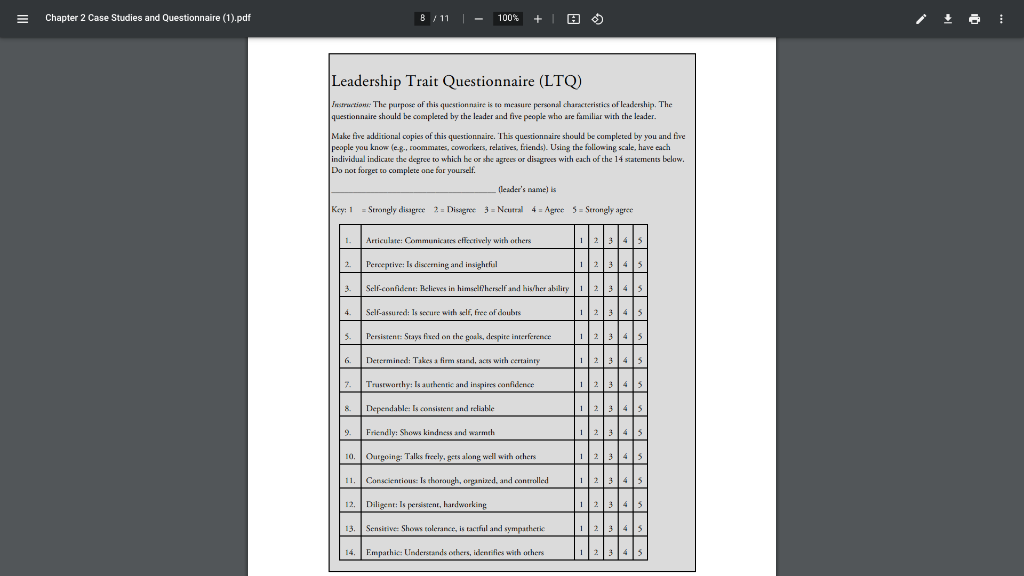
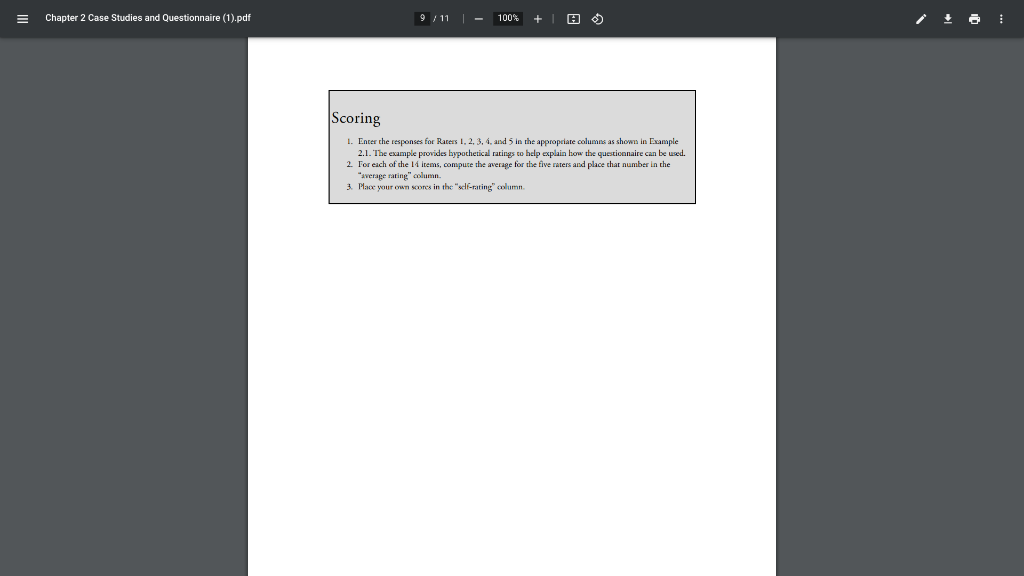
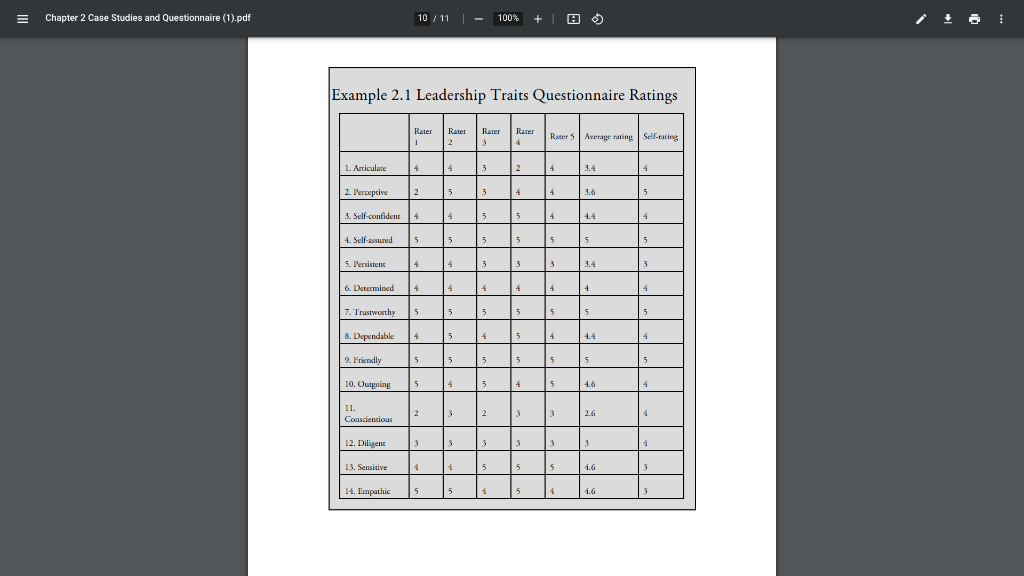
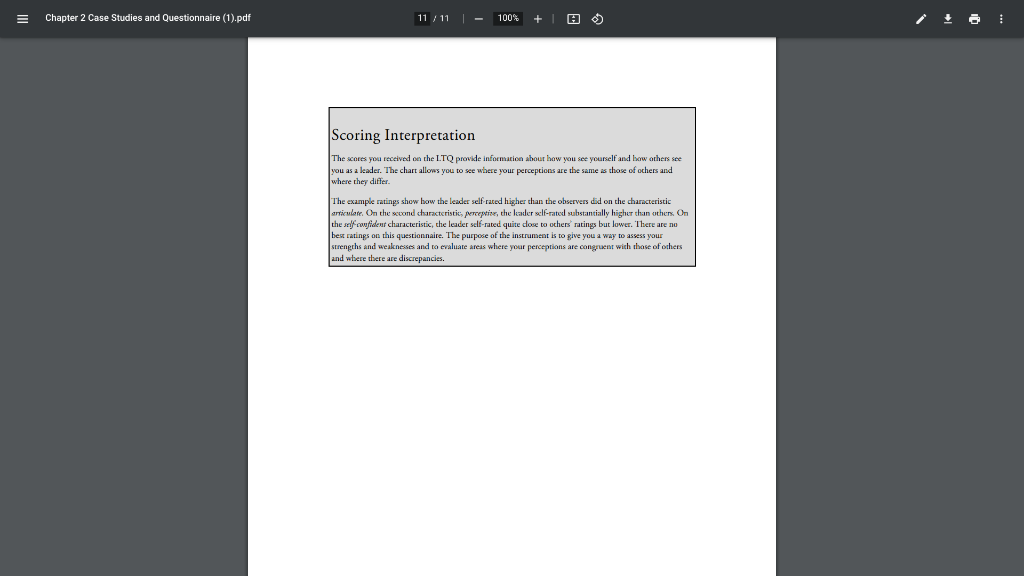
Chapter 2 Case Studies and Questionnaire (1).pdf 8/11 - 100% + Leadership Trait Questionnaire (LTQ) Serwction: The purpose of this questionnaire is to measure personal chacteristics of leadership. The questionnaire should be completed by the leader and five people who are familiar with the leader. Make five additional copies of this questionnaire. This questionnaire should be completed by you and five people you know (eg, roommates, coworkers, relatives, friends). Using the following scale, have each individual indicate the degree to which he or she agrees or disagrees with each of the 14 statements below. Do not forget to complete one for yourself fleader's name) is Key: 1 = Strongly disagree 2. Dicigre 3 = Neutral 4 = Agree S = Serongly agree Articulate: Communicate effectively with others Perceptive: Is discerning and insightful Self-confidene: Believes in himself herself and his/her ability Self-assured: Is secure with self, free of doubts Persistent: Srays fixed on the goals, despite interference Determined: Takes a firm sand, acts with certainty Trustworthy: ks authentic and inspires confidence Dependable: Is consistent and reliable Friendly: Shows kindness and warmth 10. Our going: Talks freely, gets along well with others 11. Conscientious Is thorough, organized and controlled 12 Diligent: Is persistent, hardworking 13. Sensitive Shows tolerance, is raceful and sympathetic Empathic: Understands others, identifies with others Chapter 2 Case Studies and Questionnaire (1).pdf 9/11 - 100% + 10 Scoring 1. Enter the responses for Rates 1, 2, 3, 4, and 5 in the appropriate columns as shown in Example 2.1. The example provides hypothetical ratings to help explain how the questionnaire can be used. 2. For each of the 14 items, compute the average for the five raters and place that number in the "average rating" column 3. Mace your own scores in the "sdf-rating" column. = 2 1 Chapter 2 Case Studies and Questionnaire (1).pdf 10/11 100% + Example 2.1 Leadership Traits Questionnaire Ratings Rater Rater Rater Rater 3 Rate 5 Average rating Self-rating 1 1. Articulate 4 3 12 4 4 3.4 2. Perceptive 2 5 3 4 4 3.6 5 3. Self-confident 4 5 5 4 4 4. Self-assured 5 5 5 5 5 5 5 5 5. Persistent 4 3 3 3 3 6. Determined 4 4 4 4 4 4 4 7. Trustworthy 15 5 5 5 5. 5 5 8. Dependable 4 5 4 5 4 4 4.4 4 9. Friendly 5. 5 5 5 5 5 5 5 10. Outgoing 5 4 5 4 4. 5 4.6 4 11. Conscientious 2 2 2 3 3 2.6 12. Diligent 3 3 3 3 3 3 1 13. Sensitive 1 5 5 5 3 14. Empathic 5 15 1 5 4 3 Chapter 2 Case Studies and Questionnaire (1).pdf 11/11 - 100% + 100 Scoring Interpretation The scores you received on the LTQ provide information about how you see yourself and low others see you as a leader. The chart allows you to see where your perceptions are the same as those of others and where they differ. The example ratings show how the leader self-rated higher than the observers did on the characteristic articulate. On the second characteristic, perceptime, the kader self-rated substantially higher than others. On the self-confident characteristic, the leader self-rated quite close to others ratings but lower. There are no best ratings on this questionnaire. The purpose of the instrument is to give you a way to assess your strengths and weaknesses and to evaluate areas where your perceptions congruent with those of others and where there are discrepancies









 Study Help