







Question: Chapter 2: Cost concepts, behaviour and estimationn True/False questions 1. Cost behaviour refers to the way that costs vary in relation to changes in an
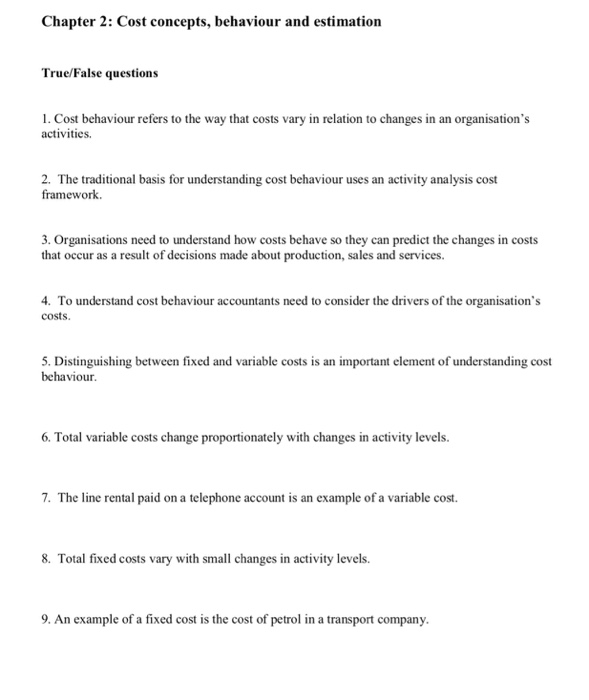
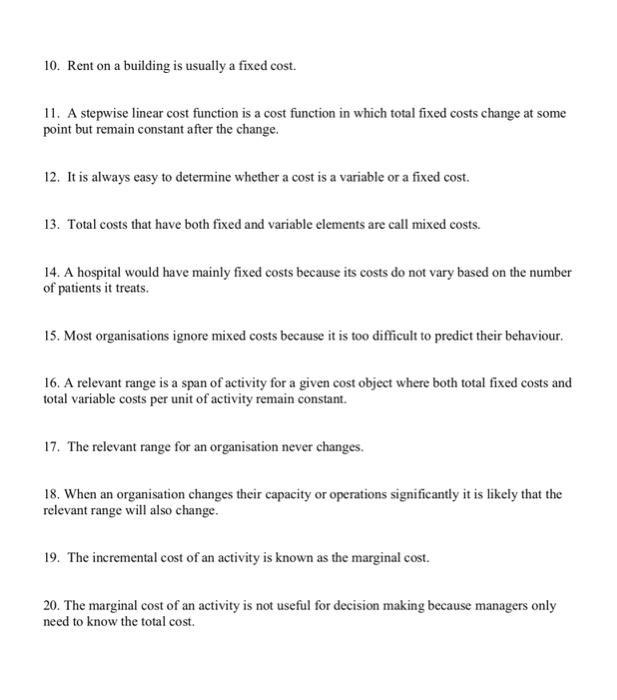
Chapter 2: Cost concepts, behaviour and estimationn True/False questions 1. Cost behaviour refers to the way that costs vary in relation to changes in an organisation's activities 2. The traditional basis for understanding cost behaviour uses an activity analysis cost framework. 3. Organisations need to understand how costs behave so they can predict the changes in costs that occur as a result of decisions made about production, sales and services 4. To understand cost behaviour accountants need to consider the drivers of the organisation's costs. 5. Distinguishing between fixed and variable costs is an important element of understanding cost behaviour 6. Total variable costs change proportionately with changes in activity levels 7. The line rental paid on a telephone account is an example of a variable cost. 8. Total fixed costs vary with small changes in activty levels 9. An example of a fixed cost is the cost of petrol in a transport company. 10. Rent on a building is usually a fixed cost. 11. A stepwise linear cost function is a cost function in which total fixed costs change at some point but remain constant after the change 12. It is always easy to determine whether a cost is a variable or a fixed cost. 13. Total costs that have both fixed and variable elements are call mixed costs. 14. A hospital would have mainly fixed costs because its costs do not vary based on the number of patients it treats 15. Most organisations ignore mixed costs because it is too difficult to predict their behaviour 16. A relevant range is a span of activity for a given cost object where both total fixed costs and total variable costs per unit of activity remain constant. 17. The relevant range for an organisation never changes. 18. When an organisation changes their capacity or operations significantly it is likely that the relevant range will also change. 19. The incremental cost of an activity is known as the marginal cost. 20. The marginal cost of an activity is not useful for decision making because managers only need to know the total cost
Step by Step Solution
There are 3 Steps involved in it

Get step-by-step solutions from verified subject matter experts
 Study Help