





Question: Chapter 2 problem 13: A hospital is interested in tracking the movements of heart patients through different units. The four units of interest are emergency

Chapter 2 problem 13: A hospital is interested inChapter 2 problem 13: A hospital is interested inChapter 2 problem 13: A hospital is interested in

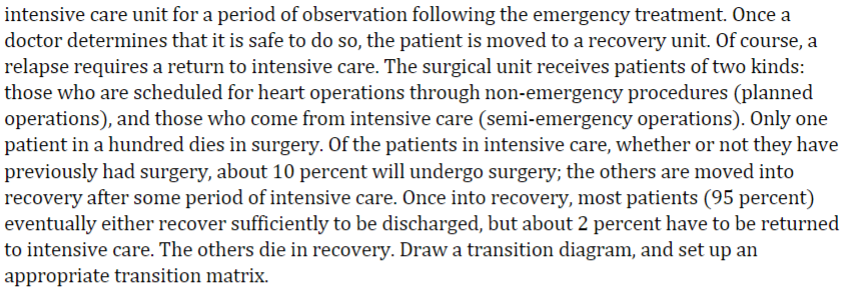
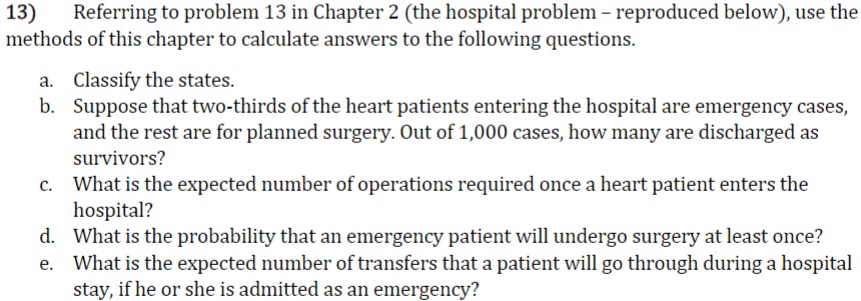
Chapter 2 problem 13: A hospital is interested in tracking the movements of heart patients through different units. The four units of interest are emergency admissions, surgery, intensive care, and recovery. Emergency patients (that is, people who have suffered heart attacks and were brought into the hospital through emergency admissions) are always assigned to the intensive care unit for a period of observation following the emergency treatment. Once a doctor determines that it is safe to do so, the patient is moved to a recovery unit. Of course, a relapse requires a return to intensive care. The surgical unit receives patients of two kinds: those who are scheduled for heart operations through non-emergency procedures (planned operations), and those who come from intensive care (semi-emergency operations). Only one patient in a hundred dies in surgery. Of the patients in intensive care, whether or not they have previously had surgery, about 10 percent will undergo surgery; the others are moved into recovery after some period of intensive care. Once into recovery, most patients (95 percent) eventually either recover sufficiently to be discharged, but about 2 percent have to be returned to intensive care. The others die in recovery. Draw a transition diagram, and set up an appropriate transition matrix. 13) Referring to problem 13 in Chapter 2 (the hospital problem - reproduced below), use the methods of this chapter to calculate answers to the following questions. a. Classify the states. b. Suppose that two-thirds of the heart patients entering the hospital are emergency cases, and the rest are for planned surgery. Out of 1,000 cases, how many are discharged as survivors? c. What is the expected number of operations required once a heart patient enters the hospital? d. What is the probability that an emergency patient will undergo surgery at least once? e. What is the expected number of transfers that a patient will go through during a hospital stay, if he or she is admitted as an emergency
Step by Step Solution

There are 3 Steps involved in it

1 Expert Approved Answer
Step: 1 Unlock blur-text-image

Question Has Been Solved by an Expert!

Get step-by-step solutions from verified subject matter experts

Step: 2 Unlock
Step: 3 Unlock

Students Have Also Explored These Related General Management Questions!