Question: Chapter 2 Project-Location, Location, Location (30 points). Instructions: The purpose of this project is to introduce decisions that organizations must often make as they grow.
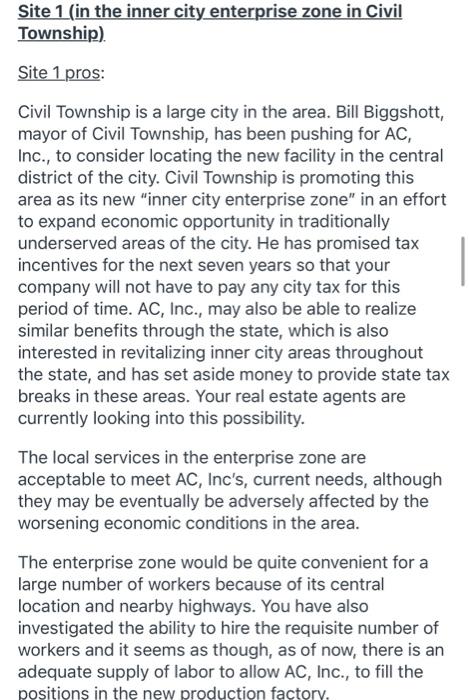
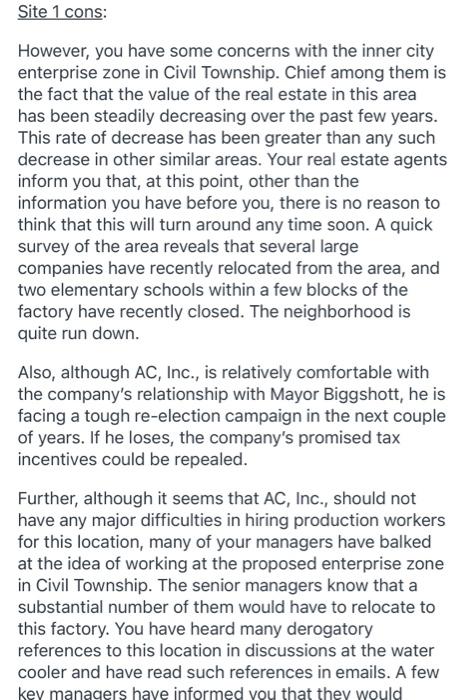
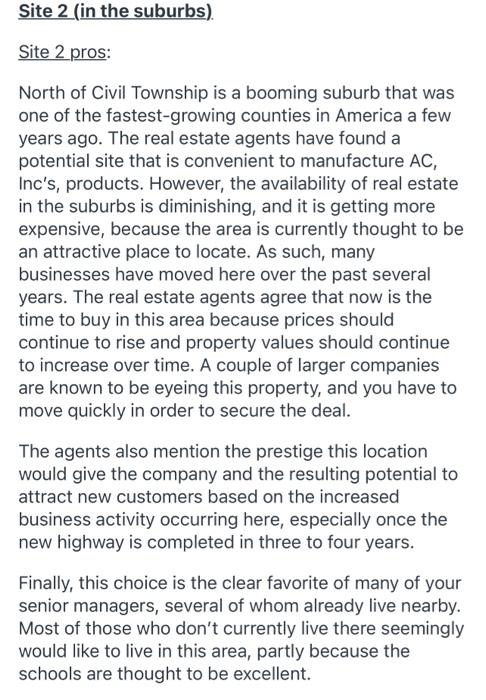
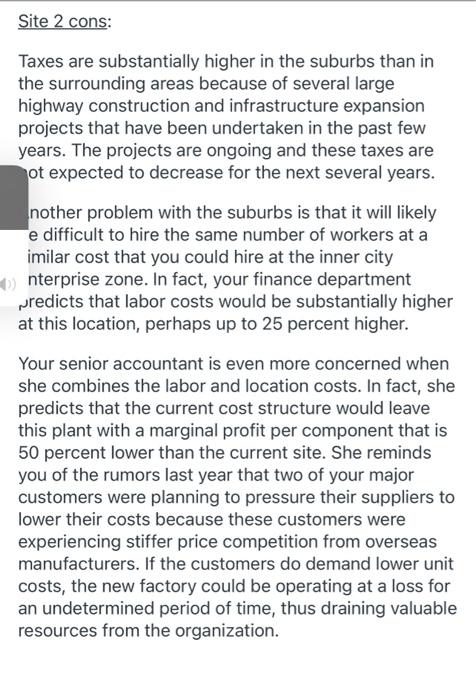
Chapter 2 Project-Location, Location, Location (30 points). Instructions: The purpose of this project is to introduce decisions that organizations must often make as they grow. Please study the information and resources, consider the background information, and then complete the assignment below. Managerial Decision-Making Information & Resources: Peter F. Drucker is generally regarded as the father of modern management thinking. His 800-plus page 1973 book Management: Tasks, Responsibilities, Practices published by Harper & Row is still one of the best management books ever written. Many so-called "new" management practices can be traced directly back to Drucker's ideas in this book. Drucker calls decision-making the first managerial skill and argues that whatever a manager does is done through making decisions. Managerial Decision-Making is the title of Chapter 2 of our textbook. According to our text, decision- making is "the action or process of thinking through possible options and selecting one." Managers typically use a systematic process for important, nonrecurring decisions, such as the decision asked for in this project. These types of decisions are also known as nonprogrammed decisions. There are six steps in the decision-making process: 1. Recognize that a decision needs to be made, 2. Generate multiple alternatives, 3. Analyze the alternatives, 4. Select an alternative 5. Implement the selected alternative, and 6. Evaluate decision effectiveness. Please read all of Chapter 2 for more information on decision-making and the decision-making process. In particular, Section 2.3 introduces the decision-making process, Section 2.4 discusses barriers to effective decision-making, and Section 2.5 is an in-depth explanation of techniques for making better nonprogrammed decisions. There are also two brief documents in the Resources module on the course home page with additional perspectives on this topic: (1) Making Better Decisions, and (2) Making Ethical Decisions. Please use them as you deem necessary. The last resource is Decision Making in Management, a YouTube video from Gregg Learning. It is yet for another perspective on the managerial decision- making process: Access the video here: g Decision Making in Management ISION KING TANAGEMEN Background Information: You are a top manager for Attribution Components, Inc. (AC, Inc.), an automotive tooling company that has been in existence for ten years. Over the course of this time, you have developed close relationships with two major automotive companies in your area. AC, Inc., has built a reputation for producing quality products and is considered to be among the most reliable suppliers in the industry. Last year, AC, Inc's, top management held an important meeting regarding the need for growth. The existing production plant was running at absolute full capacity and it was becoming apparent that the company would not be able to meet demand for its products within two years. Thus, a new production facility is a necessity for AC, Inc. The question is where to locate the new production facility. The decision is becoming urgent. You are tasked with making it. AC, Inc's, real estate agents have developed three potential facility locations. You can only choose one site. Each site has certain strengths and weaknesses, which are described below. Site 1 (in the inner city enterprise zone in Civil Township) Site 1 pros: Civil Township is a large city in the area. Bill Biggshott, mayor of Civil Township, has been pushing for AC, Inc., to consider locating the new facility in the central district of the city. Civil Township is promoting this area as its new "inner city enterprise zone" in an effort to expand economic opportunity in traditionally underserved areas of the city. He has promised tax incentives for the next seven years so that your company will not have to pay any city tax for this period of time. AC, Inc., may also be able to realize similar benefits through the state, which is also interested in revitalizing inner city areas throughout the state, and has set aside money to provide state tax breaks in these areas. Your real estate agents are currently looking into this possibility. The local services in the enterprise zone are acceptable to meet AC, Inc's, current needs, although they may be eventually be adversely affected by the worsening economic conditions in the area. The enterprise zone would be quite convenient for a large number of workers because of its central location and nearby highways. You have also investigated the ability to hire the requisite number of workers and it seems as though, as of now, there is an adequate supply of labor to allow AC, Inc., to fill the positions in the new production factory. Site 1 cons: However, you have some concerns with the inner city enterprise zone in Civil Township. Chief among them is the fact that the value of the real estate in this area has been steadily decreasing over the past few years. This rate of decrease has been greater than any such decrease in other similar areas. Your real estate agents inform you that, at this point, other than the information you have before you, there is no reason to think that this will turn around any time soon. A quick survey of the area reveals that several large companies have recently relocated from the area, and two elementary schools within a few blocks of the factory have recently closed. The neighborhood is quite run down. Also, although AC, Inc., is relatively comfortable with the company's relationship with Mayor Biggshott, he is facing a tough re-election campaign in the next couple of years. If he loses, the company's promised tax incentives could be repealed. Further, although it seems that AC, Inc., should not have any major difficulties in hiring production workers for this location, many of your managers have balked at the idea of working at the proposed enterprise zone in Civil Township. The senior managers know that a substantial number of them would have to relocate to this factory. You have heard many derogatory references to this location in discussions at the water cooler and have read such references in emails. A few key managers have informed you that they would Site 2 (in the suburbs). Site 2 pros: North of Civil Township is a booming suburb that was one of the fastest-growing counties in America a few years ago. The real estate agents have found a potential site that is convenient to manufacture AC, Inc's, products. However, the availability of real estate in the suburbs is diminishing, and it is getting more expensive, because the area is currently thought to be an attractive place to locate. As such, many businesses have moved here over the past several years. The real estate agents agree that now is the time to buy in this area because prices should continue to rise and property values should continue to increase over time. A couple of larger companies are known to be eyeing this property, and you have to move quickly in order to secure the deal. The agents also mention the prestige this location would give the company and the resulting potential to attract new customers based on the increased business activity occurring here, especially once the new highway is completed in three to four years. Finally, this choice is the clear favorite of many of your senior managers, several of whom already live nearby. Most of those who don't currently live there seemingly would like to live in this area, partly because the schools are thought to be excellent. Site 2 cons: Taxes are substantially higher in the suburbs than in the surrounding areas because of several large highway construction and infrastructure expansion projects that have been undertaken in the past few years. The projects are ongoing and these taxes are ot expected to decrease for the next several years. nother problem with the suburbs is that it will likely e difficult to hire the same number of workers at a imilar cost that you could hire at the inner city nterprise zone. In fact, your finance department predicts that labor costs would be substantially higher at this location, perhaps up to 25 percent higher. Your senior accountant is even more concerned when she combines the labor and location costs. In fact, she predicts that the current cost structure would leave this plant with a marginal profit per component that is 50 percent lower than the current site. She reminds you of the rumors last year that two of your major customers were planning to pressure their suppliers to lower their costs because these customers were experiencing stiffer price competition from overseas manufacturers. If the customers do demand lower unit costs, the new factory could be operating at a loss for an undetermined period of time, thus draining valuable resources from the organization. Site 3 (in the boondocks). Site 3 pros: The real estate agents, working with one of your general managers, uncovered a third potential site about three hours west of Civil Township in a rural and comparatively underdeveloped county. Johnsohnville Automotive is AC Inc's, largest customer and is planning to build a major factory out there in the boondocks. Your general manager learned the information because he is close friends with a couple of Johnsohnville executives. So, AC, Inc., would seemingly have a major advantage in securing future contracts with Johnsohnville if AC, Inc., locates the new production factory near Johnsohnville's new facility. The cost of the land would be considerably less expensive than in the suburban location, about the same as in the inner city enterprise zone. Also, the area in the boondocks seems like a potentially attractive place to live, with several large parks, lakes and walking trails nearby, and a growing small city, Glanton, to the south only a 20-minute drive away. Currently, the labor costs and area tax rates are even better than in the proposed enterprise zone, but both sets of costs are expected to increase over the coming years as the area continues to develop. Site 3 cons: The major problems that AC, Inc., engineers have with the location in the boondocks is that the factory would have to be built from the ground up, and that more coordination problems would result from the distance involved. This would likely drive the cost up substantially. Also, unlike the other two locations, AC, Inc., would likely experience substantial delays in ramping up production capabilities. If AC, Inc., secures some contracts that the company is currently pursuing, then it will have to outsource some production to subcontractors until the factory in the boondocks can be built and begin production. Your senior production manager strongly opposes this alternative because the quality of your product is one of its best selling points. She would rather not jeopardize this advantage by allowing other companies to produce the product. The personnel department believes that an adequate labor supply is currently available in the boondocks, but they also note that your company would actually begin to compete with Johnsohnville Automotive (and other new businesses in the area) for workers as both factories begin production. This factor could cause problems, and unwanted complications, to AC, Inc's, relationship with Johnsohnville if the labor force does not meet predicted growth trends. Even if it does, labor costs are likely to rise in the coming years in the boondocks. Assignment: Your job is to make this decision by following the decision-making process as described in our course textbook. Please include explanations for each step of the decision-making process in your answer. Obviously, some of these steps, such as the first and second steps, are done for you in the background information for this project. A brief explanation of these steps is sufficient. (Example="Step One: Where to locate AC, Inc's new production facility?") Part of step three has also been completed. There is analysis of each alternative included in the background information. Please briefly explain the included information. Then, fully evaluate the merits of the three different potential locations. Explain your analysis of each alternative as they each reasonably relate to AC, Inc's objectives in seeking out a location for a new production facility. In your explanation, be sure to discuss which people you would like to talk to as you make this decision, and explain why you want to talk with them. Also, please identify at least one barrier to effective decision-making that might negatively impact this decision, or the process, and explain how you intend to overcome the barrier. Step four is your decision. Choose the location in which to place AC, Inc's new production facility. analysis of each alternative as they each reasonably relate to AC, Inc's objectives in seeking out a location for a new production facility. In your explanation, be sure to discuss which people you would like to talk to as you make this decision, and explain why you want to talk with them. Also, please identify at least one barrier to effective decision-making that might negatively impact this decision, or the process, and explain how you intend to overcome the barrier. Step four is your decision. Choose the location in which to place AC, Inc's new production facility. Step five should explain why your choice is the best choice for AC, Inc. Regardless of which choice is made, there will be people inside the organization who strongly oppose it. That is clear from the background information. Such opposition often makes it very difficult for organizations to achieve success. Thus, it is crucial to convincingly explain how you will get the other important stakeholders that will be affected by this decision to buy into, and support, the decision. It is not yet possible to complete step six of the managerial decision-making process because the decision has not been implemented. (Simply noting this fact, and any other impressions you may have at this point, is a sufficient answer here.) Of course, it will be important for AC Inc., to evaluate the effectiveness of this important decision as time goes on. Such evaluations should help improve the quality of future decisions









 Study Help