







Question: CHAPTER 2 Questions 4. Compare and contrast ethics and morality. What do philosophers call the end result of ethical examination? 8 (A) Is it ethical
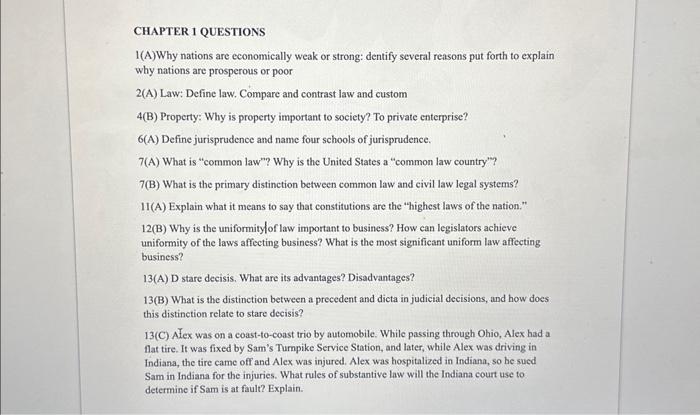
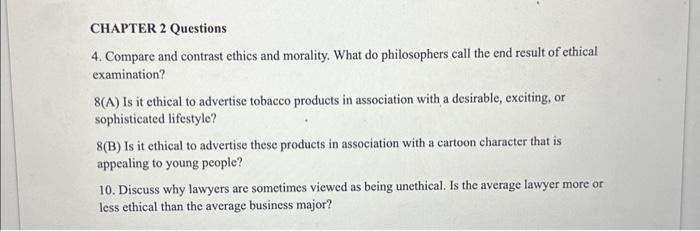
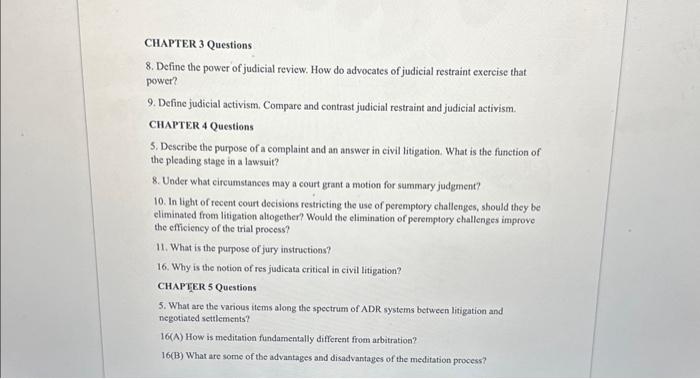
CHAPTER 2 Questions 4. Compare and contrast ethics and morality. What do philosophers call the end result of ethical examination? 8 (A) Is it ethical to advertise tobacco products in association with a desirable, exciting, or sophisticated lifestyle? 8(B) Is it ethical to advertise these products in association with a cartoon character that is appealing to young people? 10. Discuss why lawyers are sometimes viewed as being unethical. Is the average lawyer more or less ethical than the average business major? CHAPTER 3 Questions 8. Define the power of judicial review. How do advocates of judicial restraint exereise that power? 9. Define judicial activism. Compare and contrast judicial restraint and judicial activism. CHAPTER 4 Questions 5. Describe the purpose of a complaint and an answer in civil litigation. What is the function of the pleading stage in a lawsuit? 8. Under what circumstances may a court grant a motion for summary judgment? 10. In light of recent court decisions restricting the use of peremptory challenges, should they be eliminated from litigation altogether? Would the elimination of peremptory challenges improve the efficiency of the trial process? 11. What is the purpose of jury instructions? 16. Why is the notion of res judicata critical in civil litigation? CHAPTER 5 Questions 5. What are the various items along the spectrum of ADR systems between litigation and negotiated settlements? 16(A) How is meditation fundamentally different from arbitration? 16(B) What are some of the advantages and disadvantages of the meditation process? CHAPTER 1 QUESTIONS 1(A)Why nations are economically weak or strong: dentify several reasons put forth to explain why nations are prosperous or poor 2(A) Law: Define law. Compare and contrast law and custom 4(B) Property: Why is property important to society? To private enterprise? 6(A) Define jurisprudence and name four schools of jurisprudence. 7(A) What is "common law"? Why is the United States a "common law country"? 7(B) What is the primary distinction between common law and civil law legal systems? 11(A) Explain what it means to say that constitutions are the "highest laws of the nation." 12(B) Why is the uniformitylof law important to business? How can legislators achieve uniformity of the laws affecting business? What is the most significant uniform law affecting business? 13(A) D stare decisis. What are its advantages? Disadvantages? 13(B) What is the distinction between a precedent and dicta in judicial decisions, and how does this distinction relate to stare decisis? 13(C) Afex was on a coast-to-coast trio by automobile. While passing through Ohio, Alex had a flat tire. It was fixed by Sam's Tumpike Service Station, and later, while Alex was driving in Indiana, the tire came off and Alex was injured. Alex was hospitalized in Indiana, so be sued Sam in Indiana for the injuries. What rules of substantive law will the Indiana court use to determine if Sam is at fault? Explain
Step by Step Solution
There are 3 Steps involved in it

Get step-by-step solutions from verified subject matter experts
 Study Help