







Question: Chapter 24-worksheet 1. An isolated conducting sphere that has a 10.0 cm radius has an electric potential of 2.00 kV (the potential far from
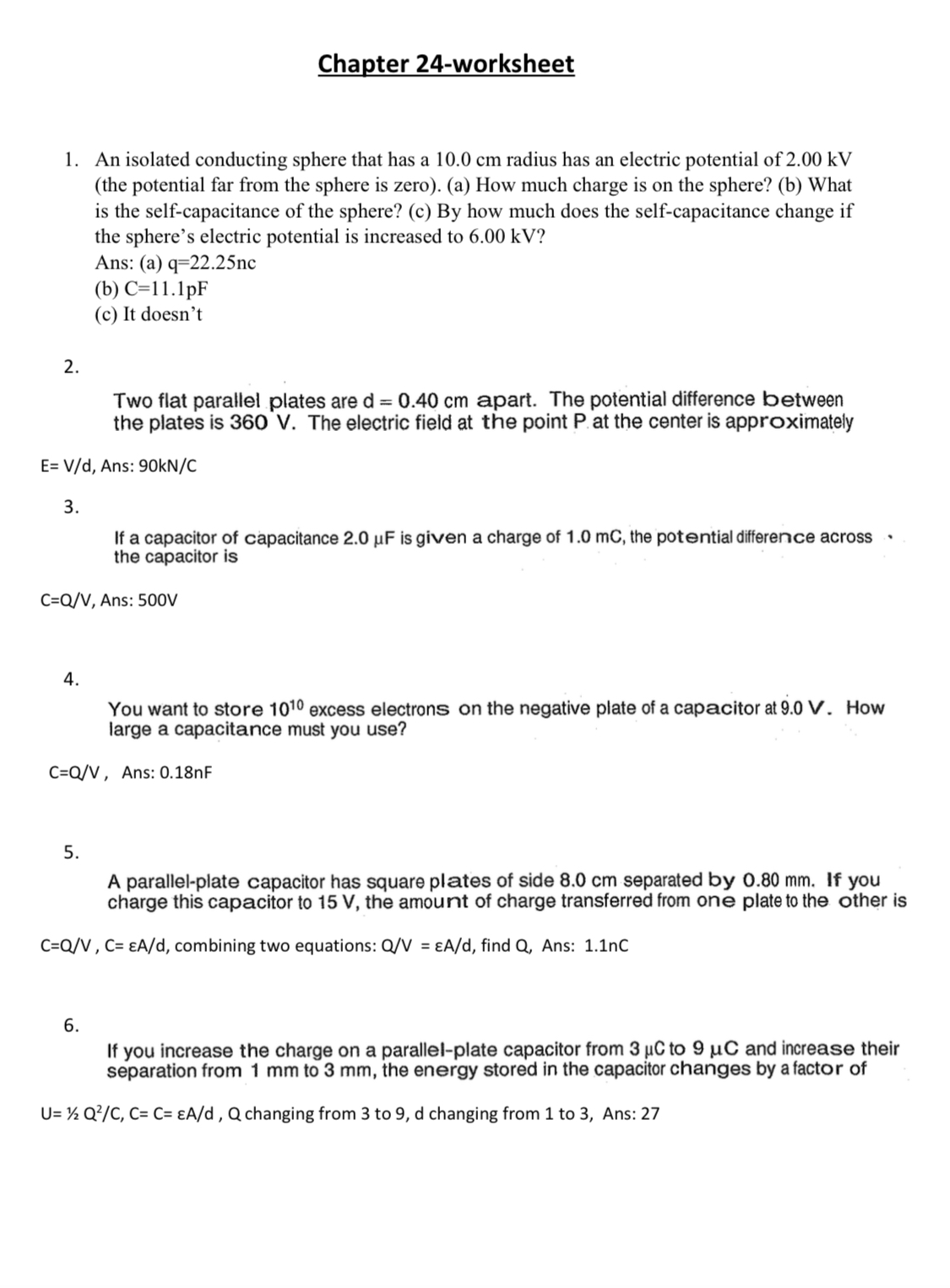
Chapter 24-worksheet 1. An isolated conducting sphere that has a 10.0 cm radius has an electric potential of 2.00 kV (the potential far from the sphere is zero). (a) How much charge is on the sphere? (b) What is the self-capacitance of the sphere? (c) By how much does the self-capacitance change if the sphere's electric potential is increased to 6.00 kV? 2. Ans: (a) q=22.25nc (b) C=11.1pF (c) It doesn't Two flat parallel plates are d = 0.40 cm apart. The potential difference between the plates is 360 V. The electric field at the point P. at the center is approximately E=V/d, Ans: 90kN/C 3. If a capacitor of capacitance 2.0 F is given a charge of 1.0 mC, the potential difference across the capacitor is C=Q/V, Ans: 500V 4. You want to store 1010 excess electrons on the negative plate of a capacitor at 9.0 V. How large a capacitance must you use? C=Q/V, Ans: 0.18nF 5. A parallel-plate capacitor has square plates of side 8.0 cm separated by 0.80 mm. If you charge this capacitor to 15 V, the amount of charge transferred from one plate to the other is C=Q/V, C= A/d, combining two equations: Q/V = A/d, find Q, Ans: 1.1nC 6. If you increase the charge on a parallel-plate capacitor from 3 C to 9 and increase their separation from 1 mm to 3 mm, the energy stored in the capacitor changes by a factor of U= Q/C, C= C=A/d, Q changing from 3 to 9, d changing from 1 to 3, Ans: 27
Step by Step Solution
There are 3 Steps involved in it

Get step-by-step solutions from verified subject matter experts
 Study Help