







Question: Chapter 25 Problem 1. (Electrochemical Machining) An ECM operation is used to cut a hole into a plate of stainless steel that is 10
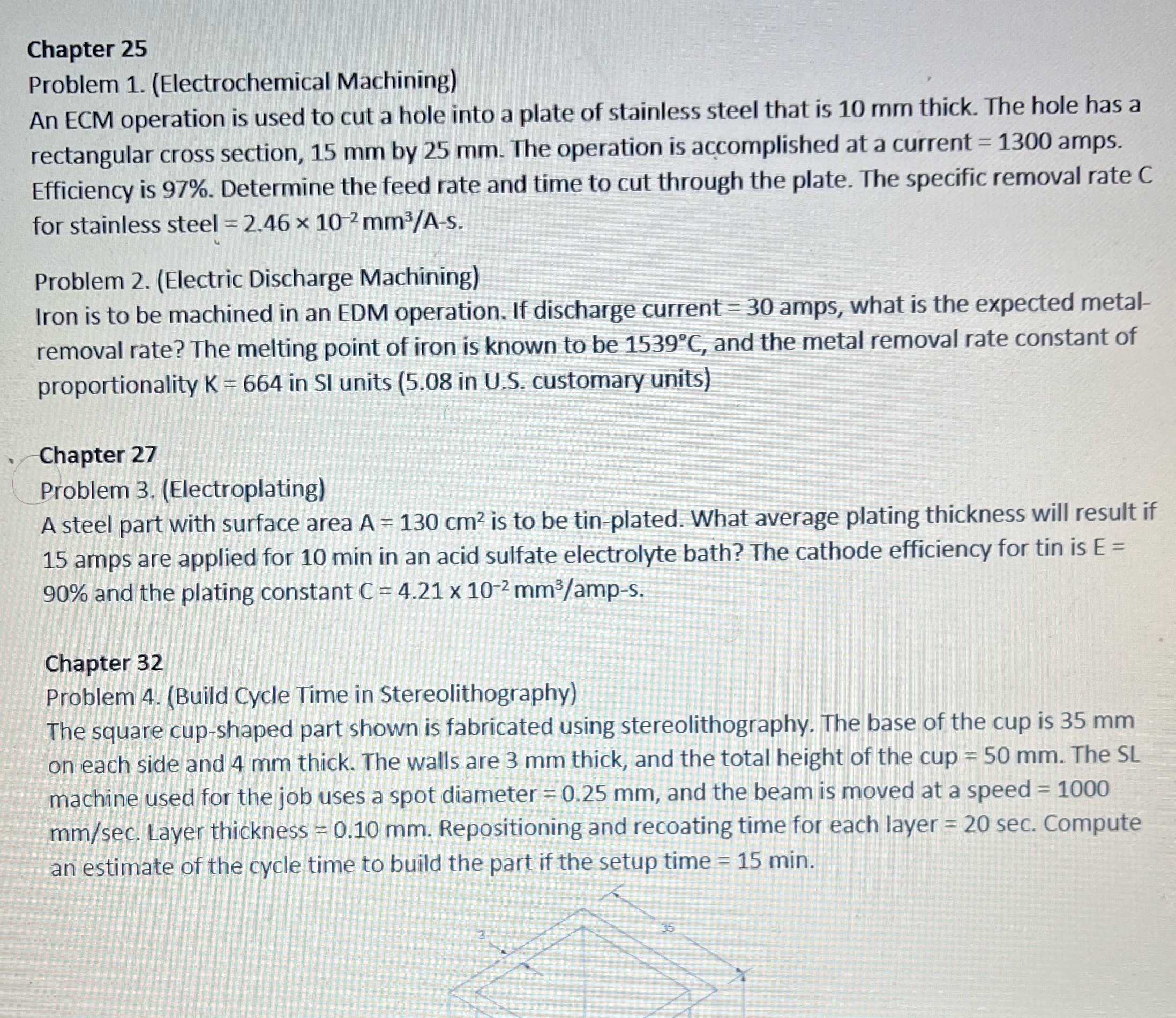
Chapter 25 Problem 1. (Electrochemical Machining) An ECM operation is used to cut a hole into a plate of stainless steel that is 10 mm thick. The hole has a rectangular cross section, 15 mm by 25 mm. The operation is accomplished at a current = 1300 amps. Efficiency is 97%. Determine the feed rate and time to cut through the plate. The specific removal rate C for stainless steel = 2.46 x 10⁻² mm/A-s. Problem 2. (Electric Discharge Machining) Iron is to be machined in an EDM operation. If discharge current = 30 amps, what is the expected metal- removal rate? The melting point of iron is known to be 1539C, and the metal removal rate constant of proportionality K = 664 in SI units (5.08 in U.S. customary units) Chapter 27 Problem 3. (Electroplating) A steel part with surface area A = 130 cm is to be tin-plated. What average plating thickness will result if 15 amps are applied for 10 min in an acid sulfate electrolyte bath? The cathode efficiency for tin is E = 90% and the plating constant C = 4.21 x 10⁻² mm/amp-s. Chapter 32 Problem 4. (Build Cycle Time in Stereolithography) The square cup-shaped part shown is fabricated using stereolithography. The base of the cup is 35 mm on each side and 4 mm thick. The walls are 3 mm thick, and the total height of the cup = 50 mm. The SL machine used for the job uses a spot diameter = 0.25 mm, and the beam is moved at a speed = 1000 mm/sec. Layer thickness = 0.10 mm. Repositioning and recoating time for each layer = 20 sec. Compute an estimate of the cycle time to build the part if the setup time = 15 min. 3 135
Step by Step Solution
There are 3 Steps involved in it

Get step-by-step solutions from verified subject matter experts
 Study Help