







Question: Chapter 2A Assignment 10 points Saved Check my work mode : This shows what is correct or incorrect for the work you have completed
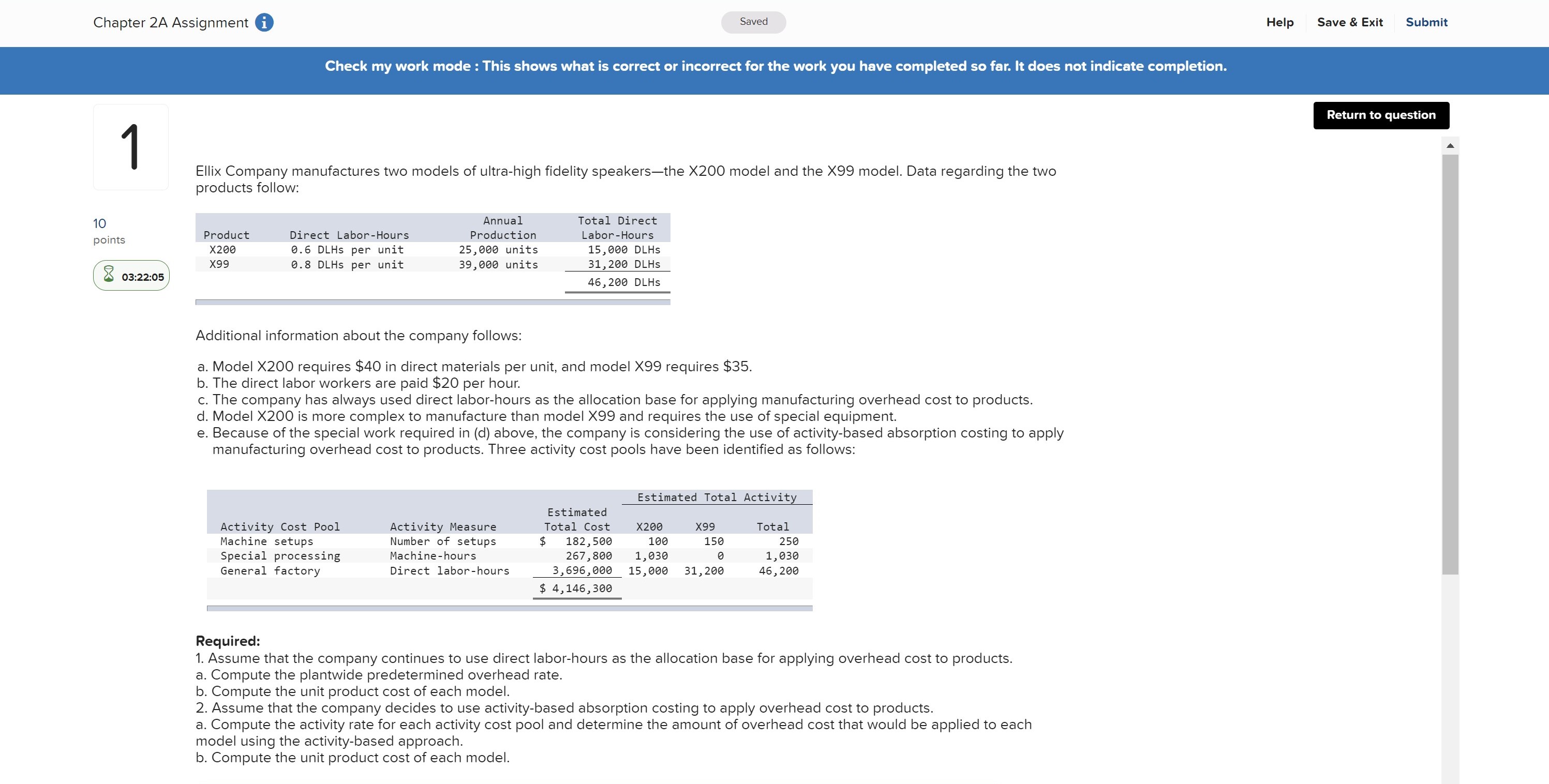
Chapter 2A Assignment 10 points Saved Check my work mode : This shows what is correct or incorrect for the work you have completed so far. It does not indicate completion. 1 Ellix Company manufactures two models of ultra-high fidelity speakers-the X200 model and the X99 model. Data regarding the two products follow: Product X200 X99 Direct Labor - Hours 0.6 DLHS per unit 0.8 DLHS per unit Annual Production 25,000 units 39,000 units Total Direct Labor-Hours 03:22:05 15,000 DLHS 31,200 DLHS 46,200 DLHS Additional information about the company follows: a. Model X200 requires $40 in direct materials per unit, and model X99 requires $35. b. The direct labor workers are paid $20 per hour. c. The company has always used direct labor-hours as the allocation base for applying manufacturing overhead cost to products. d. Model X200 is more complex to manufacture than model X99 and requires the use of special equipment. e. Because of the special work required in (d) above, the company is considering the use of activity-based absorption costing to apply manufacturing overhead cost to products. Three activity cost pools have been identified as follows: Estimated Total Activity Estimated Activity Cost Pool Machine setups Special processing General factory Activity Measure Number of setups Machine-hours Total Cost $ 182,500 X200 100 X99 Total 267,800 1,030 150 0 250 Direct labor-hours 3,696,000 15,000 31,200 1,030 46,200 $ 4,146,300 Required: 1. Assume that the company continues to use direct labor-hours as the allocation base for applying overhead cost to products. a. Compute the plantwide predetermined overhead rate. b. Compute the unit product cost of each model. 2. Assume that the company decides to use activity-based absorption costing to apply overhead cost to products. a. Compute the activity rate for each activity cost pool and determine the amount of overhead cost that would be applied to each model using the activity-based approach. b. Compute the unit product cost of each model. Help Save & Exit Submit Return to question
Step by Step Solution
There are 3 Steps involved in it

Get step-by-step solutions from verified subject matter experts
 Study Help