







Question: CHAPTER 3 Evaluating Business Ethics 129 Updated by Simon Oldham This case outlines the ethical controversies surrounding the development of the Canadian oil sands. It
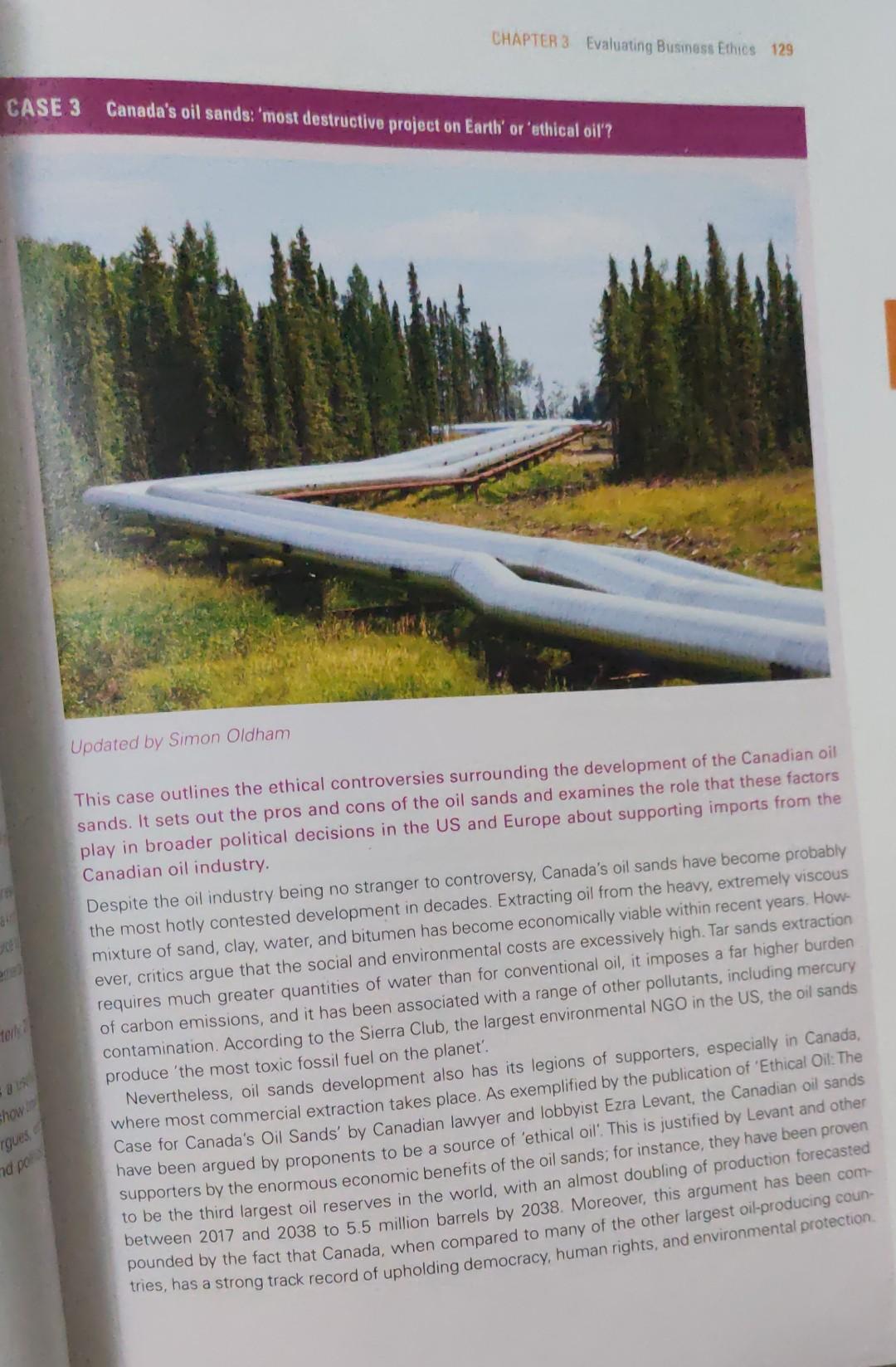
CHAPTER 3 Evaluating Business Ethics 129 Updated by Simon Oldham This case outlines the ethical controversies surrounding the development of the Canadian oil sands. It sets out the pros and cons of the oil sands and examines the role that these factors play in broader political decisions in the US and Europe about supporting imports from the Canadian oil industry. Despite the oil industry being no stranger to controversy, Canada's oil sands have become probably the most hotly contested development in decades. Extracting oil from the heavy, extremely viscous mixture of sand, clay, water, and bitumen has become economically viable within recent years. However, critics argue that the social and environmental costs are excessively high. Tar sands extraction requires much greater quantities of water than for conventional oil, it imposes a far higher burden of carbon emissions, and it has been associated with a range of other pollutants, including mercury contamination. According to the Sierra Club, the largest environmental NGO in the US, the oil sands produce 'the most toxic fossil fuel on the planet'. takes place. As exemplified by the publication of 'Ethical Oil: The Erana Levant, the Canadian oil sands dian lawyer and lobbyist Ezra Levant, the Canadian oil sands be a source of 'ethical oil'. This is justified by Levant and other mic benefits of the oil sands; for instance, they have been proven ves in the world, with an almost doubling of production forecasted 5.5 million barrels by 2038. Moreover, this argument has been comfanada, when compared to many of the other largest oil-producing coun- QUESTIONS 1. Which actors have a stake in deciding whether the oil sands are an ethical source of oil and why do you think they differ so much in their assessments? 2. How would you go about conducting a utilitarian analysis of the oil sands for the purpose of deciding whether it is an ethical source of oil? Provide a provisional assessment based on the data in the case and outline what other data you would need to make a full assessment. 3. How would this assessment differ if you focused primarily on principle-based ethics (duties, rights, and justice)? What issues take precedence now and do they give a reasonable perspective on the
Step by Step Solution
There are 3 Steps involved in it
1 Expert Approved Answer
Step: 1 Unlock

Question Has Been Solved by an Expert!
Get step-by-step solutions from verified subject matter experts
Step: 2 Unlock
Step: 3 Unlock
 Study Help