



Question: Chapter 4 Circular Motion and Gravitation 4.2 Centripetal Dynamics Homework # 29 HI-Vertical Circular Motion 09. A roller coaster enters a vertical circle with a
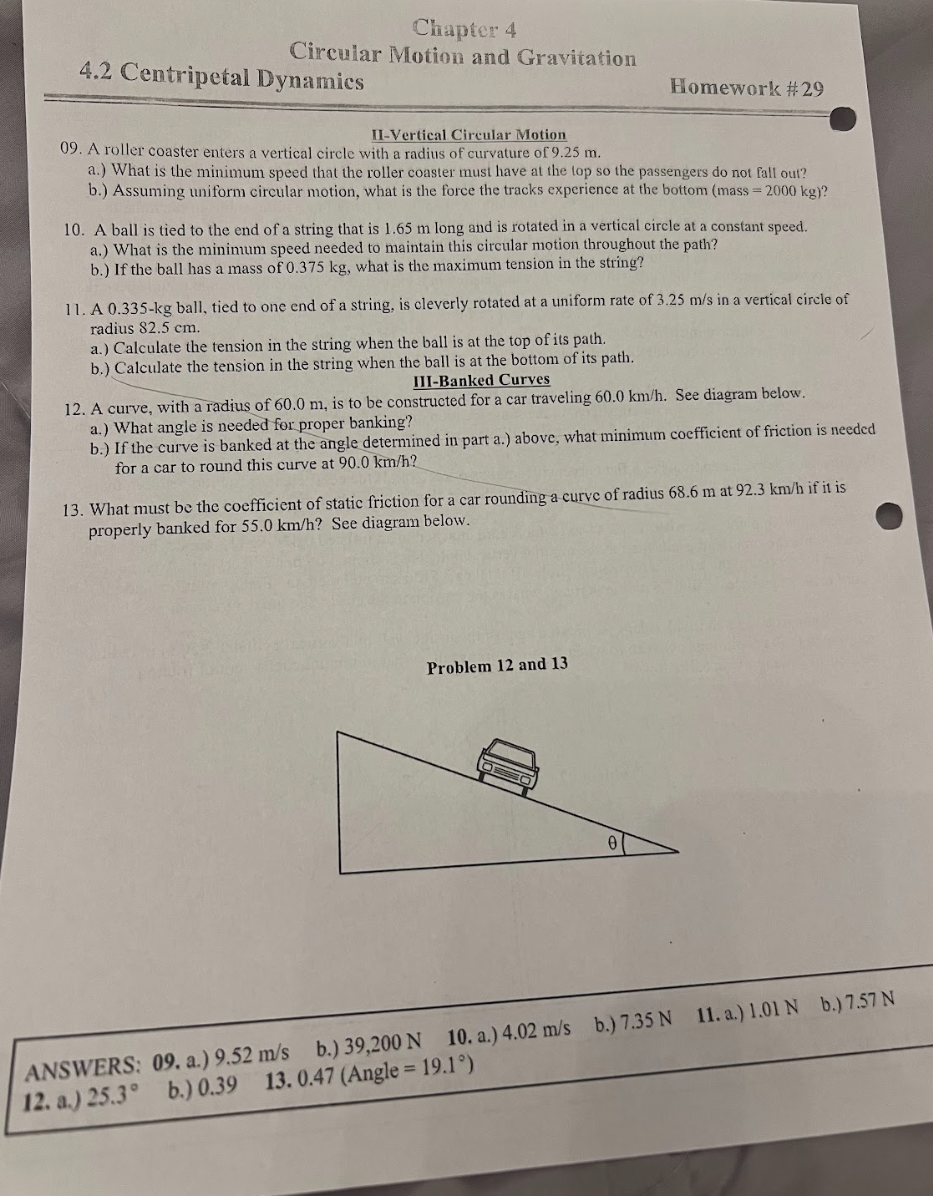
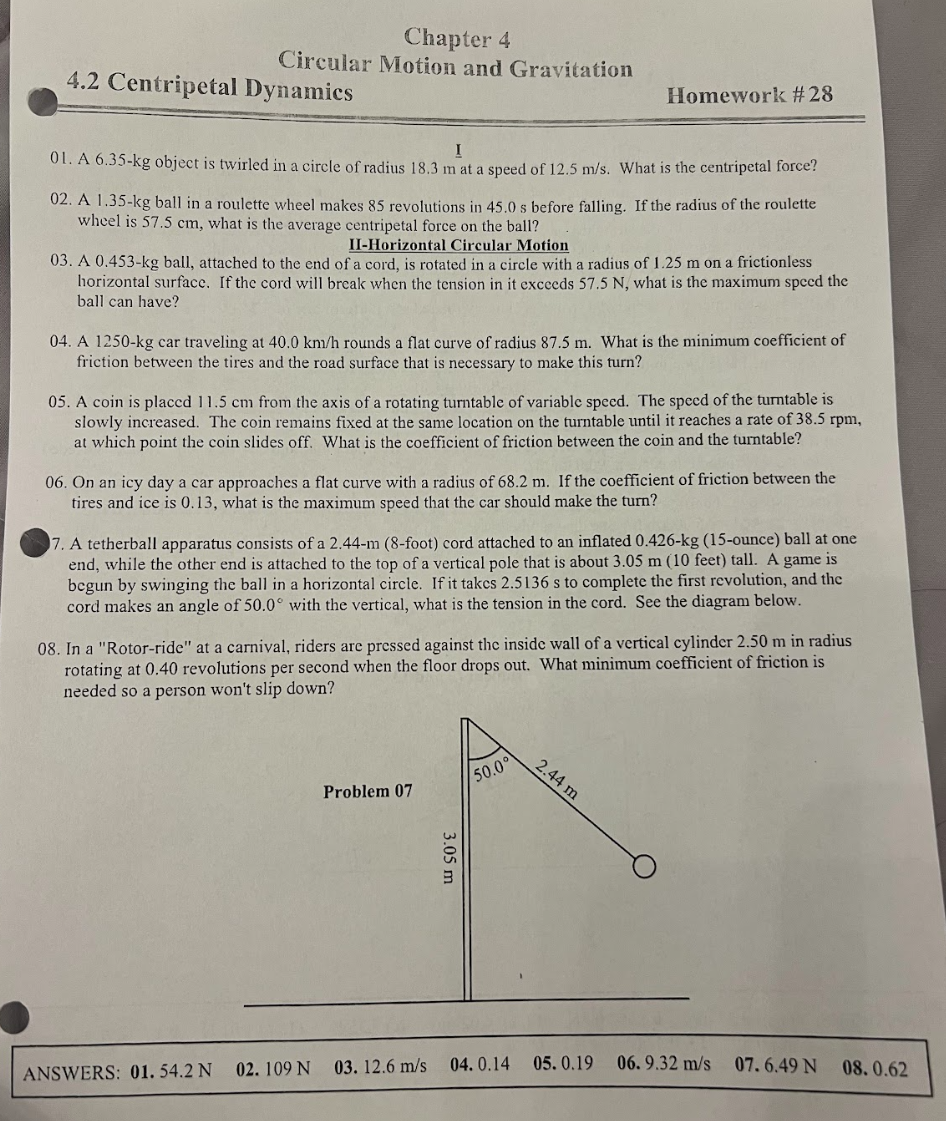
Chapter 4 Circular Motion and Gravitation 4.2 Centripetal Dynamics Homework # 29 HI-Vertical Circular Motion 09. A roller coaster enters a vertical circle with a radius of curvature of 9.25 m. a.) What is the minimum speed that the roller coaster must have at the top so the passengers do not fall out? b.) Assuming uniform circular motion, what is the force the tracks experience at the bottom (mass = 2000 kg)? 10. A ball is tied to the end of a string that is 1.65 m long and is rotated in a vertical circle at a constant speed. a.) What is the minimum speed needed to maintain this circular motion throughout the path? b. ) If the ball has a mass of 0.375 kg, what is the maximum tension in the string? 1 1. A 0.335-kg ball, tied to one end of a string, is cleverly rotated at a uniform rate of 3.25 m/s in a vertical circle of radius $2.5 cm. a.) Calculate the tension in the string when the ball is at the top of its path. b.) Calculate the tension in the string when the ball is at the bottom of its path. III-Banked Curves 12. A curve, with a radius of 60.0 m, is to be constructed for a car traveling 60.0 km/h. See diagram below. a. ) What angle is needed for proper banking? b.) If the curve is banked at the angle determined in part a.) above, what minimum coefficient of friction is needed for a car to round this curve at 90.0 km/h? 13. What must be the coefficient of static friction for a car rounding a curve of radius 68.6 m at 92.3 kmi/h if it is properly banked for 55.0 km/h? See diagram below. Problem 12 and 13 ANSWERS: 09. a.) 9.52 m/s b.) 39,200 N 10. a.) 4.02 m/s b.) 7.35 N 11. a.) 1.01 N b.) 7.57 N 12. a.) 25.3 b.) 0.39 13. 0.47 (Angle = 19.1')Chapter 4 Circular Motion and Gravitation 4.2 Centripetal Dynamics Homework # 28 01. A 6.35-kg object is twirled in a circle of radius 18.3 m at a speed of 12.5 m/s. What is the centripetal force? 02. A 1.35-kg ball in a roulette wheel makes 85 revolutions in 45.0 s before falling. If the radius of the roulette wheel is 57.5 cm, what is the average centripetal force on the ball? II-Horizontal Circular Motion 03. A 0.453-kg ball, attached to the end of a cord, is rotated in a circle with a radius of 1.25 m on a frictionless horizontal surface. If the cord will break when the tension in it exceeds 57.5 N, what is the maximum speed the ball can have? 04. A 1250-kg car traveling at 40.0 km/h rounds a flat curve of radius 87.5 m. What is the minimum coefficient of friction between the tires and the road surface that is necessary to make this turn? 05. A coin is placed 1 1.5 cm from the axis of a rotating turntable of variable speed. The speed of the turntable is slowly increased. The coin remains fixed at the same location on the turntable until it reaches a rate of 38.5 rpm, at which point the coin slides off. What is the coefficient of friction between the coin and the turntable? 06. On an icy day a car approaches a flat curve with a radius of 68.2 m. If the coefficient of friction between the tires and ice is 0. 13, what is the maximum speed that the car should make the turn? 7. A tetherball apparatus consists of a 2.44-m (8-foot) cord attached to an inflated 0.426-kg (15-ounce) ball at one end, while the other end is attached to the top of a vertical pole that is about 3.05 m (10 feet) tall. A game is begun by swinging the ball in a horizontal circle. If it takes 2.5136 s to complete the first revolution, and the cord makes an angle of 50.0" with the vertical, what is the tension in the cord. See the diagram below. 08. In a "Rotor-ride" at a carnival, riders are pressed against the inside wall of a vertical cylinder 2.50 m in radius rotating at 0.40 revolutions per second when the floor drops out. What minimum coefficient of friction is needed so a person won't slip down? 50.0 2.44 m Problem 07 3.05 m ANSWERS: 01. 54.2 N 02. 109 N 03. 12.6 m/s 04. 0.14 05. 0.19 06. 9.32 m/s 07. 6.49 N 08. 0.62
Step by Step Solution
There are 3 Steps involved in it

Get step-by-step solutions from verified subject matter experts