







Question: Chapter 4 Homework Problems Answer questions 1 to 3 from the following information: Professor Jones has created a formula with which students can predict their
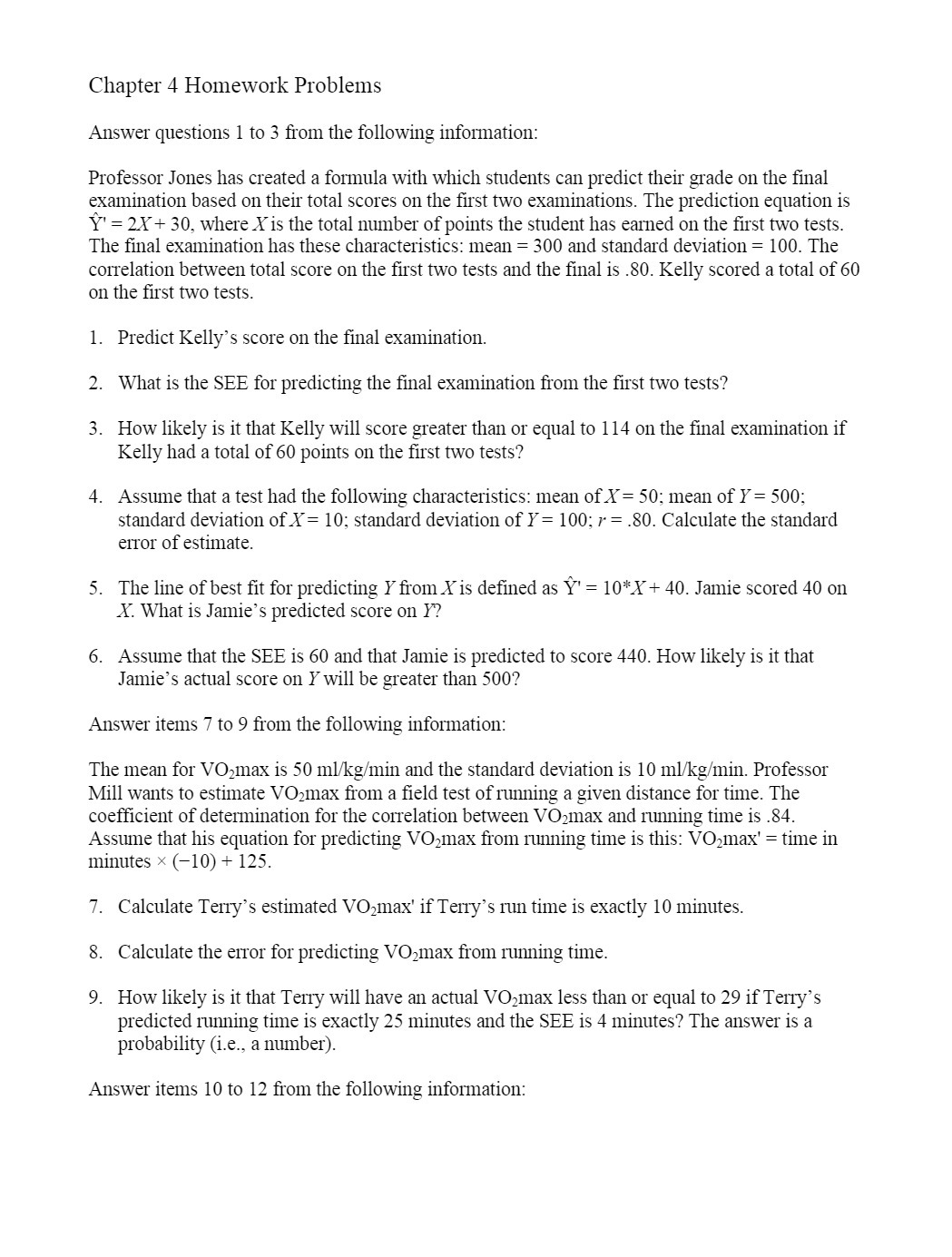
Chapter 4 Homework Problems Answer questions 1 to 3 from the following information: Professor Jones has created a formula with which students can predict their grade on the final examination based on their total scores on the first two examinations. The prediction equation is Y' = 2X + 30, where X is the total number of points the student has earned on the first two tests. The final examination has these characteristics: mean = 300 and standard deviation = 100. The correlation between total score on the first two tests and the final is .80. Kelly scored a total of 60 on the first two tests. 1. Predict Kelly's score on the final examination. 2. What is the SEE for predicting the final examination from the first two tests? 3. How likely is it that Kelly will score greater than or equal to 114 on the final examination if Kelly had a total of 60 points on the first two tests? 4. Assume that a test had the following characteristics: mean of X = 50; mean of Y = 500: standard deviation of X = 10; standard deviation of Y= 100; / = .80. Calculate the standard error of estimate. 5. The line of best fit for predicting Y from X is defined as Y' = 10*X + 40. Jamie scored 40 on X. What is Jamie's predicted score on Y? 6. Assume that the SEE is 60 and that Jamie is predicted to score 440. How likely is it that Jamie's actual score on Y will be greater than 500? Answer items 7 to 9 from the following information: The mean for VO2max is 50 ml/kg/min and the standard deviation is 10 ml/kg/min. Professor Mill wants to estimate VOzmax from a field test of running a given distance for time. The coefficient of determination for the correlation between VO2max and running time is .84. Assume that his equation for predicting VO,max from running time is this: VO,max' = time in minutes x (-10) + 125. 7. Calculate Terry's estimated VO,max' if Terry's run time is exactly 10 minutes. 8. Calculate the error for predicting VO,max from running time. 9. How likely is it that Terry will have an actual VO2max less than or equal to 29 if Terry's predicted running time is exactly 25 minutes and the SEE is 4 minutes? The answer is a probability (i.e., a number). Answer items 10 to 12 from the following information
Step by Step Solution
There are 3 Steps involved in it

Get step-by-step solutions from verified subject matter experts
 Study Help