







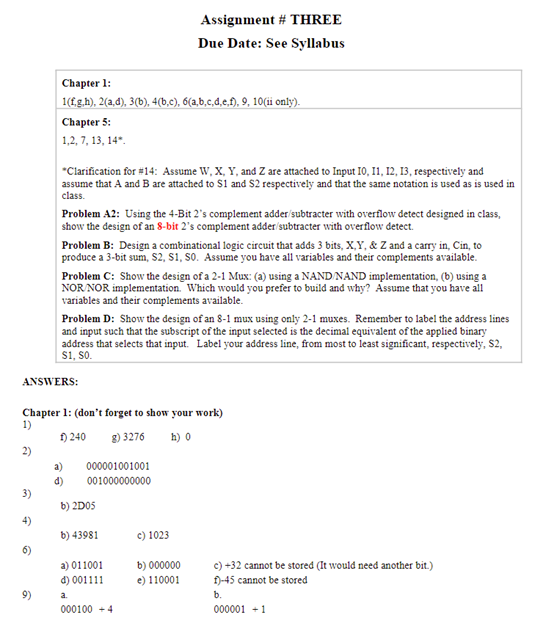
Question: Chapter 5 : 1 , 2 , 7 , 1 3 , 1 4 * . * Clarification for # 1 4 : Assume W
Chapter :
Clarification for #: Assume W X Y and Z are attached to Input I I I I respectively and
assume that A and B are attached to S and S respectively and that the same notation is used as is used in
class.
Problem A: Using the Bit s complement addersubtracter with overflow detect designed in class,
show the design of an bit s complement addersubtracter with overflow detect.
Problem B: Design a combinational logic circuit that adds bits, XY & Z and a carry in Cin, to
produce a bit sum, S S S Assume you have all variables and their complements available.
Problem C: Show the design of a Mux: a using a NANDNAND implementation, b using a
NORNOR implementation. Which would you prefer to build and why? Assume that you have all
variables and their complements available.
Problem D: Show the design of an mux using only muxes. Remember to label the address lines
and input such that the subscript of the input selected is the decimal equivalent of the applied binary
address that selects that input. Label your address line, from most to least significant, respectively, SChapter :
Clarification for #: Assume W X Y and Z are attached to Input I I I I respectively and
assume that A and B are attached to S and S respectively and that the same notation is used as is used in
class.
Problem A: Using the Bit s complement addersubtracter with overflow detect designed in class,
show the design of an bit s complement addersubtracter with overflow detect.
Problem B: Design a combinational logic circuit that adds bits, XY & Z and a carry in Cin, to
produce a bit sum, S S S Assume you have all variables and their complements available.
Problem C: Show the design of a Mux: a using a NANDNAND implementation, b using a
NORNOR implementation. Which would you prefer to build and why? Assume that you have all
variables and their complements available.
Problem D: Show the design of an mux using only muxes. Remember to label the address lines
and input such that the subscript of the input selected is the decimal equivalent of the applied binary
address that selects that input. Label your address line, from most to least significant, respectively, S
Step by Step Solution
There are 3 Steps involved in it
1 Expert Approved Answer
Step: 1 Unlock

Question Has Been Solved by an Expert!
Get step-by-step solutions from verified subject matter experts
Step: 2 Unlock
Step: 3 Unlock
 Study Help