







Question: Chapter 5 , Chapter 6 , or Chapter 7 of the Principles of Information Systems 14th edition textbook that interests you. In your answer, identify

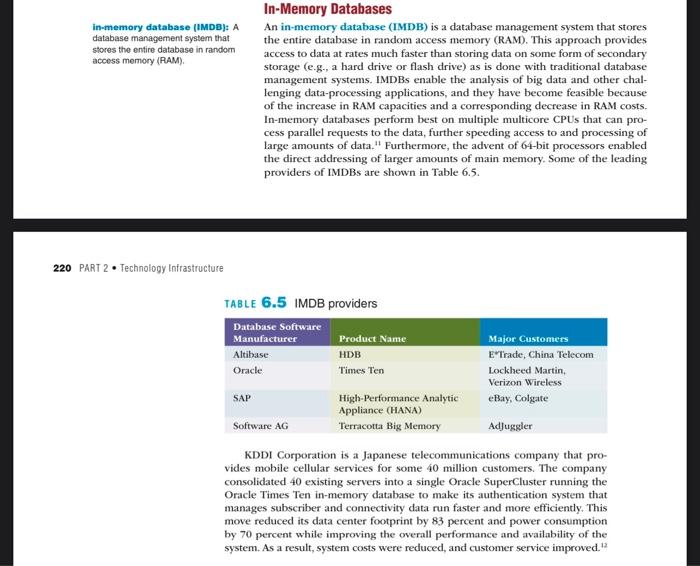
Chapter 5 , Chapter 6 , or Chapter 7 of the Principles of Information Systems 14th edition textbook that interests you. In your answer, identify the topic and explain it in your own words. Then, indicate why the topic is of interest to you and further how it may apply to you personally or professionally. - Question \#2: Using the same topic identified in Question \#1, introduce and explain something new you have learned about the topic (beyond the course textbook). You will answer this question by conducting a little bit of research (see the Research Resources module). The research performed will fulfill the outside resource/ relevant research component of the Initial Post criteria as found in the Group Discussion Forum Grading Rubric, noting the source must be cited in APA 7 th edition format (for both the in-text citation and the end reference) TOPIC CHOSEN: in-memory databases For question one the picture of the textbook description and example is attached which will be used for this answer. TOPIC CHOSEN: in-memory databases For question one the picture of the textbook description and example is attached which will be used for this answer. For question two, online research and more details are provided up top. Please link the sources used for question 2. Thank you! In-Memory Databases in-memory database (IMDB): A An in-memory database (IMDB) is a database management system that stores database management system that the entire database in random access memory (RAM). This approach provides stores the entire database in random access to data at rates much faster than storing data on some form of secondary access memory (RAM). storage (e.g., a hard drive or flash drive) as is done with traditional database management systems. IMDBs enable the analysis of big data and other challenging data-processing applications, and they have become feasible because of the increase in RAM capacities and a corresponding decrease in RAM costs. In-memory databases perform best on multiple multicore CPUs that can process parallel requests to the data, further speeding access to and processing of large amounts of data." Furthermore, the advent of 64 -bit processors enabled the direct addressing of larger amounts of main memory. Some of the leading providers of IMDBs are shown in Table 6.5. ART 2 - Technology Infrastructure TABLE 6.5 IMDB providers KDDI Corporation is a Japanese telecommunications company that provides mobile cellular services for some 40 million customers. The company consolidated 40 existing servers into a single Oracle SuperCluster running the Oracle Times Ten in-memory database to make its authentication system that manages subscriber and connectivity data run faster and more efficiently. This move reduced its data center footprint by 83 percent and power consumption by 70 percent while improving the overall performance and availability of the system. As a result, system costs were reduced, and customer service improved. 12
Step by Step Solution
There are 3 Steps involved in it

Get step-by-step solutions from verified subject matter experts
 Study Help